Dasychira vagans
Variable Tussock Moth
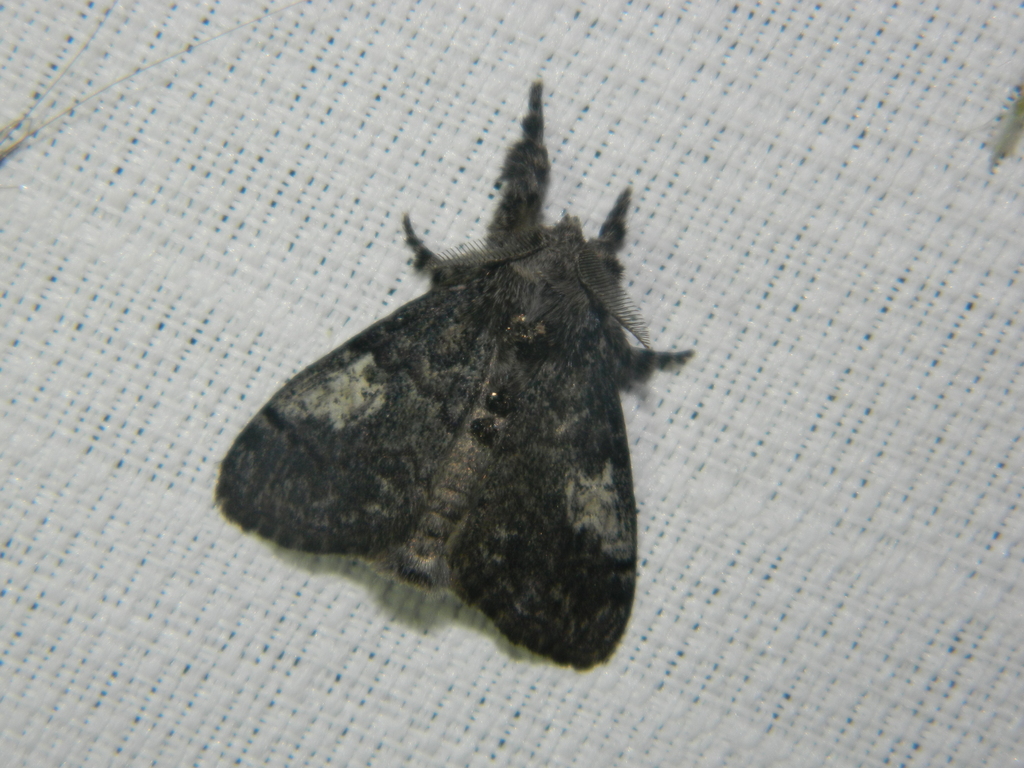
(c) Louis Imbeau, some rights reserved (CC BY) · licence
Family: Erebidae · Class: Insecta · Order: Lepidoptera
Dasychira vagans (Variable Tussock Moth) is a California animal in the Erebidae family.
The Variable Tussock Moth is a medium-sized moth in the family Erebidae, subfamily Lymantriinae. Adults display variable coloration patterns, with forewings typically grayish-brown to dark brown with lighter markings and crosslines. Males are generally smaller and more darkly colored than females, with feathery antennae. The wingspan ranges from approximately 25 to 40 mm. Larvae are densely covered with tufts of hairs (setae) in various colors including white, black, and reddish-brown, giving them a distinctive tussock-like appearance that provides the species its common name. Dasychira vagans occurs across western North America, with the subspecies D. v. grisea documented from California, Nevada, Utah, Idaho, and other western states (Lepidopterists' Society records). In California, the species has been recorded from various counties including those in the Sierra Nevada and Coast Ranges. The species extends northward into Canada and eastward across the Rocky Mountain region, demonstrating a broad continental distribution pattern typical of many tussock moth species. This moth inhabits diverse forested environments, particularly areas with deciduous and mixed forest communities. Adults are attracted to light sources and have been documented at elevations ranging from lower montane zones to higher elevation sites, including records from over 10,000 feet in Utah (Lepidopterists' Society records). The species appears to favor areas with abundant woody vegetation that can support larval development on various host plants. Larvae are polyphagous, feeding on numerous deciduous trees and shrubs including willows (Salix species), aspen (Populus species), and various other hardwood species. The caterpillars construct silk shelters and can occasionally reach outbreak densities that result in noticeable defoliation. Adults are primarily nocturnal and are most commonly encountered from late spring through early fall, with peak flight periods varying by elevation and latitude. Males are strongly attracted to pheromones released by females and may fly considerable distances to locate mates. The species typically produces one generation per year in most of its range, though this may vary with local climate conditions. Currently, Dasychira vagans has no special conservation status and is considered secure globally with a NatureServe ranking of G5 (NatureServe 2018). Populations appear stable across the species' extensive range, and the moth's ability to utilize multiple host plants provides resilience against habitat changes. While individual populations may fluctuate naturally due to weather patterns, predation, and disease cycles common to tussock moths, no significant conservation concerns have been identified for this species. The Variable Tussock Moth continues to maintain viable populations throughout western North American forests, with regular documentation by lepidopterists and naturalists confirming its ongoing presence across suitable habitats.
Classification
Class: Insecta · Order: Lepidoptera · Family: Erebidae
Frequently asked questions
How is Dasychira vagans classified?
Dasychira vagans belongs to class Insecta, order Lepidoptera, family Erebidae.
What family does Dasychira vagans belong to?
Dasychira vagans is in the Erebidae family.
What is Dasychira vagans?
The Variable Tussock Moth is a medium-sized moth in the family Erebidae, subfamily Lymantriinae.
Is Dasychira vagans found in California?
Yes. Dasychira vagans is recorded in California in The California Species Project's catalogue.
Related species
Other California species in the same genus, family, or bioregion.
Data from The California Species Project — 14,000+ California species with verified data from CNPS, CDFW, USFWS, and more.