Dasyfidonia avuncularia
Red-winged Wave Moth
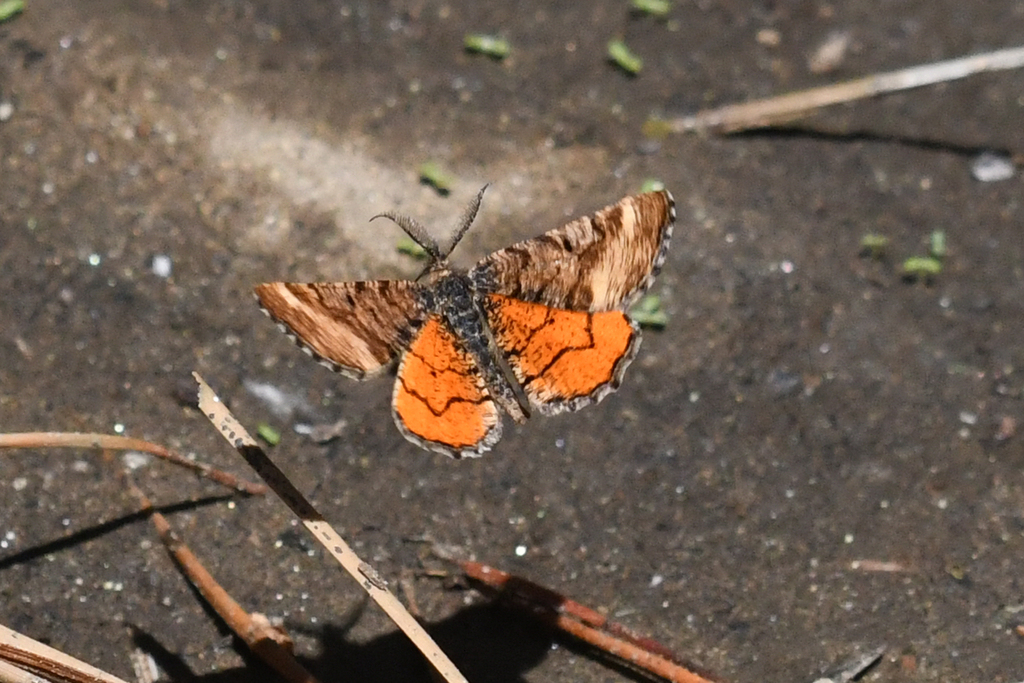
(c) Trevor Van Loon, some rights reserved (CC BY) · licence
Family: Geometridae · Class: Insecta · Order: Lepidoptera
Dasyfidonia avuncularia (Red-winged Wave Moth) is a California animal in the Geometridae family.
The Red-winged Wave Moth (Dasyfidonia avuncularia) is a geometrid moth belonging to the subfamily Ennominae. Adults typically measure 25 to 35 mm (1.0 to 1.4 inches) in wingspan. The forewings are pale gray to brown with subtle darker crosslines and a distinctive reddish-orange patch near the wing base that gives the species its common name. The hindwings are lighter in coloration, often whitish or pale gray, with faint gray markings. Males possess feathery antennae, while females have simple, thread-like antennae. The body is slender and matches the wing coloration. The Red-winged Wave Moth ranges from Alberta and British Columbia south through western North America to Nevada and California. Within California, the species occurs primarily in mountainous regions where suitable host plants are present. The distribution follows the natural range of cherry species, extending through the Sierra Nevada, Cascade Range, and portions of the Coast Ranges. Populations are generally associated with elevations where wild and cultivated cherry trees thrive. This species inhabits areas supporting cherry trees (Prunus species), which serve as the primary larval host plants. Habitats include mixed coniferous forests, woodland edges, riparian zones, and areas adjacent to cherry orchards. Adults are typically found in proximity to both wild cherry species such as bitter cherry (Prunus emarginata) and choke cherry (Prunus virginiana), as well as cultivated varieties. The moth occupies elevations ranging from foothills to montane zones where cherry species naturally occur. Red-winged Wave Moth larvae are leaf feeders that develop on cherry foliage during spring and early summer. The caterpillars are typical geometrid inchworms, moving in a characteristic looping motion. Pupation occurs in soil or leaf litter, with adults emerging in late summer to early fall. Adults are primarily nocturnal and are attracted to artificial lights. Mating occurs in late summer, with females depositing eggs on or near cherry trees. The species likely overwinters in the pupal stage, though specific details of the life cycle timing may vary with elevation and local climate conditions. The Red-winged Wave Moth does not currently hold federal or state listing status in California. Population trends are not well documented, but the species appears to maintain stable populations throughout much of its range. Potential threats include habitat loss from development in areas supporting cherry trees, forest management practices that reduce host plant availability, and pesticide applications in agricultural areas with cherry orchards. Climate change may affect the species through alterations in host plant distribution and phenology. The moth's association with both wild and cultivated cherry species may provide some resilience, though intensive orchard management practices could impact local populations where wild habitat is limited.
Classification
Class: Insecta · Order: Lepidoptera · Family: Geometridae
Frequently asked questions
How is Dasyfidonia avuncularia classified?
Dasyfidonia avuncularia belongs to class Insecta, order Lepidoptera, family Geometridae.
What family does Dasyfidonia avuncularia belong to?
Dasyfidonia avuncularia is in the Geometridae family.
What is Dasyfidonia avuncularia?
The Red-winged Wave Moth (Dasyfidonia avuncularia) is a geometrid moth belonging to the subfamily Ennominae.
Is Dasyfidonia avuncularia found in California?
Yes. Dasyfidonia avuncularia is recorded in California in The California Species Project's catalogue.
Related species
Other California species in the same genus, family, or bioregion.
Data from The California Species Project — 14,000+ California species with verified data from CNPS, CDFW, USFWS, and more.