Dasymutilla aureola
Pacific Velvet Ant
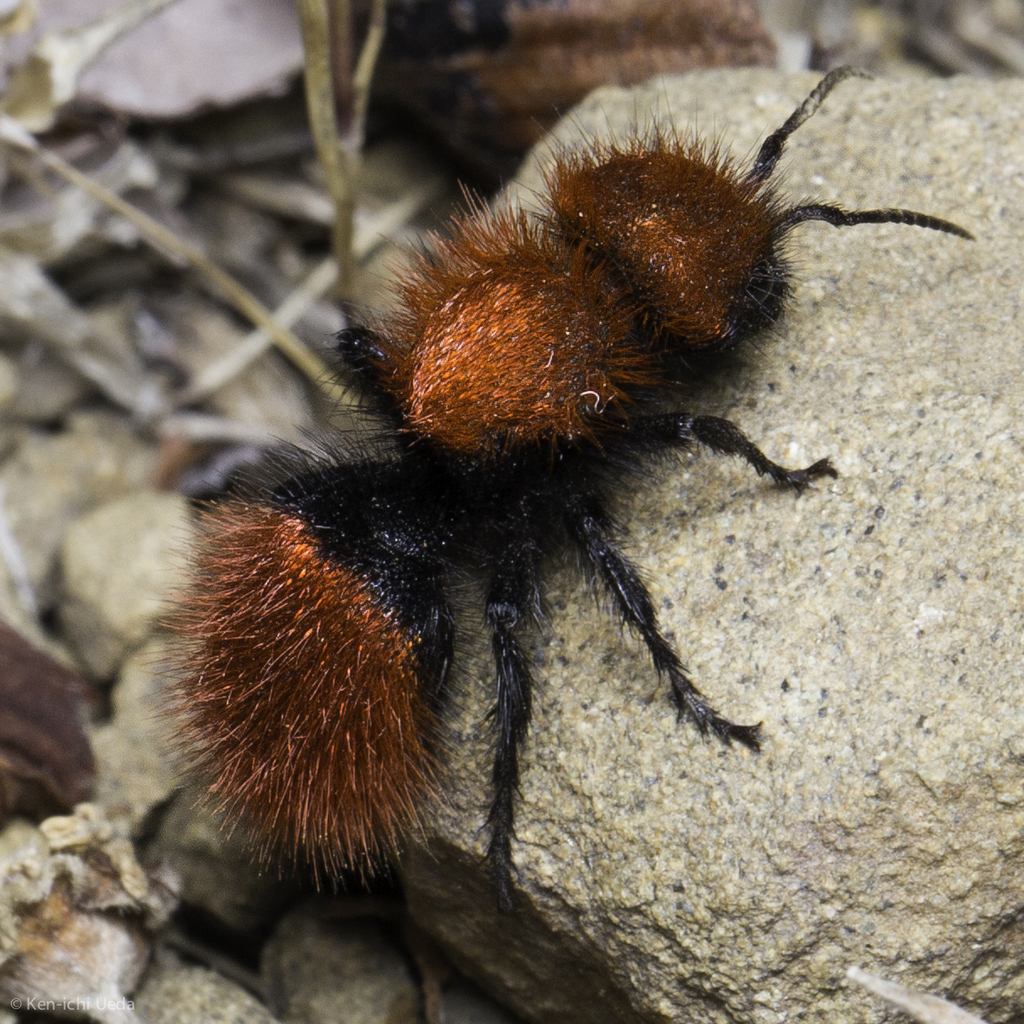
(c) Ken-ichi Ueda, some rights reserved (CC BY) · licence
Family: Mutillidae · Class: Insecta · Order: Hymenoptera
Dasymutilla aureola (Pacific Velvet Ant) is a California animal in the Mutillidae family.
The Pacific velvet ant is a large, solitary wasp in the family Mutillidae, despite its common name suggesting an ant. Females are wingless and densely covered in golden-yellow to orange setae (hairs), giving them a velvety appearance. They typically measure 12-15 mm (0.5-0.6 inches) in length. Males are winged, darker in coloration, and somewhat larger than females. The species exhibits pronounced sexual dimorphism, with females appearing ant-like due to their wingless condition and ground-dwelling behavior. Dasymutilla aureola occurs along the Pacific Coast from Washington south through Oregon and California. In California, the species is documented from coastal counties including San Luis Obispo, where observations have been recorded between Cambria and San Simeon (BugGuide). According to BugGuide data, California shows the highest concentration of records, with peak activity occurring from April through June, followed by secondary activity in October and November. The species also extends into Oregon and Washington, though with fewer documented occurrences. Pacific velvet ants inhabit coastal environments, including sandy beaches, dunes, and adjacent scrubland areas. They are commonly encountered on sand and pebble substrates near the ocean (BugGuide). The species appears to prefer open, sparsely vegetated habitats where host species are abundant. Elevation range extends from sea level to low coastal hills and terraces. Females are ectoparasitoids that seek out ground-nesting bees and wasps to serve as hosts for their developing larvae. The female locates host nests, typically of solitary bees in the families Andrenidae or Colletidae, and deposits a single egg on or near the host larva or pupa. The velvet ant larva then feeds externally on the host, eventually killing it. Adults are active during daylight hours, with females spending considerable time searching for suitable host nests while walking rapidly across the ground. Males are less frequently observed and primarily engage in mate-seeking behavior. The species produces one generation per year, with adults emerging in spring and remaining active through early fall. Velvet ants possess a potent sting, delivered only by females, which serves as an effective defense mechanism against predators. Their dense setae and bright coloration function as aposematic signals, warning potential predators of their defensive capabilities. Adults feed on nectar from various flowering plants, contributing to local pollination networks. The Pacific velvet ant currently has no federal or state conservation status and is not considered threatened. Population trends are not well documented, but the species appears stable within its coastal range. Primary threats may include coastal development and habitat modification, though the species' association with disturbed sandy areas may provide some resilience to human activities. Climate change impacts on coastal ecosystems and host species availability represent potential long-term concerns for population stability.
Classification
Class: Insecta · Order: Hymenoptera · Family: Mutillidae
Frequently asked questions
How is Dasymutilla aureola classified?
Dasymutilla aureola belongs to class Insecta, order Hymenoptera, family Mutillidae.
What family does Dasymutilla aureola belong to?
Dasymutilla aureola is in the Mutillidae family.
What is Dasymutilla aureola?
The Pacific velvet ant is a large, solitary wasp in the family Mutillidae, despite its common name suggesting an ant.
Is Dasymutilla aureola found in California?
Yes. Dasymutilla aureola is recorded in California in The California Species Project's catalogue.
Related species
Other California species in the same genus, family, or bioregion.
Data from The California Species Project — 14,000+ California species with verified data from CNPS, CDFW, USFWS, and more.