Dasymutilla californica
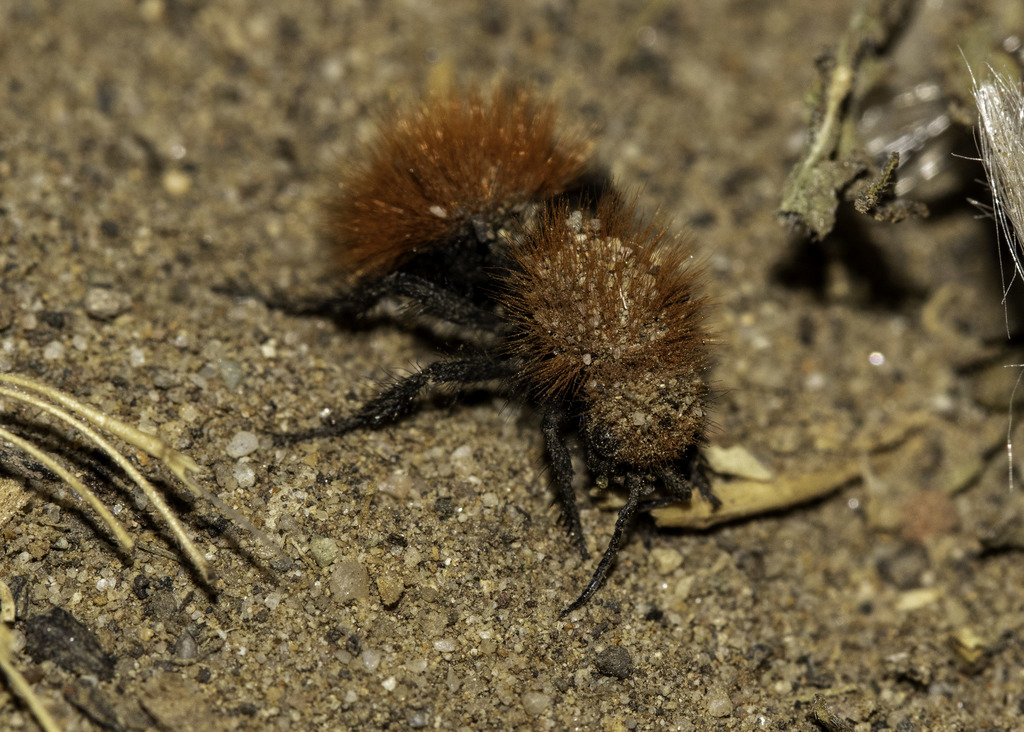
(c) Zack Abbey, some rights reserved (CC BY) · licence
Family: Mutillidae · Class: Insecta · Order: Hymenoptera
Dasymutilla californica is a California animal in the Mutillidae family.
Dasymutilla californica is a velvet ant wasp in the family Mutillidae endemic to the Colorado Desert region of California. Like other mutillids, females are wingless and densely covered with hair, giving them an ant-like appearance, while males are winged. The species exhibits the characteristic sexual dimorphism of the family, with females appearing as ground-dwelling, fuzzy insects that are often mistaken for ants despite being wasps. This species is restricted to Imperial County, California, with all documented collections originating from the vicinity of Glamis in the Algodones Dunes area (Federal Register 2006). The geographic range appears limited to the sand dune systems of the Colorado Desert, where it occurs sympatrically with related species including D. nocturna and D. imperialis. The proximity to the Algodones Dunes suggests this species may be adapted to the unique ecological conditions of active sand dune environments. Dasymutilla californica inhabits sand dune ecosystems characteristic of the Colorado Desert. These habitats feature loose, shifting sands with sparse vegetation adapted to extreme aridity and temperature fluctuations. The species likely occupies both active dune faces and more stabilized interdune areas where host insects may be more abundant. Desert dune systems provide specialized microhabitats with distinct thermal and moisture gradients that support unique arthropod communities. As with other velvet ants, females are external parasitoids that locate ground-nesting wasps or bees to serve as hosts for their developing larvae. Females use their powerful legs to dig into host nests, where they deposit eggs on or near the host larvae or pupae. The developing Dasymutilla larvae consume the host, eventually emerging as adults. Males are typically active during cooler periods and may be attracted to pheromones released by females. The species appears to be nocturnal based on relationships with closely related taxa in the region. Detailed information on habitat requirements, abundance, and population trends remains limited for D. californica (Federal Register 2006). The species' apparent endemism to the Glamis area of Imperial County raises potential conservation concerns, as this restricted range makes populations vulnerable to habitat disturbance. Sand dune ecosystems face pressures from recreational vehicle use, renewable energy development, and climate change effects on precipitation patterns. The Colorado Desert region experiences ongoing development pressure, and specialized dune habitats represent some of the most threatened ecosystems in California. Currently, D. californica lacks formal conservation status designation at state or federal levels. However, its extremely limited known range and specialized habitat requirements suggest it may warrant further study to assess population status and conservation needs. The species exemplifies the many poorly documented endemic insects of California's desert regions, where additional survey work is needed to understand biodiversity patterns and identify taxa requiring protection.
Classification
Class: Insecta · Order: Hymenoptera · Family: Mutillidae
Frequently asked questions
How is Dasymutilla californica classified?
Dasymutilla californica belongs to class Insecta, order Hymenoptera, family Mutillidae.
What family does Dasymutilla californica belong to?
Dasymutilla californica is in the Mutillidae family.
What is Dasymutilla californica?
Dasymutilla californica is a velvet ant wasp in the family Mutillidae endemic to the Colorado Desert region of California.
Is Dasymutilla californica found in California?
Yes. Dasymutilla californica is recorded in California in The California Species Project's catalogue.
Related species
Other California species in the same genus, family, or bioregion.
Data from The California Species Project — 14,000+ California species with verified data from CNPS, CDFW, USFWS, and more.