Dasymutilla coccineohirta
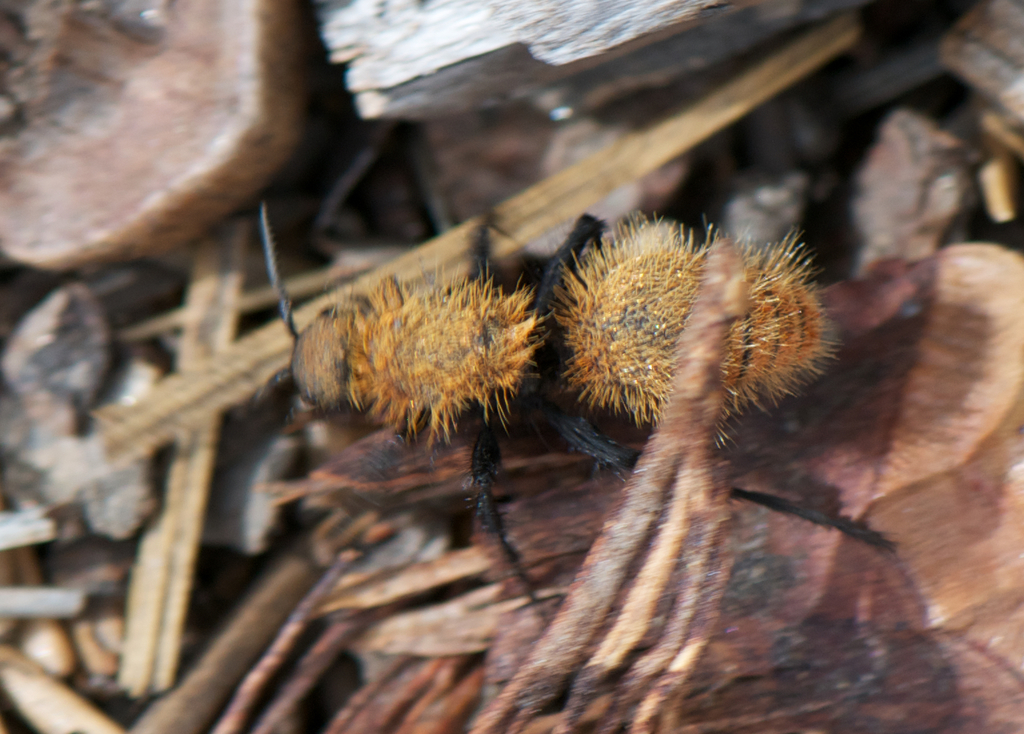
(c) Jonathan Eisen, some rights reserved (CC BY) · licence
Family: Mutillidae · Class: Insecta · Order: Hymenoptera
Dasymutilla coccineohirta is a California animal in the Mutillidae family.
Dasymutilla coccineohirta is a velvet ant species belonging to the family Mutillidae, subfamily Sphaeropthalminae. Despite their common name, velvet ants are actually wasps, with females being wingless and ant-like in appearance. This species was originally described by Blake in 1871 and has undergone taxonomic revision, with Dasymutilla clytemnestra (Fox, 1899) now considered a synonym (BugGuide.Net). Females of D. coccineohirta display the characteristic dense, velvety setae that give velvet ants their common name. The species name "coccineohirta" refers to the scarlet or crimson coloration of the body hair. Like other Dasymutilla species, females are robust and heavily armored with a strongly sclerotized exoskeleton. Males, when present, are winged and typically smaller than females, though specific morphological details for this species remain poorly documented in the literature. The geographic range and distribution of D. coccineohirta in California have not been comprehensively documented in available scientific literature. The genus Dasymutilla is diverse across North America, with various species occupying different ecological niches, but specific range data for this species requires further research and documentation. Habitat preferences for D. coccineohirta are not well-established in current literature. Velvet ants in the genus Dasymutilla typically inhabit areas where their host species occur, as females are parasitoids that must locate suitable hosts for reproduction. Many Dasymutilla species are associated with ground-nesting bees and wasps, suggesting this species may occur in sandy or well-drained soils where such hosts construct their nests. Without specific ecological studies, detailed habitat requirements remain undocumented. The life history and ecology of D. coccineohirta follow the general pattern of velvet ants. Females are wingless and search on foot for the nests of host species, typically ground-nesting bees or wasps. Once a suitable host nest is located, the female enters and deposits eggs near the developing host larvae or pupae. The velvet ant larvae then develop as external parasitoids, consuming their hosts. Adult females possess a powerful sting used for defense, making them formidable despite their relatively small size. Males, when they emerge, are winged and focus primarily on mating rather than host-seeking behavior. The conservation status of D. coccineohirta has not been formally evaluated by state or federal agencies. Like many specialized parasitoid species, velvet ants may be vulnerable to habitat loss that affects their host species. The decline of native ground-nesting bees and wasps due to habitat fragmentation, pesticide use, and urbanization could potentially impact velvet ant populations. However, specific population trends and conservation needs for this species have not been studied. Scientific documentation for this species remains limited. The information presented here is based on available sources including BugGuide taxonomic records and general knowledge of velvet ant biology. If you have additional verified information about this species' biology, distribution, or ecology, please contact us to help improve this species account.
Classification
Class: Insecta · Order: Hymenoptera · Family: Mutillidae
Frequently asked questions
How is Dasymutilla coccineohirta classified?
Dasymutilla coccineohirta belongs to class Insecta, order Hymenoptera, family Mutillidae.
What family does Dasymutilla coccineohirta belong to?
Dasymutilla coccineohirta is in the Mutillidae family.
What is Dasymutilla coccineohirta?
Dasymutilla coccineohirta is a velvet ant species belonging to the family Mutillidae, subfamily Sphaeropthalminae.
Is Dasymutilla coccineohirta found in California?
Yes. Dasymutilla coccineohirta is recorded in California in The California Species Project's catalogue.
Related species
Other California species in the same genus, family, or bioregion.
Data from The California Species Project — 14,000+ California species with verified data from CNPS, CDFW, USFWS, and more.