Dasymutilla sackenii
Sacken's Velvet Ant
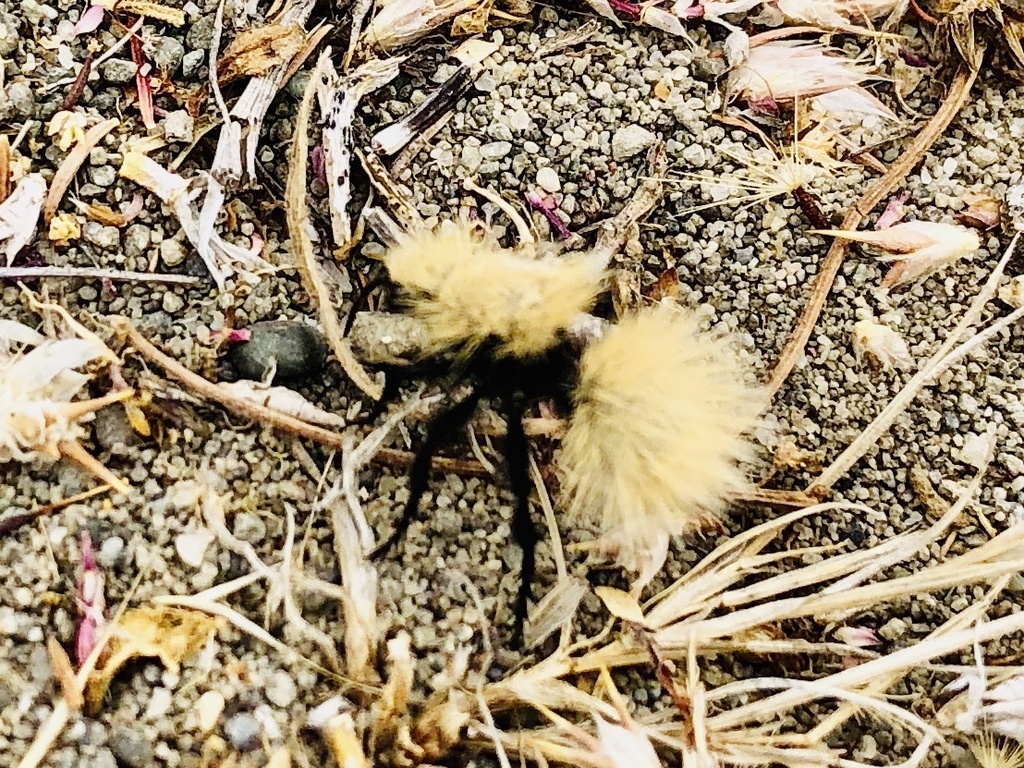
no rights reserved · CC0
Family: Mutillidae · Class: Insecta · Order: Hymenoptera
Dasymutilla sackenii (Sacken's Velvet Ant) is a California animal in the Mutillidae family.
Sacken's Velvet Ant (Dasymutilla sackenii) is a solitary wasp species in the family Mutillidae, characterized by extreme sexual dimorphism. Females are wingless and measure approximately 15-16 mm (5/8 inch) in length, while winged males are smaller at approximately 12-13 mm (1/2 inch). Females are densely covered in hair that varies geographically from stark white in southern populations to golden-orange in northern regions (BugGuide). Males possess typical wasp anatomy with functional wings and a more conventional wasp appearance, distinguishing them dramatically from the ant-like females. Dasymutilla sackenii occurs along the Pacific Coast from Baja California, Mexico, north to Oregon. Within California, the species has been documented from multiple counties including Siskiyou, Inyo, Monterey, and San Benito. The species distribution encompasses both coastal and inland areas, extending from sea level to montane regions. In the eastern Sierra Nevada, populations have been recorded near Bishop in Inyo County at elevations of approximately 1,200 meters (4,000 feet). This species inhabits diverse habitat types including maritime chaparral, oak woodlands, sandy desert areas, and mixed chaparral environments. Females are commonly encountered on sandy dirt roads and open sandy soils where host species construct burrows. The species shows a preference for areas with loose, well-drained soils that facilitate the nesting activities of their host wasps. Adults are active during summer months, with peak activity observed from June through September. Like all velvet ants, D. sackenii exhibits a parasitoid lifestyle. Females are external parasitoids of ground-nesting wasps and bees, particularly targeting sand wasps and other sphecid wasps. The wingless females locate host burrows and deposit their eggs on or near the host larvae or pupae. Female velvet ants possess powerful mandibles and a potent sting, earning them the common name "cow killers" in reference to their painful defensive capability. Males are typically observed flying low over sandy areas, presumably searching for emerging females for mating purposes. The species demonstrates temporal succession patterns, with adults appearing in areas where sand wasps were previously active in nest construction. Females produce a distinctive squeaking sound when disturbed, created by a stridulatory organ. This acoustic warning, combined with their aposematic coloration and painful sting, serves as an effective anti-predator defense system. The bright coloration and dense pubescence make females highly conspicuous against sandy substrates. Currently, Dasymutilla sackenii does not hold any federal or state conservation listing status. Population trends for this species have not been systematically monitored, and no specific conservation concerns have been identified. The species appears to maintain stable populations throughout its range, though habitat modification and urban development may impact local populations in coastal California. Climate change effects on host species availability could potentially influence future population dynamics, but comprehensive ecological studies are needed to assess long-term conservation needs.
Classification
Class: Insecta · Order: Hymenoptera · Family: Mutillidae
Frequently asked questions
How is Dasymutilla sackenii classified?
Dasymutilla sackenii belongs to class Insecta, order Hymenoptera, family Mutillidae.
What family does Dasymutilla sackenii belong to?
Dasymutilla sackenii is in the Mutillidae family.
What is Dasymutilla sackenii?
Sacken's Velvet Ant (Dasymutilla sackenii) is a solitary wasp species in the family Mutillidae, characterized by extreme sexual dimorphism.
Is Dasymutilla sackenii found in California?
Yes. Dasymutilla sackenii is recorded in California in The California Species Project's catalogue.
Related species
Other California species in the same genus, family, or bioregion.
Data from The California Species Project — 14,000+ California species with verified data from CNPS, CDFW, USFWS, and more.