Datana ministra
Yellow-necked Caterpillar Moth
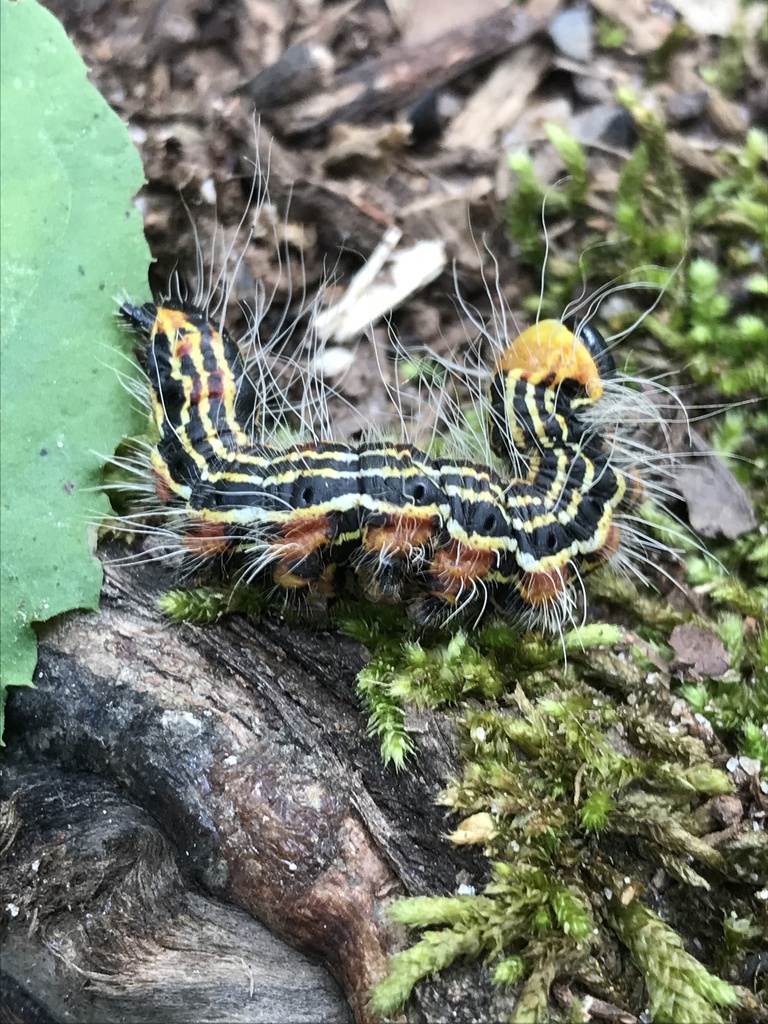
no rights reserved · CC0
Family: Notodontidae · Class: Insecta · Order: Lepidoptera
Datana ministra (Yellow-necked Caterpillar Moth) is a California animal in the Notodontidae family.
The yellow-necked caterpillar moth (Datana ministra) is a medium-sized moth in the family Notodontidae, notable for the distinctive larval stage that gives the species its common name. Adults have a wingspan of 38 to 50 mm (1.5 to 2.0 inches) and display mottled brown and gray forewings with subtle darker cross-lines and pale patches. The hindwings are typically lighter brown to tan. At rest, the moth holds its wings in a tent-like position over the body. The thorax and head are covered in dense, brownish-gray scales. The yellow-necked caterpillar moth occurs across much of North America, from southern Canada to northern Mexico. In California, the species is distributed throughout most regions where suitable host plants are present, including the Central Valley, coastal ranges, Sierra Nevada foothills, and southern California mountains. The species extends from sea level to elevations of approximately 2,400 meters (7,900 feet). This moth inhabits deciduous and mixed forests, woodland edges, orchards, and urban areas with mature trees. The species shows particular association with areas containing oak woodlands, riparian forests, and developed landscapes with ornamental plantings. Larvae require access to host trees for feeding, while adults frequent areas with nectar sources including flowering shrubs and herbaceous plants. The yellow-necked caterpillar moth is univoltine in most of its range, producing one generation per year. Adults emerge from late June through August, with peak flight activity occurring in July. Mating typically occurs at night, and females deposit clusters of 25 to 100 eggs on the undersides of host plant leaves. The distinctive larvae are gregarious feeders that develop through five instars over 6 to 8 weeks. Mature caterpillars measure 50 to 60 mm (2.0 to 2.4 inches) in length and display yellow and black stripes along the body with a prominent yellow collar behind the head. When disturbed, larvae rear up in a defensive posture with both head and tail elevated. The species overwinters as pupae in earthen cells constructed 5 to 15 cm below the soil surface. Larvae are polyphagous, feeding on numerous deciduous trees and shrubs including oaks (Quercus species), maples (Acer species), birches (Betula species), cherries (Prunus species), and various fruit trees. In California, oak species serve as primary hosts, though the caterpillars also utilize introduced ornamental trees in urban environments. Adults feed on nectar from various flowering plants. The yellow-necked caterpillar moth is not listed under federal or California endangered species legislation and appears to maintain stable populations throughout most of its range. The species demonstrates adaptability to human-modified landscapes and benefits from the presence of both native and non-native host plants in suburban and agricultural areas. Occasional population outbreaks can result in noticeable defoliation of host trees, though serious damage is typically localized and temporary. Climate change may affect the species' distribution and phenology, particularly in marginal habitats at elevation extremes.
Classification
Class: Insecta · Order: Lepidoptera · Family: Notodontidae
Frequently asked questions
How is Datana ministra classified?
Datana ministra belongs to class Insecta, order Lepidoptera, family Notodontidae.
What family does Datana ministra belong to?
Datana ministra is in the Notodontidae family.
What is Datana ministra?
The yellow-necked caterpillar moth (Datana ministra) is a medium-sized moth in the family Notodontidae, notable for the distinctive larval stage that gives the species its common name.
Is Datana ministra found in California?
Yes. Datana ministra is recorded in California in The California Species Project's catalogue.
Related species
Other California species in the same genus, family, or bioregion.
Data from The California Species Project — 14,000+ California species with verified data from CNPS, CDFW, USFWS, and more.