Dendragapus fuliginosus howardi
Mount Pinos Sooty Grouse
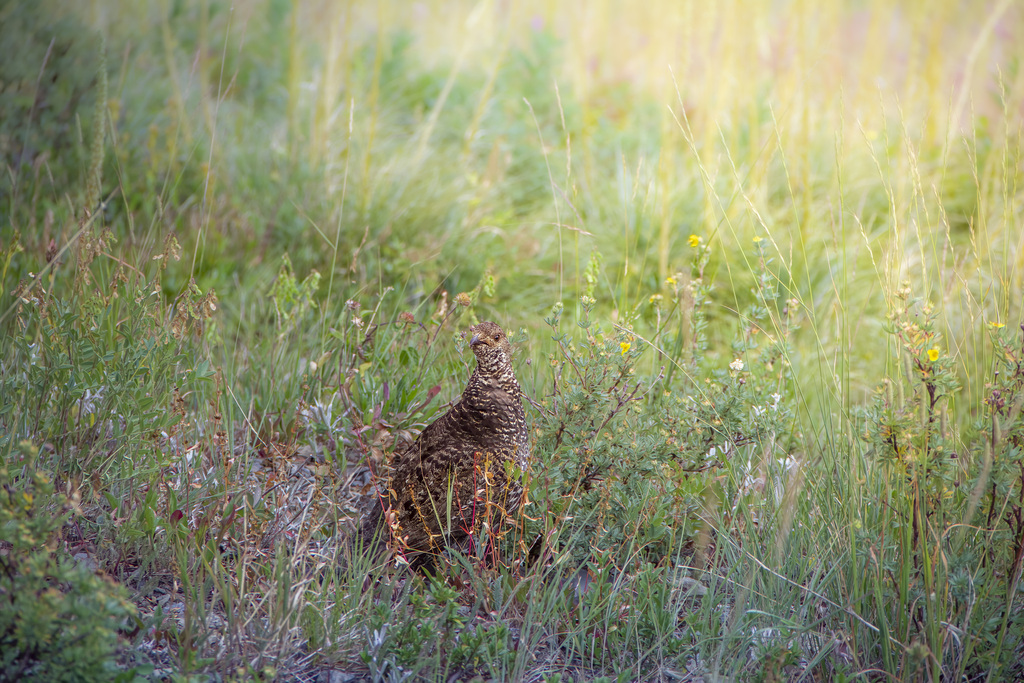
(c) Romain Boisseau, some rights reserved (CC BY-SA) · licence
Family: Phasianidae · Class: Aves · Order: Galliformes
Conservation status: G5T2T3 S3
Dendragapus fuliginosus howardi (Mount Pinos Sooty Grouse) is a California animal in the Phasianidae family.
The Mount Pinos Sooty Grouse is a subspecies of the Sooty Grouse (Dendragapus fuliginosus) endemic to mountainous regions of southern California. Adults measure 40-50 cm (16-20 inches) in length and weigh 900-1,400 grams, with males typically larger than females. The plumage is predominantly dusky gray-brown with subtle barring, and males display distinctive orange-red eyecombs during breeding season. Like other sooty grouse, both sexes possess feathered legs and feet adapted for cold mountain environments. This subspecies has an extremely restricted range centered on the Mount Pinos region in the southern Sierra Nevada and Transverse Ranges of California. The population occurs primarily in Kern and Ventura counties, with some presence extending into adjacent Los Padres National Forest lands. According to NatureServe, the subspecies occupies isolated montane habitats in this southern portion of its range, representing a disjunct population from other Sooty Grouse subspecies (NatureServe 2025). Mount Pinos Sooty Grouse inhabit mixed coniferous forests at elevations typically ranging from 1,500 to 2,500 meters (4,900 to 8,200 feet). Breeding habitat consists primarily of open areas within or adjacent to coniferous forest, including meadows, clearings, and forest edges with dense understory vegetation. During winter months, the subspecies moves to dense coniferous forests where it feeds almost exclusively on conifer needles, particularly those of fir, pine, and Douglas fir species. Breeding occurs from May through August, with peak activity in June and July. Females construct ground nests in concealed locations under shrubs or fallen logs, typically laying 6-10 buff-colored eggs with brown spots. Chicks are precocial and leave the nest within 24 hours of hatching. During the breeding season, adults feed on a variety of plant materials including leaves, flowers, berries, and insects, while chicks consume primarily insects for protein. The species exhibits altitudinal migration, moving from lower elevation breeding areas to higher elevation winter ranges where suitable coniferous forest provides food and thermal cover. The Mount Pinos Sooty Grouse currently holds a Global Rank of T2T3 and State Rank of S3, indicating it faces moderate to high conservation concern due to its restricted range and small population size. In 2024, a petition was submitted to the U.S. Fish and Wildlife Service requesting Endangered Species Act protection for this subspecies (USFWS 2024). Primary threats include habitat fragmentation, fire suppression altering forest structure, recreational disturbance, and climate change impacts on montane forest ecosystems. The limited range makes the subspecies particularly vulnerable to catastrophic events and habitat modifications. Population monitoring and habitat protection within its restricted range are critical for long-term conservation of this endemic California subspecies.
Classification
Class: Aves · Order: Galliformes · Family: Phasianidae
Conservation status
G5T2T3 S3
Frequently asked questions
How is Dendragapus fuliginosus howardi classified?
Dendragapus fuliginosus howardi belongs to class Aves, order Galliformes, family Phasianidae.
What family does Dendragapus fuliginosus howardi belong to?
Dendragapus fuliginosus howardi is in the Phasianidae family.
Is Dendragapus fuliginosus howardi protected or of conservation concern?
Dendragapus fuliginosus howardi carries the following status: G5T2T3 S3.
What is Dendragapus fuliginosus howardi?
The Mount Pinos Sooty Grouse is a subspecies of the Sooty Grouse (Dendragapus fuliginosus) endemic to mountainous regions of southern California.
Is Dendragapus fuliginosus howardi found in California?
Yes. Dendragapus fuliginosus howardi is recorded in California in The California Species Project's catalogue.
Related species
Other California species in the same genus, family, or bioregion.
Data from The California Species Project — 14,000+ California species with verified data from CNPS, CDFW, USFWS, and more.