Dendraster excentricus
Eccentric Sand Dollar
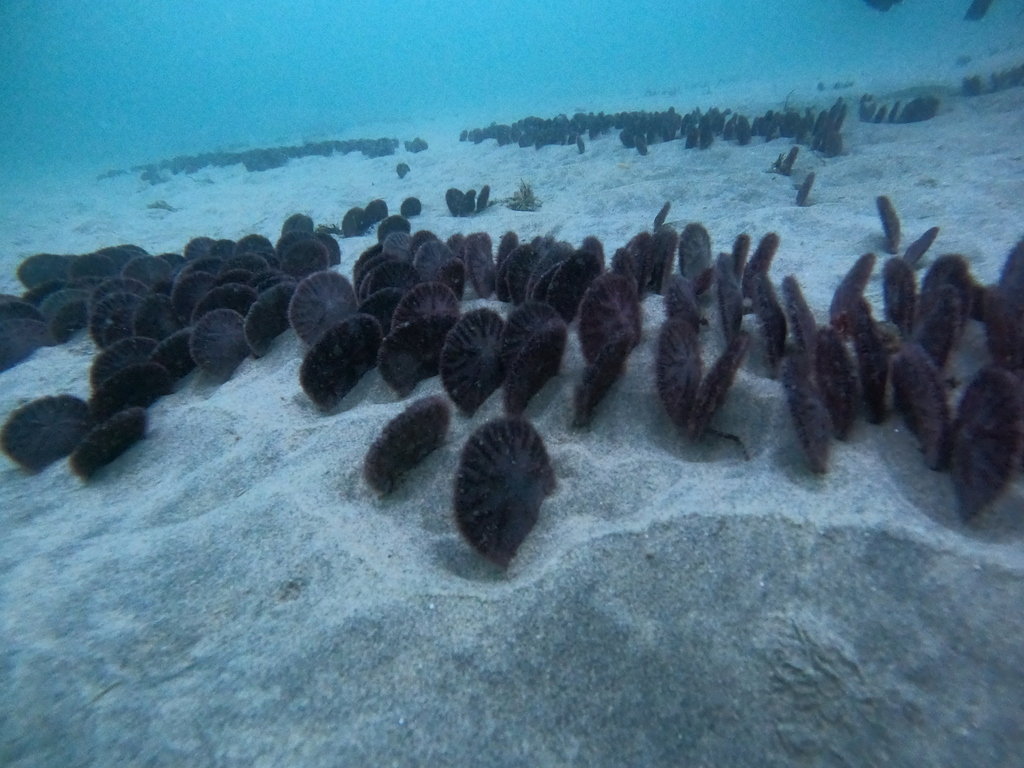
(c) Daniel Z, some rights reserved (CC BY) · licence
Family: Dendrasteridae · Class: Echinoidea · Order: Clypeasteroida
Dendraster excentricus (Eccentric Sand Dollar) is a California animal in the Dendrasteridae family.
The Eccentric Sand Dollar is a flattened, disc-shaped echinoderm belonging to the order Clypeasteroida and family Dendrasteridae. Adult specimens typically measure 5 to 10 centimeters (2 to 4 inches) in diameter and reach heights of 1 to 2 centimeters (0.4 to 0.8 inches). The test (skeleton) displays a characteristic off-center (eccentric) position of the apical system, giving the species its common name. Living individuals are covered with short, dense spines that give them a velvety purple to brown appearance, while bleached tests found on beaches are typically gray to white. Dendraster excentricus occurs along the Pacific coast from British Columbia, Canada, to Baja California, Mexico. In California waters, the species is distributed from the northern border south to at least Point Conception, where populations are documented within the Point Conception State Marine Reserve. The species inhabits both nearshore and offshore waters of the continental shelf. Eccentric sand dollars inhabit sandy and muddy substrates in subtidal waters, typically at depths ranging from the low intertidal zone to approximately 40 meters (130 feet). They prefer areas with moderate to strong water circulation that facilitates feeding and prevents burial by sediment. Large aggregations often form dense beds on sandy bottoms, particularly in areas with consistent water movement and adequate food supply. These echinoderms are suspension feeders and deposit feeders, capturing plankton and organic particles from the water column and seafloor. They use their numerous tube feet and specialized feeding structures to collect microscopic algae, detritus, and small planktonic organisms. Sand dollars exhibit unique feeding behavior, often standing vertically or at angles in the sediment to maximize water flow across their feeding surfaces during periods of strong current. Reproduction occurs through broadcast spawning, with males and females releasing gametes into the water column where external fertilization takes place. Larvae undergo several developmental stages before settling and metamorphosing into juvenile sand dollars. Dendraster excentricus currently holds no federal or state conservation listing status. The species appears to maintain stable populations throughout much of its range, though localized impacts from coastal development, pollution, and fishing activities may affect some populations. California's Marine Life Management Act identifies sand dollars among marine species monitored by the California Department of Fish and Wildlife, though they are not managed under specific fishery management plans. The establishment of marine protected areas, such as the Point Conception State Marine Reserve where taking or possessing any living marine resources is prohibited, provides habitat protection for sand dollar populations and associated marine communities. Climate change and ocean acidification may pose future challenges to sand dollar populations, as these factors can affect the ability of echinoderms to build and maintain their calcium carbonate skeletons.
Classification
Class: Echinoidea · Order: Clypeasteroida · Family: Dendrasteridae
Frequently asked questions
How is Dendraster excentricus classified?
Dendraster excentricus belongs to class Echinoidea, order Clypeasteroida, family Dendrasteridae.
What family does Dendraster excentricus belong to?
Dendraster excentricus is in the Dendrasteridae family.
What is Dendraster excentricus?
The Eccentric Sand Dollar is a flattened, disc-shaped echinoderm belonging to the order Clypeasteroida and family Dendrasteridae.
Is Dendraster excentricus found in California?
Yes. Dendraster excentricus is recorded in California in The California Species Project's catalogue.
More California species
This species has no close relatives in our California data — here are other species to explore.
Data from The California Species Project — 14,000+ California species with verified data from CNPS, CDFW, USFWS, and more.