Dendroleon speciosus
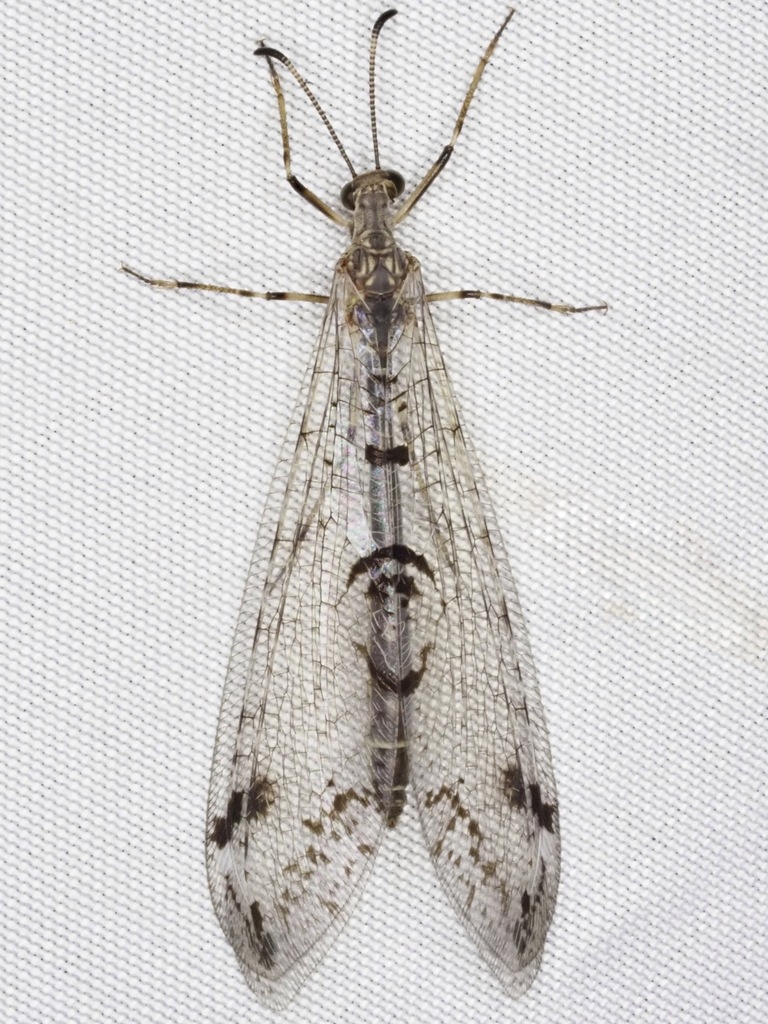
no rights reserved · CC0
Family: Myrmeleontidae · Class: Insecta · Order: Neuroptera
Dendroleon speciosus is a California animal in the Myrmeleontidae family.
Dendroleon speciosus is a species of antlion in the family Myrmeleontidae, part of the order Neuroptera. Adults are moderate-sized neuropterans with four membranous wings held roof-like over the body when at rest. Like other antlions, they possess clubbed antennae and large, compound eyes. The wings typically display a mottled pattern of light and dark markings that provides camouflage against bark and vegetation. The distribution and range of Dendroleon speciosus in California requires further documentation. The genus Dendroleon is known to occur in western North America, with various species found in arid and semi-arid regions. However, specific locality records and range boundaries for D. speciosus within California have not been comprehensively mapped in available databases. Habitat preferences for this species have not been well documented in the scientific literature. Other Dendroleon species typically inhabit areas with sandy or loose soil where larvae can construct pit traps, often in association with shrublands, oak woodlands, or chaparral environments. Adults may be found near areas suitable for larval development, particularly locations with appropriate soil conditions and prey availability. The life cycle of Dendroleon speciosus follows the typical antlion pattern, though specific details for this species are lacking. Larvae are predatory, constructing conical pit traps in sandy soil to capture small arthropods, particularly ants (Xerces Society 2019). The larvae remain hidden at the bottom of these pits, using their large mandibles to seize prey that falls into the trap. Larval development may take one to two years depending on environmental conditions and prey availability. Adults emerge after pupation in a silk cocoon constructed in the soil. Adult antlions are generally weak fliers and may be active during evening hours, though specific behavioral observations for D. speciosus are not well documented. The conservation status of Dendroleon speciosus has not been formally assessed by state or federal agencies. The species does not appear on current threatened or endangered species lists in California as of December 2025. However, like many specialized insects, antlions may be vulnerable to habitat loss and degradation, particularly conversion of natural areas with suitable soil conditions for larval development. Climate change and altered precipitation patterns could potentially affect soil moisture and prey availability, though specific impacts on this species have not been studied. Scientific documentation for Dendroleon speciosus remains limited. The information presented here is based on general knowledge of antlion biology and limited available sources. Detailed ecological studies, including specific habitat requirements, distribution patterns, and population status, are needed to better understand this species. We welcome contributions of verified scientific data, photographs, or field observations to enhance this species account.
Classification
Class: Insecta · Order: Neuroptera · Family: Myrmeleontidae
Frequently asked questions
How is Dendroleon speciosus classified?
Dendroleon speciosus belongs to class Insecta, order Neuroptera, family Myrmeleontidae.
What family does Dendroleon speciosus belong to?
Dendroleon speciosus is in the Myrmeleontidae family.
What is Dendroleon speciosus?
Dendroleon speciosus is a species of antlion in the family Myrmeleontidae, part of the order Neuroptera.
Is Dendroleon speciosus found in California?
Yes. Dendroleon speciosus is recorded in California in The California Species Project's catalogue.
Related species
Other California species in the same genus, family, or bioregion.
Data from The California Species Project — 14,000+ California species with verified data from CNPS, CDFW, USFWS, and more.