Dermacentor variabilis
American Dog Tick
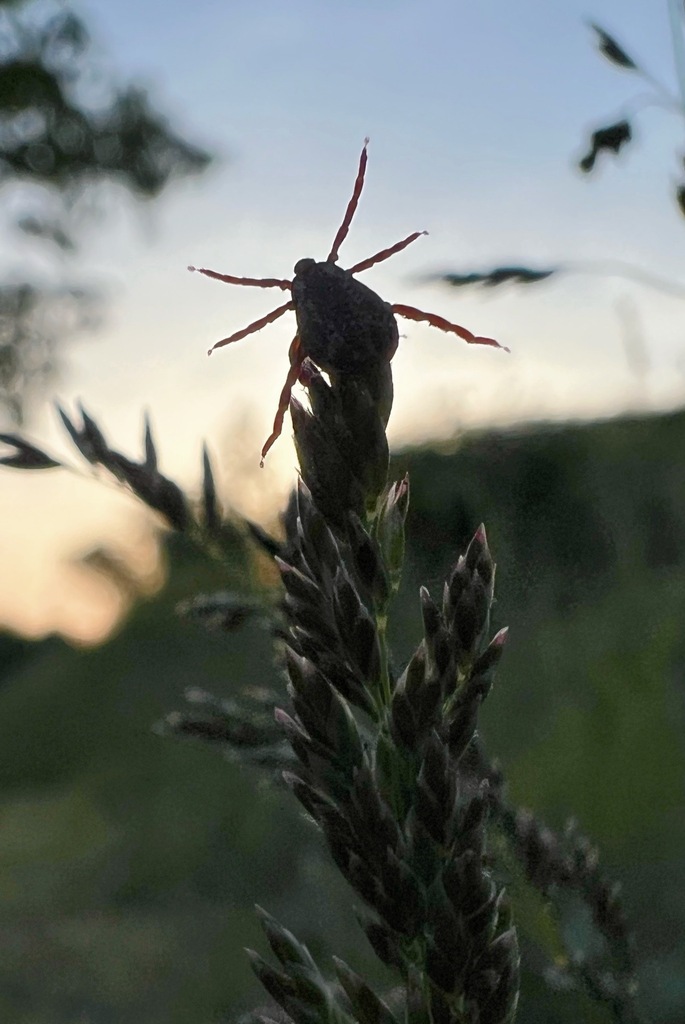
(c) Nova Patch, some rights reserved (CC BY-SA) · licence
Family: Ixodidae · Class: Arachnida · Order: Ixodida
Dermacentor variabilis (American Dog Tick) is a California animal in the Ixodidae family.
The American dog tick is a hard-bodied tick species in the family Ixodidae, one of the most widely distributed tick species in North America. Adult males measure approximately 5 mm (0.2 inches) in length, while unfed females are slightly larger at 5-6 mm, expanding to 15 mm (0.6 inches) when fully engorged with blood. The species exhibits sexual dimorphism in coloration: males display a mottled brown and white pattern across their entire dorsal surface, while females have a dark brown body with a distinctive white or yellowish scutum (shield) behind the head region. The American dog tick occurs throughout much of the United States, with its range extending from the Atlantic coast westward to parts of California and from southern Canada to northern Mexico. In California, populations are primarily found in the northern and central portions of the state, particularly in areas with suitable host populations. The species is absent from the southeastern United States, where it is replaced by closely related Dermacentor species. American dog ticks inhabit diverse environments including deciduous and mixed forests, grasslands, shrublands, and edge habitats where forest meets open areas (Animal Diversity Web). They prefer areas with moderate to high humidity and are commonly found along trails, forest edges, and in tall grass or brush where they can easily contact passing hosts. The species thrives in habitats that support populations of medium to large mammals, which serve as primary hosts for adult ticks. This species follows a typical three-host tick life cycle, requiring a blood meal at each developmental stage. Larvae and nymphs typically feed on small mammals such as rodents, while adults prefer larger hosts including dogs, deer, cattle, and occasionally humans. Adult activity peaks during spring and early summer months when temperatures range from 4-25°C (39-77°F). Mating occurs on the host animal, and engorged females drop to the ground to lay eggs in protected microhabitats. A single female can deposit 4,000 to 6,500 eggs in a single clutch. The complete life cycle typically requires two years under optimal conditions but can extend to three years in cooler climates. The American dog tick serves as a vector for several human and animal pathogens, most notably Rocky Mountain spotted fever (Rickettsia rickettsii) and tularemia (Francisella tularensis). Despite its disease transmission capabilities, the species is not considered threatened or endangered and maintains stable populations throughout its range. Climate change may potentially affect its distribution patterns, with warming temperatures possibly expanding suitable habitat northward while reducing populations in southern regions. The species benefits from suburban development that creates edge habitats and maintains populations of domestic dogs and other suitable hosts. Population monitoring focuses primarily on disease surveillance rather than conservation concerns, as this species is considered medically and veterinary significant rather than of conservation priority. Management efforts typically center on public education about tick-borne disease prevention and integrated pest management strategies in areas of human activity.
Classification
Class: Arachnida · Order: Ixodida · Family: Ixodidae
Frequently asked questions
How is Dermacentor variabilis classified?
Dermacentor variabilis belongs to class Arachnida, order Ixodida, family Ixodidae.
What family does Dermacentor variabilis belong to?
Dermacentor variabilis is in the Ixodidae family.
What is Dermacentor variabilis?
The American dog tick is a hard-bodied tick species in the family Ixodidae, one of the most widely distributed tick species in North America.
Is Dermacentor variabilis found in California?
Yes. Dermacentor variabilis is recorded in California in The California Species Project's catalogue.
Related species
Other California species in the same genus, family, or bioregion.
Data from The California Species Project — 14,000+ California species with verified data from CNPS, CDFW, USFWS, and more.