Dermasterias imbricata
Leather Star
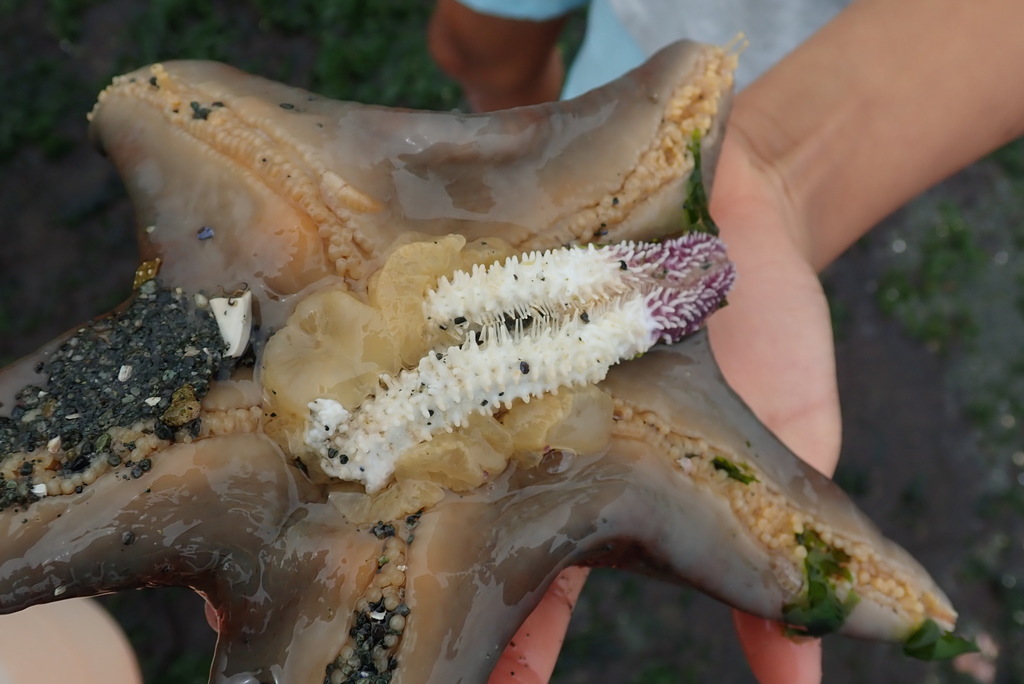
no rights reserved · CC0
Family: Asteropseidae · Class: Asteroidea · Order: Valvatida
Dermasterias imbricata (Leather Star) is a California animal in the Asteropseidae family.
The leather star is a large sea star native to the northeastern Pacific Ocean, reaching up to 15 centimeters (6 inches) in diameter. The species is characterized by its distinctive leathery, smooth skin texture that gives it its common name. The body typically displays mottled patterns of gray, brown, orange, or purple coloration, often with darker blotches or patches. Unlike many sea stars, the leather star has a relatively thick, fleshy appearance with five broad, triangular arms that taper gradually from the central disc. The aboral (upper) surface is covered with small, scattered spines and pedicellariae, while the oral (lower) surface contains numerous tube feet arranged in grooves along each arm. Dermasterias imbricata ranges along the Pacific coast from Alaska to Baja California, Mexico. In California, the species occurs from the Oregon border south to Point Conception, with scattered populations extending into southern California waters. The leather star is commonly found in nearshore marine environments, including rocky intertidal zones, kelp forests, and subtidal rocky reefs. It inhabits depths from the low intertidal zone to approximately 91 meters (300 feet), though it is most abundant in waters less than 30 meters (100 feet) deep. The species prefers hard substrate environments, including rocky outcrops, boulder fields, and artificial structures such as piers and jetties. Leather stars are frequently observed in kelp forest ecosystems, where they move across rocky surfaces and among kelp holdfasts. They can tolerate a range of wave exposures, from protected bays to moderately exposed outer coast locations. The species is often found in association with other echinoderms, including purple sea urchins, red sea urchins, and various sea star species. Leather stars are carnivorous predators that feed primarily on sea anemones, their preferred prey. They use their tube feet to grasp and manipulate prey items, then extrude their stomach to digest soft tissues externally. The species also consumes other cnidarians, small mollusks, and occasionally dead or dying marine organisms. Reproduction occurs through broadcast spawning, with individuals releasing gametes into the water column during spring and summer months. Fertilized eggs develop into planktonic larvae that eventually settle and metamorphose into juvenile sea stars. The leather star is not currently listed under federal or state endangered species legislation. The species maintains stable populations throughout most of its range, though local densities can fluctuate due to environmental factors such as ocean temperature changes, predation pressure, and habitat availability. Climate change and ocean acidification represent potential long-term threats to the species and its prey base. The leather star plays an important ecological role as both predator and prey in nearshore marine ecosystems, contributing to the regulation of sea anemone populations while serving as food for larger predators including fish, crabs, and marine mammals.
Classification
Class: Asteroidea · Order: Valvatida · Family: Asteropseidae
Frequently asked questions
How is Dermasterias imbricata classified?
Dermasterias imbricata belongs to class Asteroidea, order Valvatida, family Asteropseidae.
What family does Dermasterias imbricata belong to?
Dermasterias imbricata is in the Asteropseidae family.
What is Dermasterias imbricata?
The leather star is a large sea star native to the northeastern Pacific Ocean, reaching up to 15 centimeters (6 inches) in diameter.
Is Dermasterias imbricata found in California?
Yes. Dermasterias imbricata is recorded in California in The California Species Project's catalogue.
More California species
This species has no close relatives in our California data — here are other species to explore.
Data from The California Species Project — 14,000+ California species with verified data from CNPS, CDFW, USFWS, and more.