Dermochelys coriacea
Leatherback sea turtle
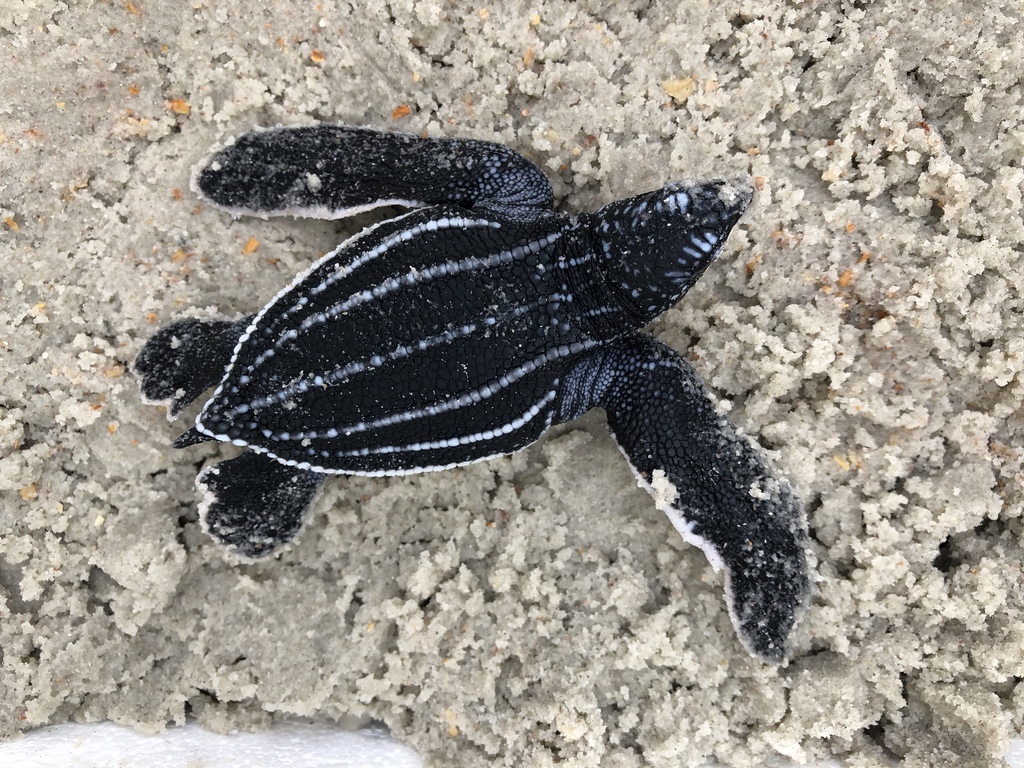
(c) Pam Kleinsasser, some rights reserved (CC BY) · licence
Family: Dermochelyidae · Class: Reptilia · Order: Testudines
Conservation status: SE · Endangered
Dermochelys coriacea (Leatherback sea turtle) is a California animal in the Dermochelyidae family.
The leatherback sea turtle is the largest living turtle species, with adults measuring 1.8 to 2.2 meters (6 to 7 feet) in carapace length and weighing 250 to 700 kilograms (550 to 1,540 pounds). Unlike other sea turtles, the leatherback lacks a hard shell, instead possessing a flexible, leathery carapace composed of connective tissue embedded with small bony plates. The carapace is dark blue to black with white or pale spots, featuring seven distinct longitudinal ridges. The species has proportionally large front flippers that can span up to 2.7 meters (8.9 feet) across, making it well-adapted for long-distance oceanic travel. Leatherback sea turtles occur in all major oceans worldwide, representing the most widely distributed reptile species. In the Pacific, two distinct populations exist: the Western Pacific population, which nests primarily in Indonesia, Papua New Guinea, and the Solomon Islands, and the critically depleted Eastern Pacific population, which nests along the Pacific coasts of Mexico and Central America. California waters serve as important foraging habitat for both populations, with individuals traveling thousands of kilometers to feed in the productive waters off the California coast. The species inhabits pelagic environments, primarily foraging in areas with high jellyfish concentrations. Leatherbacks demonstrate specialized physiological adaptations for deep diving, regularly reaching depths exceeding 1,000 meters (3,280 feet) and capable of diving to over 1,200 meters (3,937 feet). They maintain core body temperature through countercurrent heat exchange and a thick layer of insulating fat, enabling foraging in cold waters where jellyfish aggregate. Leatherback sea turtles are specialized predators, feeding almost exclusively on gelatinous zooplankton, particularly cnidarian jellyfish and salps. Adults can consume up to 200 kilograms (440 pounds) of jellyfish daily. Females reach sexual maturity between 16 and 50 years of age and exhibit natal homing, returning to their birth beaches to nest every two to three years. Nesting occurs on tropical and subtropical beaches, with females depositing 80 to 100 eggs per clutch and producing multiple clutches per season at 8 to 12 day intervals. The leatherback sea turtle has been federally listed as endangered since 1970, with California listing the species as endangered under state law. The Eastern Pacific population has experienced catastrophic decline, dropping from approximately 91,000 nesting females in 1980 to fewer than 1,400 in recent years according to NOAA Fisheries. Primary threats include fisheries bycatch, particularly in gillnet and longline fisheries, plastic pollution that resembles jellyfish prey, coastal development destroying nesting beaches, and climate change affecting sand temperatures and ocean productivity. According to the California Department of Fish and Wildlife, the species is not currently tracked by the California Natural Diversity Database. Recovery efforts focus on reducing fisheries interactions, protecting nesting beaches, and international cooperation given the species' transoceanic migrations.
Classification
Class: Reptilia · Order: Testudines · Family: Dermochelyidae
Conservation status
SE · Endangered
Frequently asked questions
How is Dermochelys coriacea classified?
Dermochelys coriacea belongs to class Reptilia, order Testudines, family Dermochelyidae.
What family does Dermochelys coriacea belong to?
Dermochelys coriacea is in the Dermochelyidae family.
Is Dermochelys coriacea protected or of conservation concern?
Dermochelys coriacea carries the following status: SE · Endangered.
What is Dermochelys coriacea?
The leatherback sea turtle is the largest living turtle species, with adults measuring 1.8 to 2.2 meters (6 to 7 feet) in carapace length and weighing 250 to 700 kilograms (550 to 1,540 pounds).
Is Dermochelys coriacea found in California?
Yes. Dermochelys coriacea is recorded in California in The California Species Project's catalogue.
More California species
This species has no close relatives in our California data — here are other species to explore.
Data from The California Species Project — 14,000+ California species with verified data from CNPS, CDFW, USFWS, and more.