Desmia funeralis
Grape Leaffolder Moth
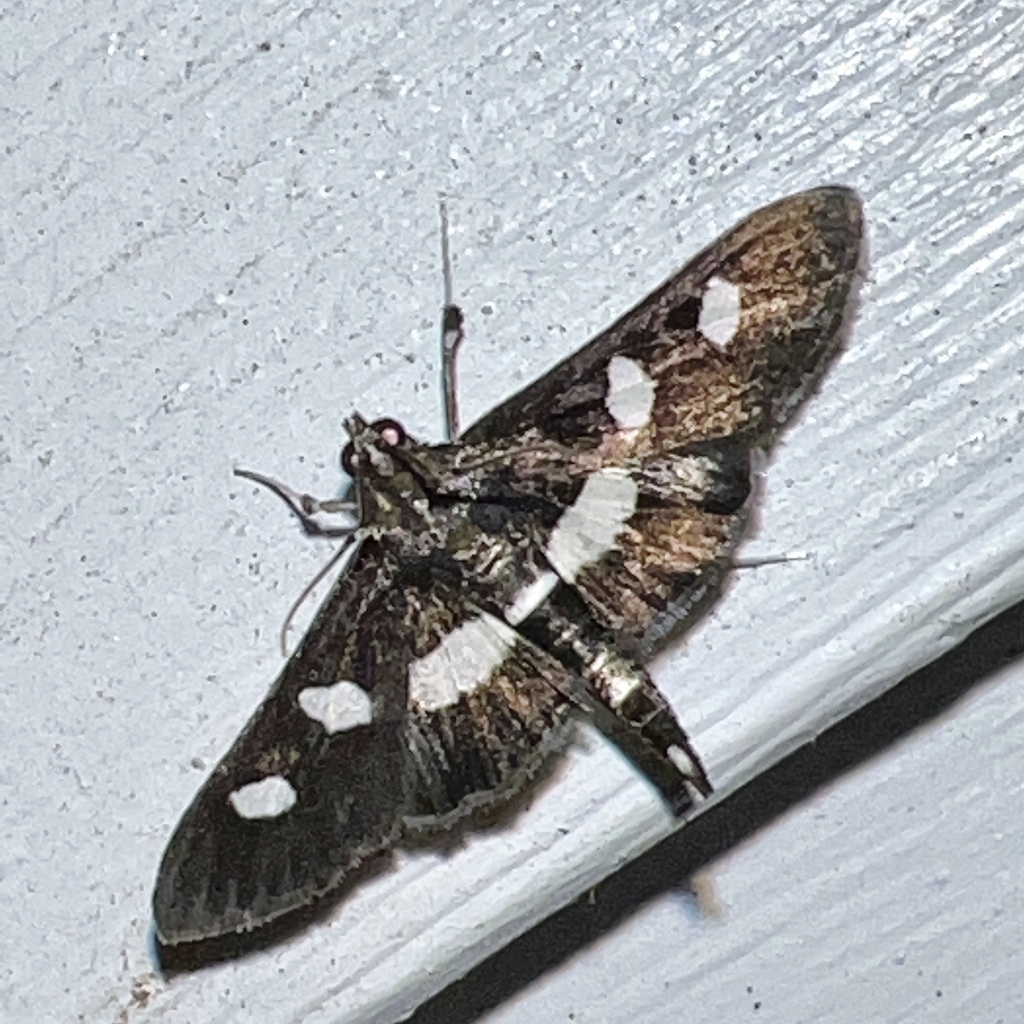
(c) Healthy Yards, some rights reserved (CC BY) · licence
Family: Crambidae · Class: Insecta · Order: Lepidoptera
Desmia funeralis (Grape Leaffolder Moth) is a California animal in the Crambidae family.
The grape leaffolder moth (Desmia funeralis) is a small pyralid moth in the family Crambidae, measuring approximately 12-16 mm (0.47-0.63 inches) in wingspan. Adults display distinctive black wings with white markings, including prominent white patches on the forewings and white-spotted hindwings. The thorax is black with white spots, while the abdomen shows alternating black and white segments. Males typically have more pronounced white markings than females, and both sexes possess feathery antennae. This species occurs throughout much of North America, ranging from southern Canada to northern South America. In California, the grape leaffolder moth is found in suitable habitats from the Central Valley through coastal regions, extending into foothill areas where host plants are present. The species has been documented in numerous California counties, including those supporting viticulture and areas with native grape species. The grape leaffolder moth inhabits areas where Vitis species grow, including vineyards, riparian zones, and oak woodlands where wild grapes occur. Adults are most commonly encountered in agricultural areas, particularly wine-growing regions, and in natural habitats supporting native California grape species such as Vitis californica. The species adapts to various elevations from sea level to approximately 1,500 meters (4,900 feet) in foothill regions. Larvae are the primary concern for grape growers, as they feed exclusively on grape foliage by creating characteristic leaf folds. Caterpillars construct shelters by folding grape leaves lengthwise and securing them with silk webbing, feeding on the leaf tissue from within these protective chambers. This feeding behavior gives the species its common name. Development proceeds through five larval instars over 3-4 weeks during warm weather. In California, the species typically produces two to three generations annually, with peak activity occurring from late spring through early fall. Adults are primarily nocturnal and are attracted to artificial lights. Pupation occurs within the leaf fold or in nearby plant debris, with adults emerging after 10-14 days. Females deposit eggs singly or in small clusters on grape leaves, with each female capable of laying 100-200 eggs. The species overwinters as pupae in protected locations, including fallen leaves and vineyard debris. The grape leaffolder moth is not listed under federal or state endangered species legislation and maintains stable populations throughout its range. While not considered a conservation concern, the species represents an economically significant agricultural pest in grape-growing regions. Integrated pest management strategies in vineyards include monitoring adult populations with pheromone traps, selective use of biological control agents such as parasitic wasps, and targeted insecticide applications when economic thresholds are exceeded. The species' dependence on Vitis species makes it vulnerable to habitat conversion, though its association with cultivated grapes provides alternative habitat in agricultural landscapes.
Classification
Class: Insecta · Order: Lepidoptera · Family: Crambidae
Frequently asked questions
How is Desmia funeralis classified?
Desmia funeralis belongs to class Insecta, order Lepidoptera, family Crambidae.
What family does Desmia funeralis belong to?
Desmia funeralis is in the Crambidae family.
What is Desmia funeralis?
The grape leaffolder moth (Desmia funeralis) is a small pyralid moth in the family Crambidae, measuring approximately 12-16 mm (0.47-0.63 inches) in wingspan.
Is Desmia funeralis found in California?
Yes. Desmia funeralis is recorded in California in The California Species Project's catalogue.
Related species
Other California species in the same genus, family, or bioregion.
Data from The California Species Project — 14,000+ California species with verified data from CNPS, CDFW, USFWS, and more.