Desmocerus californicus dimorphus
Valley elderberry longhorn beetle
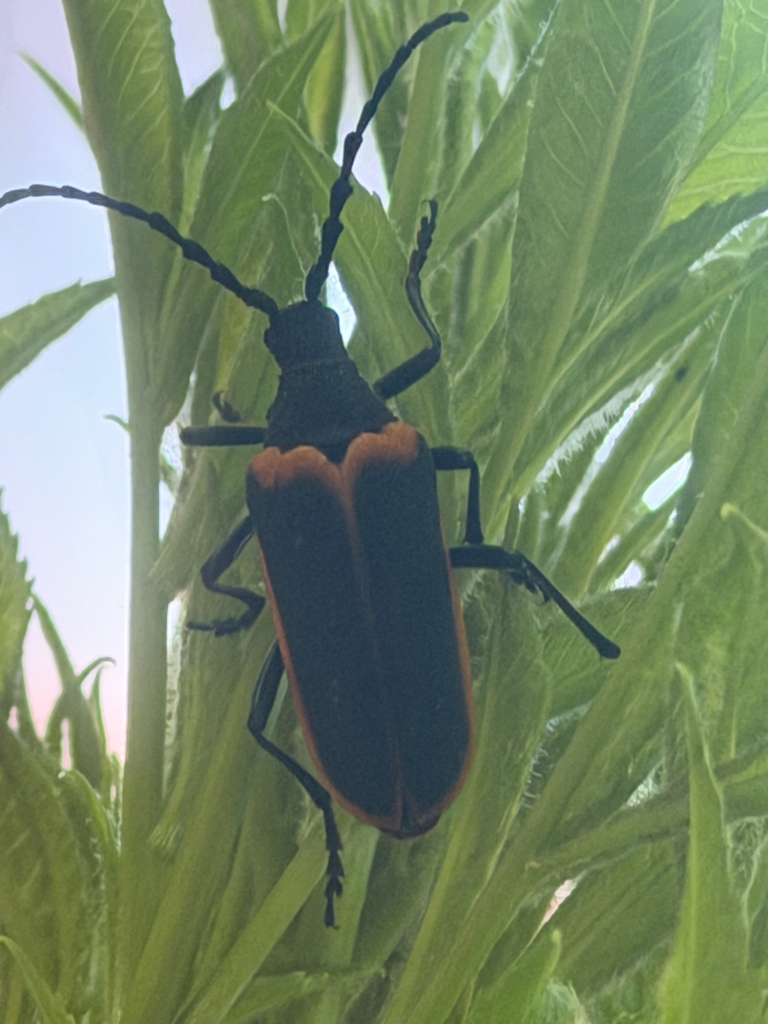
no rights reserved · CC0
Family: Cerambycidae · Class: Insecta · Order: Coleoptera
Conservation status: Threatened · G3T3 S3
Desmocerus californicus dimorphus (Valley elderberry longhorn beetle) is a California animal in the Cerambycidae family.
The valley elderberry longhorn beetle is a medium-sized beetle endemic to California's Central Valley. Adults measure 12-25 millimeters (0.5-1.0 inches) in length, with males typically smaller than females. The species exhibits sexual dimorphism in coloration: males are entirely metallic green to black, while females display metallic green to black elytra with four orange to yellow spots. Both sexes possess long antennae characteristic of longhorn beetles, with males having proportionally longer antennae than females. Historically, the valley elderberry longhorn beetle ranged throughout the Central Valley from approximately Shasta County in the north to Fresno County in the south, including the valley floor and adjacent foothills (USFWS 2017). At the time of federal listing in 1980, the beetle was known from fewer than 10 locations along the American River, Putah Creek, and Merced River. The species has experienced significant range contraction due to habitat loss and fragmentation. This beetle is entirely dependent on elderberry shrubs, primarily blue elderberry (Sambucus mexicana), for reproduction and larval development. Adults are found in riparian forests, valley oak woodlands, and other habitats containing elderberry within the Central Valley's Mediterranean climate zone. The species occurs from near sea level to approximately 914 meters (3,000 feet) elevation. Riparian corridors along rivers and streams provide the most suitable habitat, though scattered elderberry shrubs in agricultural and urban areas may also support populations. Adult beetles emerge from March through June, with peak activity typically occurring in April and May. Females lay eggs in bark crevices of elderberry stems, and larvae bore into the pith where they complete development over 1-2 years. Under laboratory conditions, adult males live 4-5 days while females survive up to 3 weeks (USFWS 2017). Adults feed on elderberry leaves and flowers. The only external evidence of beetle presence is the distinctive round exit hole, approximately 6 millimeters in diameter, created when adults emerge from elderberry stems. The U.S. Fish and Wildlife Service listed the valley elderberry longhorn beetle as threatened in 1980, making it one of the first insects to receive federal protection. The species faces ongoing threats from habitat conversion to agricultural and urban development, fragmentation of riparian corridors, and degradation of elderberry habitat through invasive plant species and altered hydrology. Conservation efforts focus on protecting existing elderberry habitat and establishing elderberry plantings in restoration projects. The USFWS Framework for Assessing Impacts provides guidance for minimizing project effects on the species through habitat preservation and compensatory mitigation measures (USFWS 2017). Population monitoring continues throughout the species' range to track recovery progress.
Classification
Class: Insecta · Order: Coleoptera · Family: Cerambycidae
Conservation status
Threatened · G3T3 S3
Frequently asked questions
How is Desmocerus californicus dimorphus classified?
Desmocerus californicus dimorphus belongs to class Insecta, order Coleoptera, family Cerambycidae.
What family does Desmocerus californicus dimorphus belong to?
Desmocerus californicus dimorphus is in the Cerambycidae family.
Is Desmocerus californicus dimorphus protected or of conservation concern?
Desmocerus californicus dimorphus carries the following status: Threatened · G3T3 S3.
What is Desmocerus californicus dimorphus?
The valley elderberry longhorn beetle is a medium-sized beetle endemic to California's Central Valley.
Is Desmocerus californicus dimorphus found in California?
Yes. Desmocerus californicus dimorphus is recorded in California in The California Species Project's catalogue.
Related species
Other California species in the same genus, family, or bioregion.
Data from The California Species Project — 14,000+ California species with verified data from CNPS, CDFW, USFWS, and more.