Diabrotica undecimpunctata
Spotted Cucumber Beetle
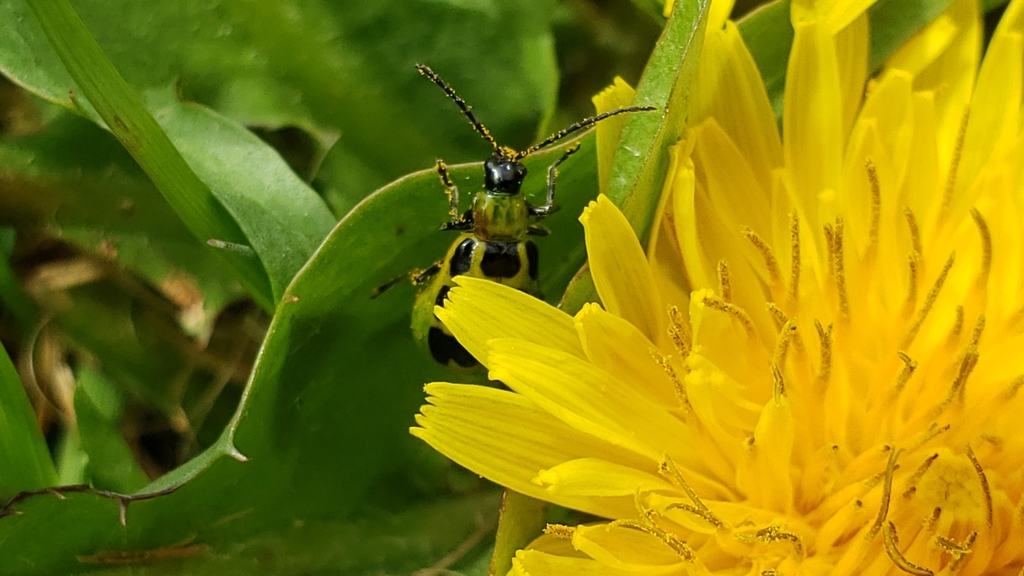
(c) Gavin Slater, some rights reserved (CC BY) · licence
Family: Chrysomelidae · Class: Insecta · Order: Coleoptera
Diabrotica undecimpunctata (Spotted Cucumber Beetle) is a California animal in the Chrysomelidae family.
The spotted cucumber beetle is a small chrysomelid beetle measuring 5-7 mm (0.2-0.3 inches) in length. Adults are yellowish-green with eleven distinct black spots on their elytra, though spot number can vary from 8-12 individuals. The head and thorax are typically yellowish to light green, while the antennae and legs are dark. Sexual dimorphism is minimal, with males slightly smaller than females. This species has an extremely broad distribution across North America, ranging from southern Canada to northern Mexico. In California, spotted cucumber beetles occur throughout the state from sea level to approximately 2,000 meters elevation. They are found in all major biogeographic regions including the Central Valley, coastal areas, desert regions, and montane zones. According to NatureServe, the species maintains a Global Rank of G5, indicating it is secure and widespread (NatureServe Explorer). Spotted cucumber beetles inhabit diverse agricultural and natural environments. Adults are commonly found in vegetable gardens, agricultural fields, meadows, and disturbed areas with abundant herbaceous vegetation. They show particular affinity for plants in the Cucurbitaceae family but also occur in areas with other suitable host plants. The species tolerates various soil types and moisture conditions, contributing to its broad ecological range. This beetle exhibits a complex life cycle with one to three generations annually, depending on climate. Adults overwinter in leaf litter, under bark, or in soil debris, emerging in spring when temperatures consistently exceed 15°C (59°F). Females deposit eggs in soil near host plant roots. The subterranean larvae, known as corn rootworms, feed on plant roots for 4-8 weeks before pupating in the soil. Adult beetles are active from late spring through early fall, with peak abundance typically occurring in mid-summer. Adults are strong fliers and can disperse considerable distances to locate suitable host plants. Dietary habits vary between life stages. Larvae primarily consume roots of grasses and other plants, while adults feed on leaves, flowers, pollen, and occasionally fruits of numerous plant species. Although particularly associated with cucurbits like squash, cucumber, and melon, adults also feed on corn, beans, and many wild herbaceous plants. This polyphagous feeding behavior contributes to the species' agricultural significance. The spotted cucumber beetle is not considered a conservation concern due to its widespread distribution and stable populations. No federal or state listing status applies to this species. However, it represents an economically important agricultural pest, causing damage through direct feeding and by vectoring bacterial wilt disease in cucurbit crops. Management typically focuses on integrated pest management approaches rather than conservation measures. Climate change may potentially expand the species' range northward and increase generation numbers in warmer regions, though specific population trend data are not systematically collected.
Classification
Class: Insecta · Order: Coleoptera · Family: Chrysomelidae
Frequently asked questions
How is Diabrotica undecimpunctata classified?
Diabrotica undecimpunctata belongs to class Insecta, order Coleoptera, family Chrysomelidae.
What family does Diabrotica undecimpunctata belong to?
Diabrotica undecimpunctata is in the Chrysomelidae family.
What is Diabrotica undecimpunctata?
The spotted cucumber beetle is a small chrysomelid beetle measuring 5-7 mm (0.2-0.3 inches) in length.
Is Diabrotica undecimpunctata found in California?
Yes. Diabrotica undecimpunctata is recorded in California in The California Species Project's catalogue.
Related species
Other California species in the same genus, family, or bioregion.
Data from The California Species Project — 14,000+ California species with verified data from CNPS, CDFW, USFWS, and more.