Diadasia nigrifrons
Black-fronted turret bee
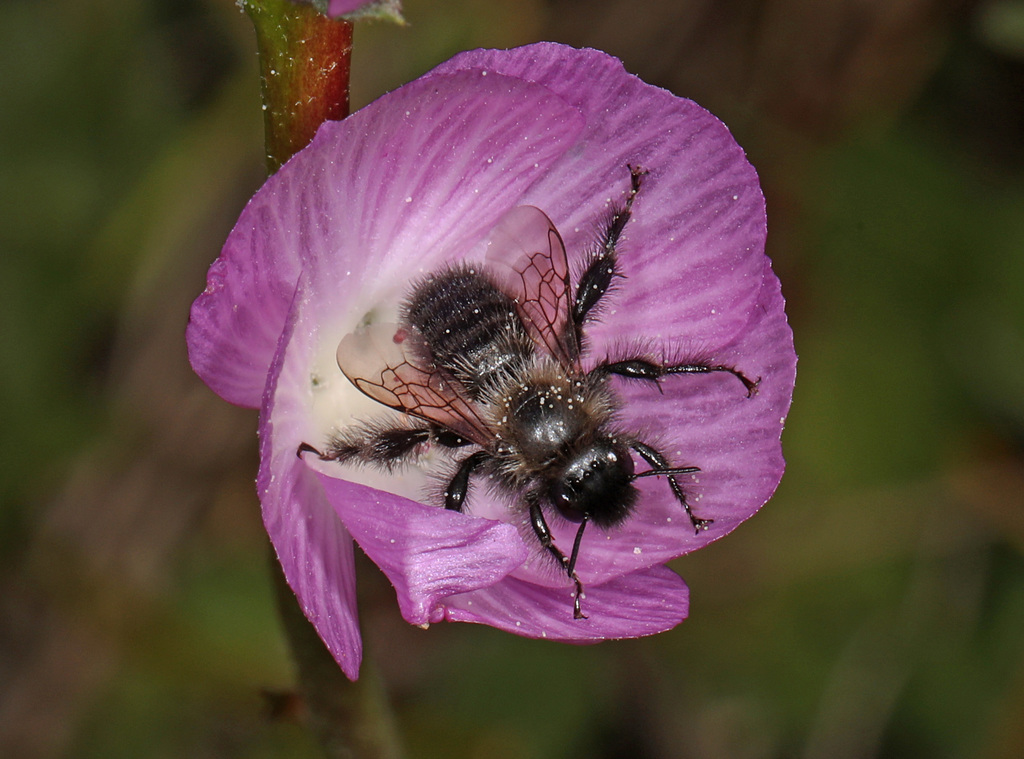
(c) Judy Gallagher, some rights reserved (CC BY-SA) · licence
Family: Apidae · Class: Insecta · Order: Hymenoptera
Diadasia nigrifrons (Black-fronted turret bee) is a California animal in the Apidae family.
The black-fronted turret bee (Diadasia nigrifrons) is a solitary ground-nesting bee in the family Apidae. This species belongs to the genus Diadasia, which comprises robust, medium-sized bees known for their specialized relationships with certain flowering plants. Physical characteristics of D. nigrifrons include the distinctive black coloration on the front portion of the head that gives the species its common name, though detailed morphological descriptions remain limited in the scientific literature. The black-fronted turret bee occurs in western North America, with documented populations in California, Oregon, and potentially other western states. In California, the species has been recorded from scattered locations in the Sacramento and San Joaquin Valleys. The range extends northward into Oregon's Willamette Valley, where it has been observed in association with native prairie habitats. Current distribution data suggests the species may have a broader historical range than presently documented. This species inhabits open grasslands, prairies, and meadow edges where its host plants occur. The bee constructs nests in the ground, typical of many Diadasia species, though specific soil preferences and nesting site requirements have not been thoroughly documented. Habitat associations are closely tied to the distribution of checker-mallow species, particularly in areas with alkaline soils ranging from pH 7.2 to 9.5. Diadasia nigrifrons exhibits highly specialized pollination behavior as a checker-mallow specialist. The species has been identified as the dominant pollinating insect for several Sidalcea species, including pedate checker-mallow (S. pedata) and potentially Nelson's checker-mallow (S. nelsoniana) (USFWS recovery documents). Female bees collect pollen exclusively from checker-mallow flowers, making them oligolectic specialists. This specialization creates a critical ecological relationship where the bee's reproduction depends entirely on the availability of these host plants. The species appears to be colonial in its ground-nesting behavior, with multiple females potentially nesting in suitable habitat areas. Like other Diadasia species, adults are likely most active during the flowering period of their host plants, typically during late spring and summer months. The conservation status of the black-fronted turret bee reflects concerns associated with habitat loss and the decline of its checker-mallow host plants. While not federally listed, the species appears on California's Special Animals list, indicating it is tracked by the California Natural Diversity Database as a species at risk. The bee's specialized relationship with checker-mallows, several of which are themselves rare or declining, creates conservation challenges. Threats likely include habitat conversion, agricultural development, and altered hydrology in valley grasslands and prairie systems. The species' dependence on specific host plants means that conservation efforts must focus on protecting and restoring checker-mallow populations and their associated habitats. Given the limited scientific documentation available, additional research is needed to fully understand the species' distribution, population status, and ecological requirements.
Classification
Class: Insecta · Order: Hymenoptera · Family: Apidae
Frequently asked questions
How is Diadasia nigrifrons classified?
Diadasia nigrifrons belongs to class Insecta, order Hymenoptera, family Apidae.
What family does Diadasia nigrifrons belong to?
Diadasia nigrifrons is in the Apidae family.
What is Diadasia nigrifrons?
The black-fronted turret bee (Diadasia nigrifrons) is a solitary ground-nesting bee in the family Apidae.
Is Diadasia nigrifrons found in California?
Yes. Diadasia nigrifrons is recorded in California in The California Species Project's catalogue.
Related species
Other California species in the same genus, family, or bioregion.
Data from The California Species Project — 14,000+ California species with verified data from CNPS, CDFW, USFWS, and more.