Diadophis punctatus modestus
San Bernardino Ringneck Snake
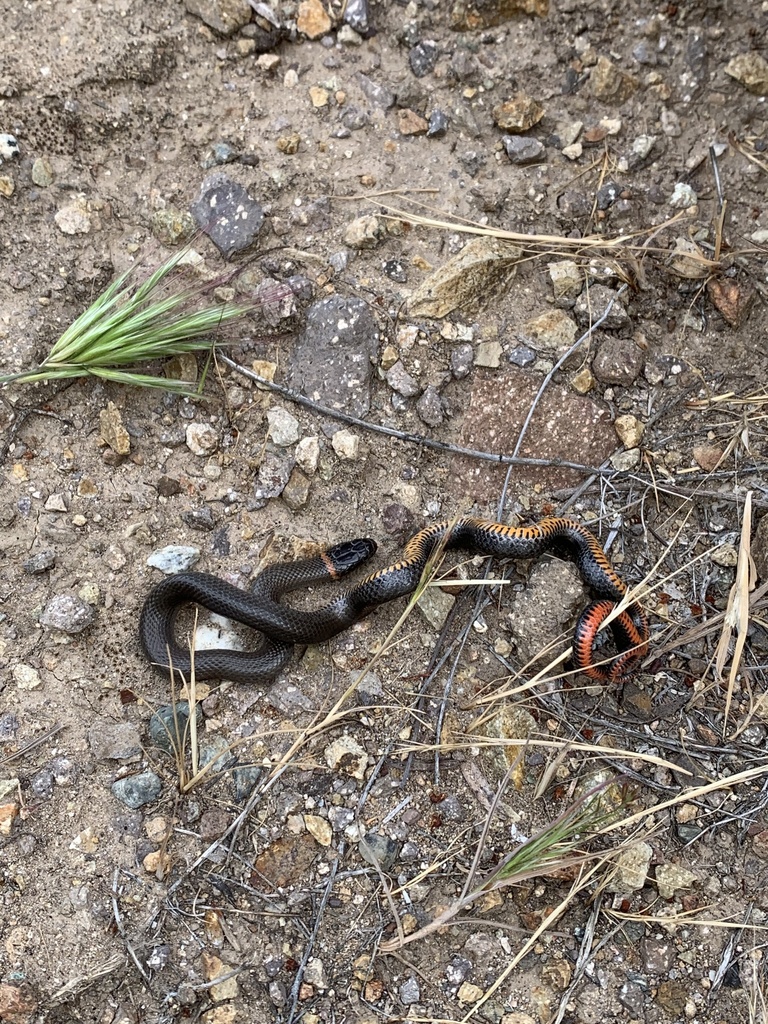
(c) Cayman Lanzone, some rights reserved (CC BY) · licence
Family: Dipsadidae · Class: Reptilia · Order: Squamata
Conservation status: G5T2T3 S2?
Diadophis punctatus modestus (San Bernardino Ringneck Snake) is a California animal in the Dipsadidae family.
The San Bernardino ringneck snake is a small, slender serpent that represents one of four ringneck snake subspecies found in California. Adults typically reach 24 to 34 inches (61 to 86 cm) in total length, with smooth scales and a distinctive appearance that characterizes the ringneck snake group. The dorsal coloration is gray to olive-gray, with the characteristic yellow to orange ring around the neck that separates the darker head from the body. The ventral surface displays bright yellow to orange coloration, which may extend onto the lower sides of the body. This subspecies occurs primarily in the mountains of southern California, with its range centered in the San Bernardino Mountains of San Bernardino County. The species also extends into portions of Riverside County and the San Gabriel Mountains of Los Angeles County (californiaherps.com). Recent surveys have documented the subspecies in unexpected locations, including the Ballona Wetlands Ecological Reserve in coastal Los Angeles County, where it was newly identified during baseline surveys conducted between 2010-2015 (Johnston et al. 2015). This coastal occurrence represents a significant range extension from the typical montane distribution. San Bernardino ringneck snakes inhabit diverse habitats ranging from lower montane zones to higher elevations. They are found in mixed coniferous forests, oak woodlands, chaparral, grasslands, and rocky hillsides, typically between 1,400 and 6,100 feet elevation in the San Bernardino Mountains (californiaherps.com). The species prefers moist microhabitats and is often associated with areas containing rocks, logs, and debris that provide cover and maintain humidity. They may also occur in suburban gardens and agricultural areas where suitable moisture and cover conditions exist. This subspecies exhibits typical ringneck snake behavior, being secretive and primarily nocturnal or crepuscular in activity patterns. They spend most daylight hours hidden under rocks, logs, bark, or other surface cover objects. The diet consists primarily of small invertebrates including earthworms, slugs, and small salamanders, though they may occasionally consume small lizards and juvenile snakes. When threatened, ringneck snakes display their brightly colored ventral surface by coiling the tail and exposing the orange or yellow underside. Reproduction occurs through egg-laying, with females typically depositing small clutches of 2 to 10 elongated eggs in moist soil or under decaying logs during summer months. The San Bernardino ringneck snake currently holds a global rank of G5T2T3, indicating the subspecies is imperiled to vulnerable, while the state rank is S2?, reflecting uncertainty about its status in California but suggesting it may be imperiled statewide. The species faces habitat pressures from urban development, particularly in foothill areas where residential expansion continues to fragment suitable habitat. Climate change may also affect this moisture-dependent species through altered precipitation patterns and increased temperatures in montane habitats. The discovery of populations in coastal areas like Ballona Wetlands suggests the subspecies' distribution and habitat requirements may be more complex than previously understood, highlighting the need for continued surveys and monitoring efforts.
Classification
Class: Reptilia · Order: Squamata · Family: Dipsadidae
Conservation status
G5T2T3 S2?
Frequently asked questions
How is Diadophis punctatus modestus classified?
Diadophis punctatus modestus belongs to class Reptilia, order Squamata, family Dipsadidae.
What family does Diadophis punctatus modestus belong to?
Diadophis punctatus modestus is in the Dipsadidae family.
Is Diadophis punctatus modestus protected or of conservation concern?
Diadophis punctatus modestus carries the following status: G5T2T3 S2?.
What is Diadophis punctatus modestus?
The San Bernardino ringneck snake is a small, slender serpent that represents one of four ringneck snake subspecies found in California.
Is Diadophis punctatus modestus found in California?
Yes. Diadophis punctatus modestus is recorded in California in The California Species Project's catalogue.
Related species
Other California species in the same genus, family, or bioregion.
Data from The California Species Project — 14,000+ California species with verified data from CNPS, CDFW, USFWS, and more.