Diadophis punctatus similis
San Diego Ringneck Snake
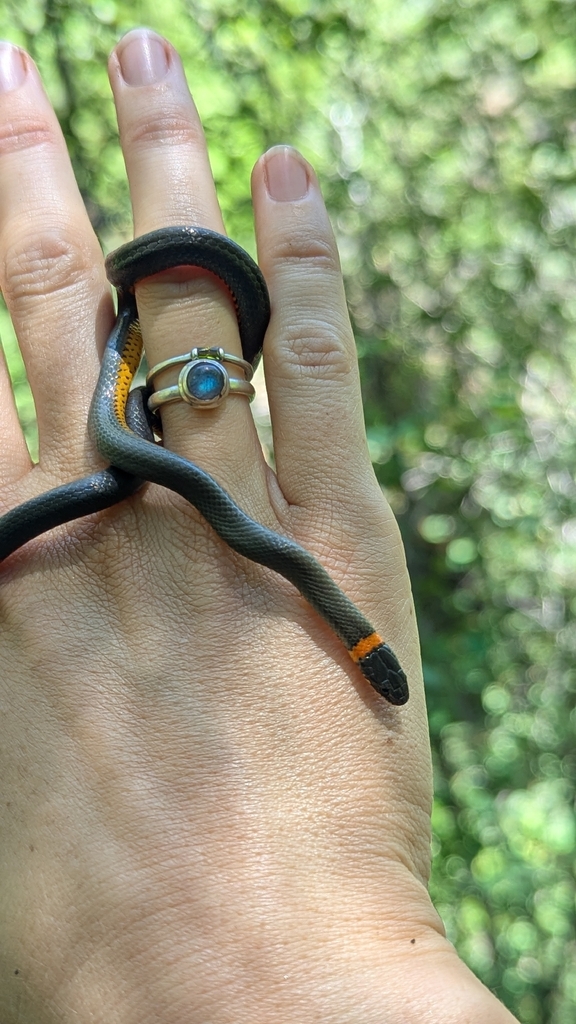
(c) Cypress Hansen, some rights reserved (CC BY) · licence
Family: Dipsadidae · Class: Reptilia · Order: Squamata
Conservation status: G5T4 S2?
Diadophis punctatus similis (San Diego Ringneck Snake) is a California animal in the Dipsadidae family.
The San Diego ringneck snake (Diadophis punctatus similis) is a small, secretive serpent endemic to southern California and Baja California, Mexico. Adults typically measure 25 to 38 cm (10 to 15 inches) in total length, making this one of the smaller subspecies of ringneck snake. The dorsal coloration is uniformly dark gray to black, while the ventral surface displays the characteristic bright orange to coral-red coloration that distinguishes this subspecies from other ringneck snakes. A distinctive yellow to orange neck ring, usually complete but occasionally broken, encircles the neck just behind the head. The scales are smooth and glossy, giving the snake a polished appearance. Historically, the San Diego ringneck snake ranged throughout coastal southern California from Los Angeles County south through San Diego County and into Baja California, Mexico. Current populations are fragmented and restricted primarily to remaining natural areas within this range. The subspecies occurs from sea level to approximately 1,525 meters (5,000 feet) elevation in mountainous areas. This subspecies inhabits a variety of moist habitats including chaparral, oak woodlands, pine-oak forests, riparian areas, and coastal sage scrub. It shows a strong preference for areas with adequate ground cover such as logs, rocks, leaf litter, and dense vegetation. The species requires sufficient moisture and is typically found in areas with higher humidity than surrounding dry habitats. Rocky hillsides, canyon bottoms, and areas near water sources provide optimal conditions. San Diego ringneck snakes are highly secretive and fossorial, spending most daylight hours hidden beneath surface objects or in shallow burrows. They are primarily active during twilight and nighttime hours, particularly during cooler, humid conditions. The diet consists almost exclusively of small invertebrates, including earthworms, slugs, salamanders, and small arthropods. When threatened, individuals may coil their tail to display the bright ventral coloration while hiding their head, a defensive behavior known as "tail display." Reproduction occurs in spring, with females laying 2 to 10 small, elongated eggs in moist soil or rotting logs during late spring or early summer. The San Diego ringneck snake has a NatureServe global subspecies rank of G5T4, indicating the subspecies is apparently secure globally but may be uncommon in parts of its range. However, it carries a California state rank of S2?, suggesting it is imperiled within the state with 6 to 20 occurrences or few remaining individuals. The primary threats include habitat loss and fragmentation due to urban development, particularly in coastal areas of southern California. Fire suppression and altered fire regimes may also impact habitat quality by changing vegetation structure and moisture retention. Climate change poses additional concerns through increased temperatures and reduced precipitation in already marginal habitats. The subspecies' restricted range and specific habitat requirements make it vulnerable to continued habitat modification and loss.
Classification
Class: Reptilia · Order: Squamata · Family: Dipsadidae
Conservation status
G5T4 S2?
Frequently asked questions
How is Diadophis punctatus similis classified?
Diadophis punctatus similis belongs to class Reptilia, order Squamata, family Dipsadidae.
What family does Diadophis punctatus similis belong to?
Diadophis punctatus similis is in the Dipsadidae family.
Is Diadophis punctatus similis protected or of conservation concern?
Diadophis punctatus similis carries the following status: G5T4 S2?.
What is Diadophis punctatus similis?
The San Diego ringneck snake (Diadophis punctatus similis) is a small, secretive serpent endemic to southern California and Baja California, Mexico.
Is Diadophis punctatus similis found in California?
Yes. Diadophis punctatus similis is recorded in California in The California Species Project's catalogue.
Related species
Other California species in the same genus, family, or bioregion.
Data from The California Species Project — 14,000+ California species with verified data from CNPS, CDFW, USFWS, and more.