Dicamptodon ensatus
California Giant Salamander
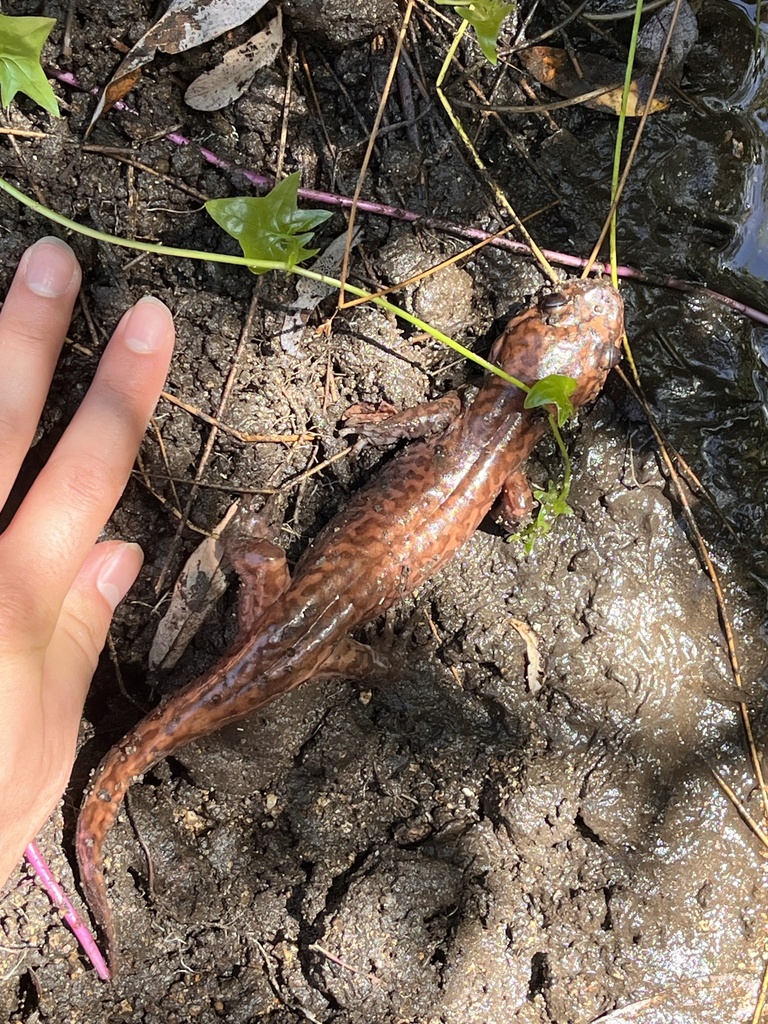
(c) Parsa Fard, some rights reserved (CC BY) · licence
Family: Dicamptodontidae · Class: Amphibia · Order: Caudata
Conservation status: G2G3 S2S3
Dicamptodon ensatus (California Giant Salamander) is a California animal in the Dicamptodontidae family.
The California Giant Salamander is the largest terrestrial salamander in California and one of the largest salamanders in North America. Adults typically measure 175 to 350 mm (6.9 to 13.8 inches) in total length, with exceptional individuals reaching up to 350 mm. The body is robust and cylindrical, with a broad, flattened head and prominent eyes. Coloration varies from brown to olive-green dorsally, often with darker mottling or marbling patterns. The ventral surface is typically lighter, ranging from pale yellow to cream. Adults possess well-developed limbs with distinct digits, distinguishing them from the neotenic larvae which retain external gills and more compressed tails. The California Giant Salamander is endemic to coastal California, with a fragmented distribution extending from Mendocino County south to Santa Cruz County. The species occurs in the Coast Ranges and associated foothills, with isolated populations documented in specific watersheds. Historical records suggest a more continuous distribution, but habitat fragmentation has resulted in disjunct populations separated by unsuitable habitat or geographic barriers. This species inhabits cool, moist coniferous and mixed forests, particularly those dominated by coast redwood (Sequoia sempervirens) and Douglas-fir (Pseudotsuga menziesii). California Giant Salamanders require permanent or semi-permanent water sources for reproduction, including springs, seeps, and clear, rocky streams. Adults are typically found under logs, rocks, and other cover objects within 100 meters of water sources. The species occurs from sea level to approximately 1,500 meters (4,921 feet) elevation, though most populations are found below 1,000 meters. California Giant Salamanders exhibit complex life cycles that may include both aquatic and terrestrial phases. Larvae are fully aquatic and may remain in streams for 2 to 4 years before metamorphosis. Some populations exhibit neoteny, with sexually mature individuals retaining larval characteristics throughout their lives. Terrestrial adults are primarily nocturnal and feed on a variety of invertebrates, including slugs, earthworms, insects, and spiders. Larger individuals may consume small vertebrates. Reproduction occurs in late fall through early spring, with females depositing 135 to 200 eggs in protected aquatic sites. Adults demonstrate strong site fidelity, often returning to the same cover objects. The California Giant Salamander has a Global/State Rank of G2G3 S2S3, indicating the species is imperiled to vulnerable both globally and within California. Primary threats include habitat loss and fragmentation due to logging, urban development, and agricultural conversion. Stream alterations, including sedimentation from logging activities and water diversions, degrade aquatic breeding habitat. Climate change poses additional threats through increased temperatures and altered precipitation patterns that may reduce suitable habitat. The species' limited dispersal ability and specific habitat requirements make populations particularly vulnerable to local extirpations. Conservation efforts focus on protecting intact forest watersheds and maintaining water quality in occupied streams.
Classification
Class: Amphibia · Order: Caudata · Family: Dicamptodontidae
Conservation status
G2G3 S2S3
Frequently asked questions
How is Dicamptodon ensatus classified?
Dicamptodon ensatus belongs to class Amphibia, order Caudata, family Dicamptodontidae.
What family does Dicamptodon ensatus belong to?
Dicamptodon ensatus is in the Dicamptodontidae family.
Is Dicamptodon ensatus protected or of conservation concern?
Dicamptodon ensatus carries the following status: G2G3 S2S3.
What is Dicamptodon ensatus?
The California Giant Salamander is the largest terrestrial salamander in California and one of the largest salamanders in North America.
Is Dicamptodon ensatus found in California?
Yes. Dicamptodon ensatus is recorded in California in The California Species Project's catalogue.
Related species
Other California species in the same genus, family, or bioregion.
Data from The California Species Project — 14,000+ California species with verified data from CNPS, CDFW, USFWS, and more.