Dicamptodon tenebrosus
Coastal Giant Salamander
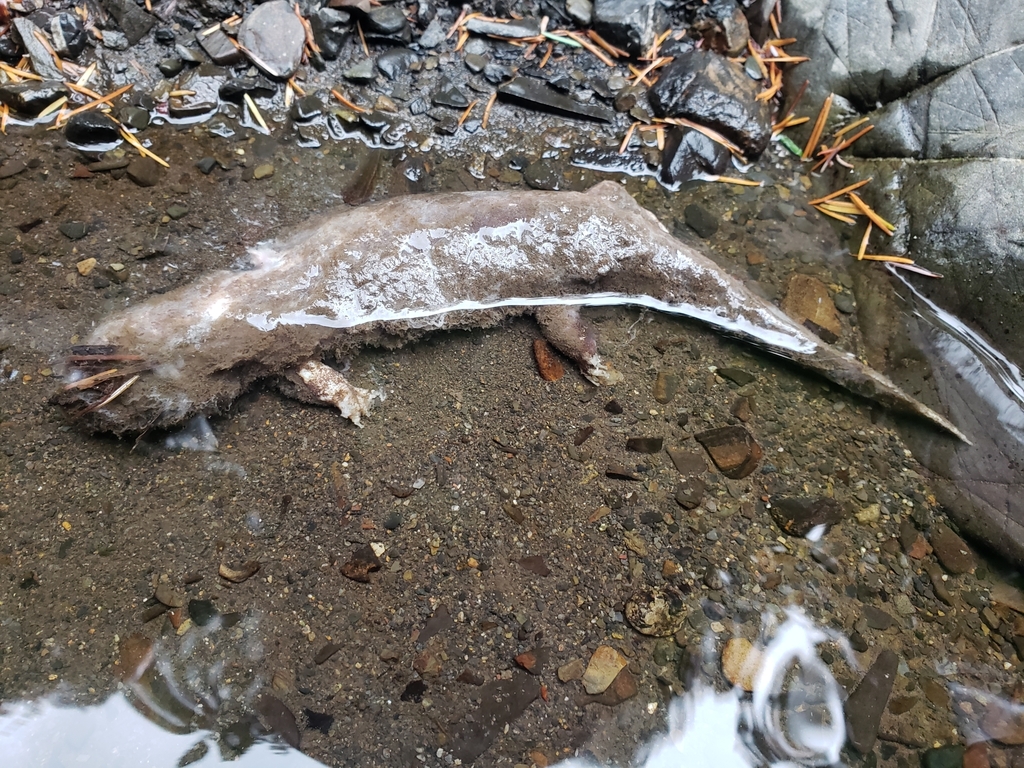
(c) M, some rights reserved (CC BY) · licence
Family: Dicamptodontidae · Class: Amphibia · Order: Caudata
Dicamptodon tenebrosus (Coastal Giant Salamander) is a California animal in the Dicamptodontidae family.
The Coastal Giant Salamander (Dicamptodon tenebrosus) is the largest terrestrial salamander in North America, with adults reaching lengths of 170 to 343 mm (6.7 to 13.5 inches) from snout to tail tip. Adults typically weigh 20 to 150 grams. The species exhibits a robust body with relatively short limbs and a laterally compressed tail. Dorsal coloration ranges from brown to purplish-brown with irregular darker markings, while the ventral surface is lighter, often cream or yellow. The skin is smooth and moist, with a network of grooves running along the body. Adults possess well-developed eyes with moveable eyelids and lack external gills. The Coastal Giant Salamander occurs along the Pacific Coast from extreme southwestern British Columbia through western Washington and Oregon to northwestern California. In California, the species is restricted to coastal areas in Del Norte, Humboldt, and northern Mendocino counties. The range extends from sea level to approximately 1,370 meters (4,500 feet) elevation in the Coast Range. Populations are concentrated in watersheds draining into the Pacific Ocean, including the Smith, Klamath, Mad, and Eel river systems. This species inhabits old-growth and mature second-growth coniferous forests dominated by Douglas fir, western hemlock, and redwood. Adults require cool, humid microhabitats including talus slopes, rocky crevices, rotting logs, and areas beneath bark or forest debris. Larvae develop in clear, cold, well-oxygenated streams with rocky substrates, typically in first- through third-order streams with temperatures below 15°C (59°F). The species demonstrates strong site fidelity, with adults often remaining within 50 meters of natal streams throughout their lives. Coastal Giant Salamanders are primarily nocturnal and terrestrial as adults, though they may become active during daylight hours in sufficiently humid conditions. Adults are opportunistic predators, consuming arthropods, mollusks, earthworms, and occasionally smaller salamanders and small vertebrates including mice and juvenile snakes. Larvae are aquatic for 2 to 4 years, feeding on aquatic invertebrates, small fish, and other amphibian larvae. Breeding occurs from April through September, with females depositing 135 to 200 unpigmented eggs in underground nests near seeps or springs. Eggs require 9 to 10 months to hatch, with larvae emerging the following spring. Sexual maturity is reached at 4 to 6 years of age. The species is not federally listed but faces ongoing threats from habitat loss due to timber harvesting, particularly clearcutting of old-growth forests. Stream sedimentation from logging operations degrades larval habitat by reducing dissolved oxygen levels and covering rocky substrates essential for development. Climate change poses additional risks through increased temperatures and altered precipitation patterns that may reduce suitable habitat availability. Population monitoring indicates stable populations in protected areas, but declines in heavily logged regions. The species benefits from forest management practices that maintain canopy cover, preserve riparian buffers, and minimize soil disturbance near streams.
Classification
Class: Amphibia · Order: Caudata · Family: Dicamptodontidae
Frequently asked questions
How is Dicamptodon tenebrosus classified?
Dicamptodon tenebrosus belongs to class Amphibia, order Caudata, family Dicamptodontidae.
What family does Dicamptodon tenebrosus belong to?
Dicamptodon tenebrosus is in the Dicamptodontidae family.
What is Dicamptodon tenebrosus?
The Coastal Giant Salamander (Dicamptodon tenebrosus) is the largest terrestrial salamander in North America, with adults reaching lengths of 170 to 343 mm (6.7 to 13.5 inches) from snout to tail tip.
Is Dicamptodon tenebrosus found in California?
Yes. Dicamptodon tenebrosus is recorded in California in The California Species Project's catalogue.
Related species
Other California species in the same genus, family, or bioregion.
Data from The California Species Project — 14,000+ California species with verified data from CNPS, CDFW, USFWS, and more.