Diceroprocta apache
Citrus Cicada
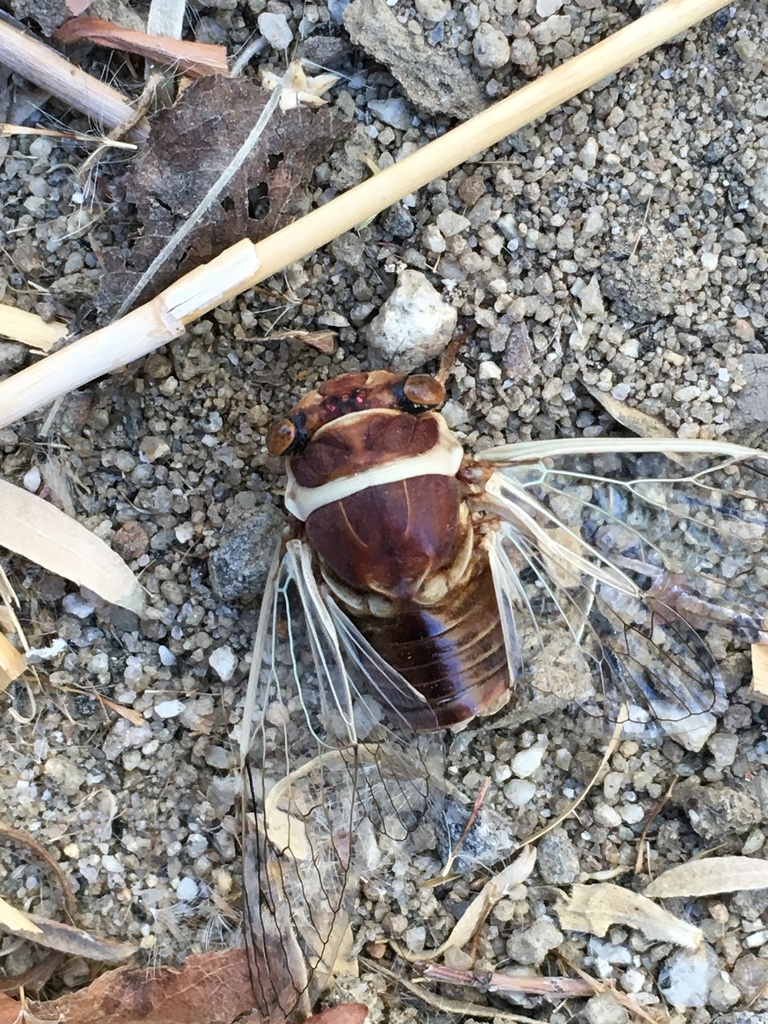
(c) kclarksdnhmorg, some rights reserved (CC BY) · licence
Family: Cicadidae · Class: Insecta · Order: Hemiptera
Diceroprocta apache (Citrus Cicada) is a California animal in the Cicadidae family.
The Citrus Cicada is a medium-sized cicada species native to the southwestern United States. Adults display the typical cicada morphology with prominent compound eyes, short antennae, and clear wings with distinct venation patterns. Males possess specialized sound-producing organs called tymbals, which they use to generate species-specific calls during mating displays. The body coloration typically includes dark patterns on a lighter background, though detailed morphological descriptions require further taxonomic study. Diceroprocta apache occurs across the southwestern United States, including southeastern California, Arizona, southern Utah, and southern Nevada, with its range extending into northern Mexico (BugGuide). According to collection records, this species has a broader distribution than the closely related D. semicincta, though taxonomic confusion and misidentifications have made precise range mapping challenging (BugGuide). In Arizona, D. apache populations are reported to begin around Casa Grande and extend northward, while D. cinctifera occupies areas further south. This species inhabits arid and semi-arid regions typical of the Sonoran and Mojave desert ecosystems. Citrus cicadas are associated with desert shrubland and riparian vegetation communities where their host plants occur. Adults emerge during warm months when temperatures support active calling and mating behaviors. The specific elevation range and microhabitat preferences have not been comprehensively documented in the scientific literature. Like other cicada species, D. apache exhibits a complex life cycle with extended underground larval development. Nymphs feed on plant roots for multiple years before emerging as adults during synchronized emergence events. Adult males establish territories and produce loud, distinctive calls to attract females for mating. The specific call characteristics, breeding timing, and larval development period for this species require additional research. Adults are presumed to feed on plant fluids through their piercing-sucking mouthparts, though detailed dietary studies are lacking. No formal conservation status has been assigned to Diceroprocta apache at federal or state levels. The species is not listed under the Endangered Species Act or included in California's special concern species designations. However, southwestern cicada populations face potential threats from habitat modification, urbanization, and climate change impacts on desert ecosystems. Taxonomic uncertainty within the Diceroprocta genus complicates conservation assessment, as misidentifications may affect population monitoring efforts. The distribution of several western Diceroprocta species remains incompletely understood due to identification challenges (BugGuide). Scientific documentation for this species remains limited beyond basic taxonomic and distributional information. Detailed ecological studies examining host plant relationships, population dynamics, and specific habitat requirements would enhance understanding of this southwestern cicada. The information presented here synthesizes available data from taxonomic databases and collection records. Additional field research is needed to clarify the species' biology, precise distribution, and conservation status within its range.
Classification
Class: Insecta · Order: Hemiptera · Family: Cicadidae
Frequently asked questions
How is Diceroprocta apache classified?
Diceroprocta apache belongs to class Insecta, order Hemiptera, family Cicadidae.
What family does Diceroprocta apache belong to?
Diceroprocta apache is in the Cicadidae family.
What is Diceroprocta apache?
The Citrus Cicada is a medium-sized cicada species native to the southwestern United States.
Is Diceroprocta apache found in California?
Yes. Diceroprocta apache is recorded in California in The California Species Project's catalogue.
Related species
Other California species in the same genus, family, or bioregion.
Data from The California Species Project — 14,000+ California species with verified data from CNPS, CDFW, USFWS, and more.