Dichordophora phoenix
Phoenix Emerald Moth
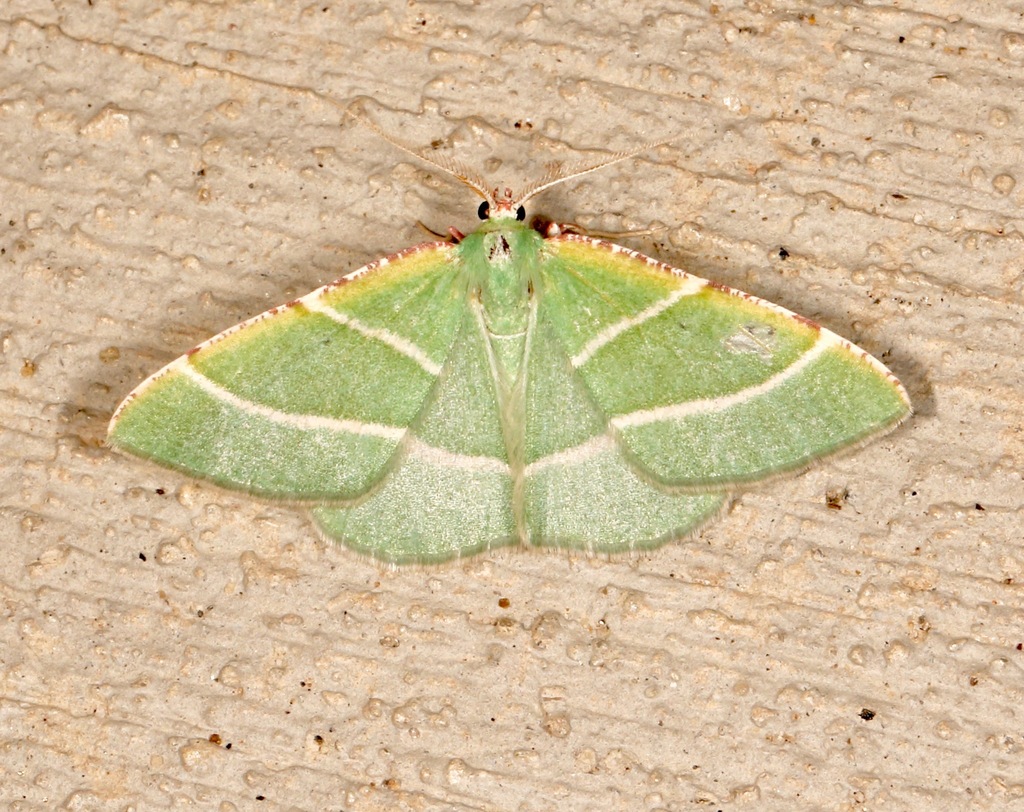
(c) Laura Gaudette, some rights reserved (CC BY) · licence
Family: Geometridae · Class: Insecta · Order: Lepidoptera
Dichordophora phoenix (Phoenix Emerald Moth) is a California animal in the Geometridae family.
The Phoenix Emerald Moth (Dichordophora phoenix) is a small geometrid moth in the family Geometridae, subfamily Geometrinae. This species belongs to the emerald moth group, characterized by their typically green coloration, though specific morphological details for this species are not well documented in current literature. Adult wingspan measurements and detailed physical descriptions have not been comprehensively recorded in available scientific sources. The Phoenix Emerald Moth occurs across a broad range in western and southwestern North America, extending from California and Nevada eastward to Colorado and Texas. In California, the species is documented from desert regions, though specific county records and elevational distribution within the state require further documentation. The species' presence across this extensive geographic range suggests adaptation to varied climatic conditions from Mediterranean California through the Great Basin to the southwestern deserts. This species inhabits desert environments, as indicated by records from arid regions across its range (BugGuide). The moth's distribution corresponds with areas where its host plant, Skunkbush Sumac (Rhus trilobata), occurs naturally. Skunkbush Sumac is a drought-tolerant shrub that grows in desert washes, canyon bottoms, and rocky slopes at elevations typically ranging from 1,000 to 7,000 feet, suggesting the moth likely occurs within this elevational band. The larvae of Phoenix Emerald Moth feed specifically on Skunkbush Sumac (Rhus trilobata), a native shrub in the cashew family (Anacardiaceae). This host plant relationship indicates a specialized feeding strategy, as many geometrid moths are associated with specific plant families or genera. Skunkbush Sumac produces clusters of small flowers in spring followed by red berries, and the timing of the moth's life cycle likely corresponds with periods of optimal host plant condition. Adult flight periods, egg-laying behavior, and larval development timing have not been well documented for this species. Like other members of the Geometridae family, Phoenix Emerald Moth larvae are likely "inchworms" or "loopers" that move by arching their bodies due to the absence of prolegs on their middle abdominal segments. The species probably overwinters as eggs or pupae, emerging as adults during warmer months when host plants are actively growing, though specific phenology data are lacking. The Phoenix Emerald Moth currently has no federal or state conservation listing status. The species' broad geographic distribution across multiple states suggests stable populations, though specific population trends have not been systematically monitored. The primary habitat requirement—Skunkbush Sumac—remains widespread across appropriate desert and semi-arid environments throughout the species' range. However, like many specialized herbivorous insects, the species could be vulnerable to habitat modification, climate change effects on host plant distribution, and potential impacts from urban development in desert regions. Scientific documentation for this species remains limited. The information presented here is based on available sources including taxonomic databases and citizen science observations. If you have additional verified information about this species' biology, distribution, or ecology, please contact us to help improve this species account.
Classification
Class: Insecta · Order: Lepidoptera · Family: Geometridae
Frequently asked questions
How is Dichordophora phoenix classified?
Dichordophora phoenix belongs to class Insecta, order Lepidoptera, family Geometridae.
What family does Dichordophora phoenix belong to?
Dichordophora phoenix is in the Geometridae family.
What is Dichordophora phoenix?
The Phoenix Emerald Moth (Dichordophora phoenix) is a small geometrid moth in the family Geometridae, subfamily Geometrinae.
Is Dichordophora phoenix found in California?
Yes. Dichordophora phoenix is recorded in California in The California Species Project's catalogue.
Related species
Other California species in the same genus, family, or bioregion.
Data from The California Species Project — 14,000+ California species with verified data from CNPS, CDFW, USFWS, and more.