Dicymolomia metalliferalis
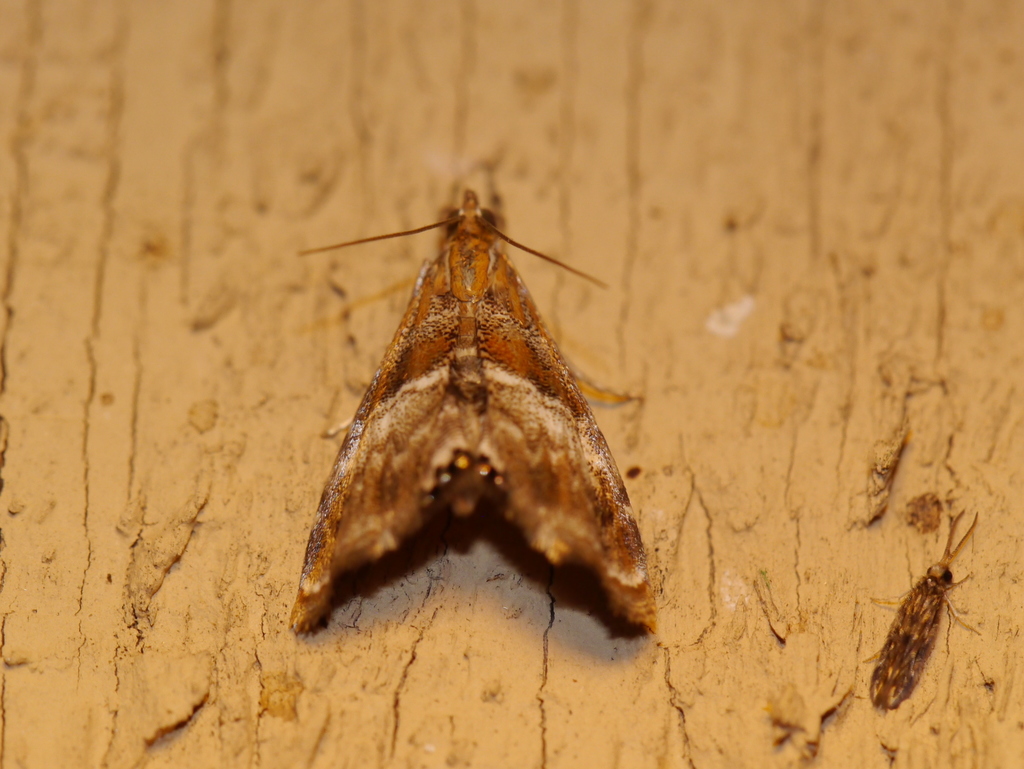
(c) Matt Muir, some rights reserved (CC BY) · licence
Family: Crambidae · Class: Insecta · Order: Lepidoptera
Dicymolomia metalliferalis is a California animal in the Crambidae family.
Dicymolomia metalliferalis is a small moth in the family Crambidae, commonly known as the grass moths or snout moths. This species belongs to the subfamily Spilomelinae, a diverse group of pyraloid moths found throughout North America. Adult moths typically measure 15 to 20 mm in wingspan, with forewings displaying a distinctive metallic bronze or copper coloration that gives the species its scientific name 'metalliferalis,' meaning 'bearing metal.' The forewings feature subtle darker markings and pale streaks, while the hindwings are typically lighter, ranging from pale yellow to whitish with darkened margins. The body is slender with prominent labial palps that project forward from the head, characteristic of many crambid moths. The species ranges along the Pacific coast from southern Vancouver Island, British Columbia, south to San Diego, California. This distribution encompasses coastal regions, inland valleys, and montane areas throughout the Pacific Northwest and California. The moth occurs in diverse habitats from sea level to moderate elevations, though specific elevation limits for this species have not been well documented in the literature. Dicymolomia metalliferalis inhabits a variety of open and semi-open environments, including grasslands, meadows, coastal scrub, chaparral, and disturbed areas such as agricultural fields and urban margins. The species appears to favor areas with abundant herbaceous vegetation, particularly grasses and low-growing forbs. Adults are attracted to lights and can be found flying during evening and nighttime hours throughout much of the year in warmer regions, with peak activity typically occurring during spring and summer months. Like other crambid moths, D. metalliferalis undergoes complete metamorphosis. Larvae are believed to feed on various herbaceous plants, though specific host plant associations remain poorly documented for this species. Adult moths are primarily nocturnal and feed on nectar from various flowering plants. Mating and reproductive behavior follow typical patterns for crambid moths, with females laying eggs on or near larval host plants. The species likely produces multiple generations per year in warmer portions of its range, while northern populations may be limited to fewer annual generations. This species does not appear on federal or California state lists of threatened or endangered species, suggesting stable populations throughout its range. As a widespread moth species occurring across diverse habitats, D. metalliferalis likely faces typical challenges associated with habitat modification and urbanization, but no specific conservation concerns have been identified. The species' apparent adaptability to disturbed environments may contribute to its persistence across its broad geographic range. Limited research attention has been focused on this particular species, reflecting the general lack of detailed ecological information available for many smaller moth species in the region.
Classification
Class: Insecta · Order: Lepidoptera · Family: Crambidae
Frequently asked questions
How is Dicymolomia metalliferalis classified?
Dicymolomia metalliferalis belongs to class Insecta, order Lepidoptera, family Crambidae.
What family does Dicymolomia metalliferalis belong to?
Dicymolomia metalliferalis is in the Crambidae family.
What is Dicymolomia metalliferalis?
Dicymolomia metalliferalis is a small moth in the family Crambidae, commonly known as the grass moths or snout moths.
Is Dicymolomia metalliferalis found in California?
Yes. Dicymolomia metalliferalis is recorded in California in The California Species Project's catalogue.
Related species
Other California species in the same genus, family, or bioregion.
Data from The California Species Project — 14,000+ California species with verified data from CNPS, CDFW, USFWS, and more.