Dilophus orbatus
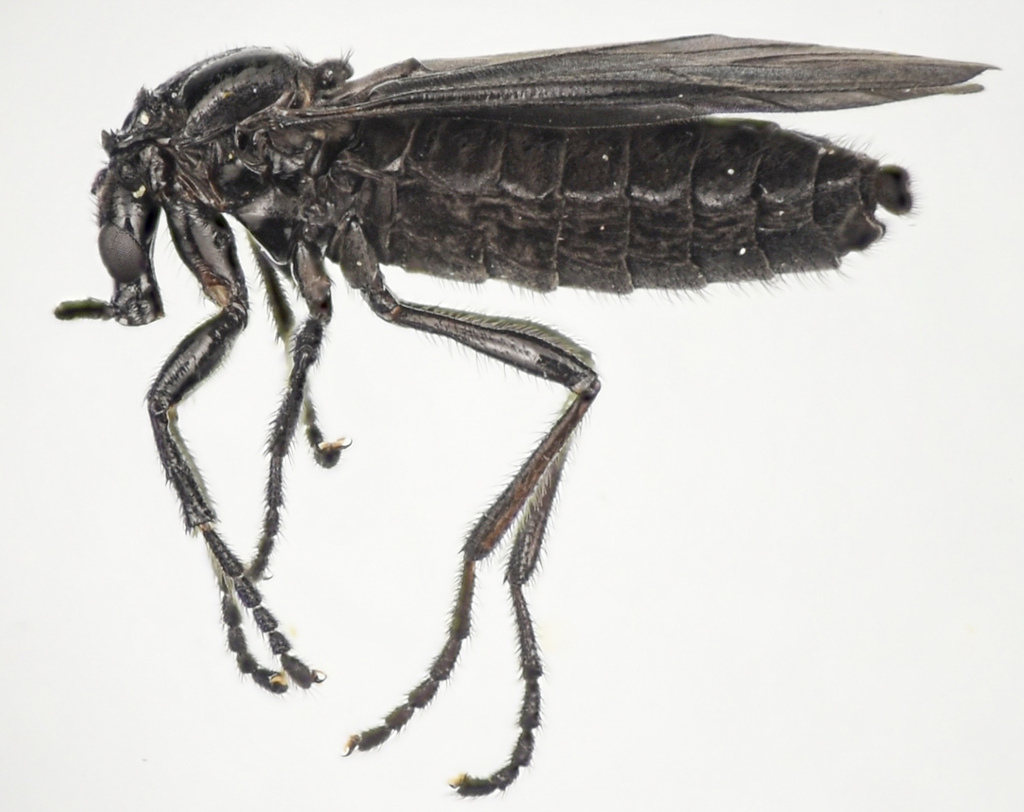
(c) Don Loarie, some rights reserved (CC BY) · licence
Family: Bibionidae · Class: Insecta · Order: Diptera
Dilophus orbatus is a California animal in the Bibionidae family.
Dilophus orbatus is a small fly belonging to the family Bibionidae, commonly known as march flies or love bugs. This species is part of the order Diptera, which encompasses all true flies. Members of the genus Dilophus are characterized by their robust build and distinctive wing venation patterns typical of bibionid flies. The taxonomic placement of D. orbatus within the family Bibionidae indicates it shares morphological characteristics with other march flies, including a relatively short, thick body and prominent compound eyes. Adult bibionids typically measure 5-15 millimeters in length, though specific measurements for D. orbatus have not been well documented in available literature. The family is distinguished by their wing venation pattern, with veins that do not extend to the wing margin in certain areas. The distribution and range of Dilophus orbatus remain poorly documented in current scientific literature. Bibionid flies are generally distributed across temperate regions of North America, with various species occupying different ecological niches from coastal areas to mountainous regions. Without specific collection records or range data for D. orbatus, its precise geographic distribution within California or North America cannot be definitively stated. Habitat preferences for D. orbatus have not been specifically documented, though other Dilophus species typically inhabit areas with rich organic soil where larvae can develop. Bibionid larvae are generally saprophagous, feeding on decaying organic matter in soil and leaf litter. Adults are often found near their larval development sites and may be attracted to flowers for nectar feeding. The life cycle of D. orbatus likely follows the typical bibionid pattern, with complete metamorphosis including egg, larval, pupal, and adult stages. Adult march flies are often observed in spring and early summer months, which corresponds to their common name. Males of many Dilophus species form mating swarms, though specific behavioral observations for D. orbatus are lacking in current literature. Larvae develop in soil environments rich in organic matter, playing a role in decomposition processes. Conservation status information for Dilophus orbatus is not available through standard databases, suggesting it may not be considered threatened or endangered at federal or state levels as of December 2025. The species does not appear on USFWS threatened and endangered species lists or California Department of Fish and Wildlife special status species inventories. However, the lack of recent scientific documentation and ecological studies makes it difficult to assess population trends or conservation needs. Detailed ecological studies of this species are lacking, and much of the biology and distribution remains undocumented. The information presented here is based on general knowledge of the Bibionidae family and genus Dilophus characteristics. Comprehensive field studies would be needed to better understand the specific habitat requirements, distribution, and ecological role of D. orbatus within California's diverse ecosystems.
Classification
Class: Insecta · Order: Diptera · Family: Bibionidae
Frequently asked questions
How is Dilophus orbatus classified?
Dilophus orbatus belongs to class Insecta, order Diptera, family Bibionidae.
What family does Dilophus orbatus belong to?
Dilophus orbatus is in the Bibionidae family.
What is Dilophus orbatus?
Dilophus orbatus is a small fly belonging to the family Bibionidae, commonly known as march flies or love bugs.
Is Dilophus orbatus found in California?
Yes. Dilophus orbatus is recorded in California in The California Species Project's catalogue.
More California species
This species has no close relatives in our California data — here are other species to explore.
Data from The California Species Project — 14,000+ California species with verified data from CNPS, CDFW, USFWS, and more.