Dinacoma caseyi
Casey’s June beetle
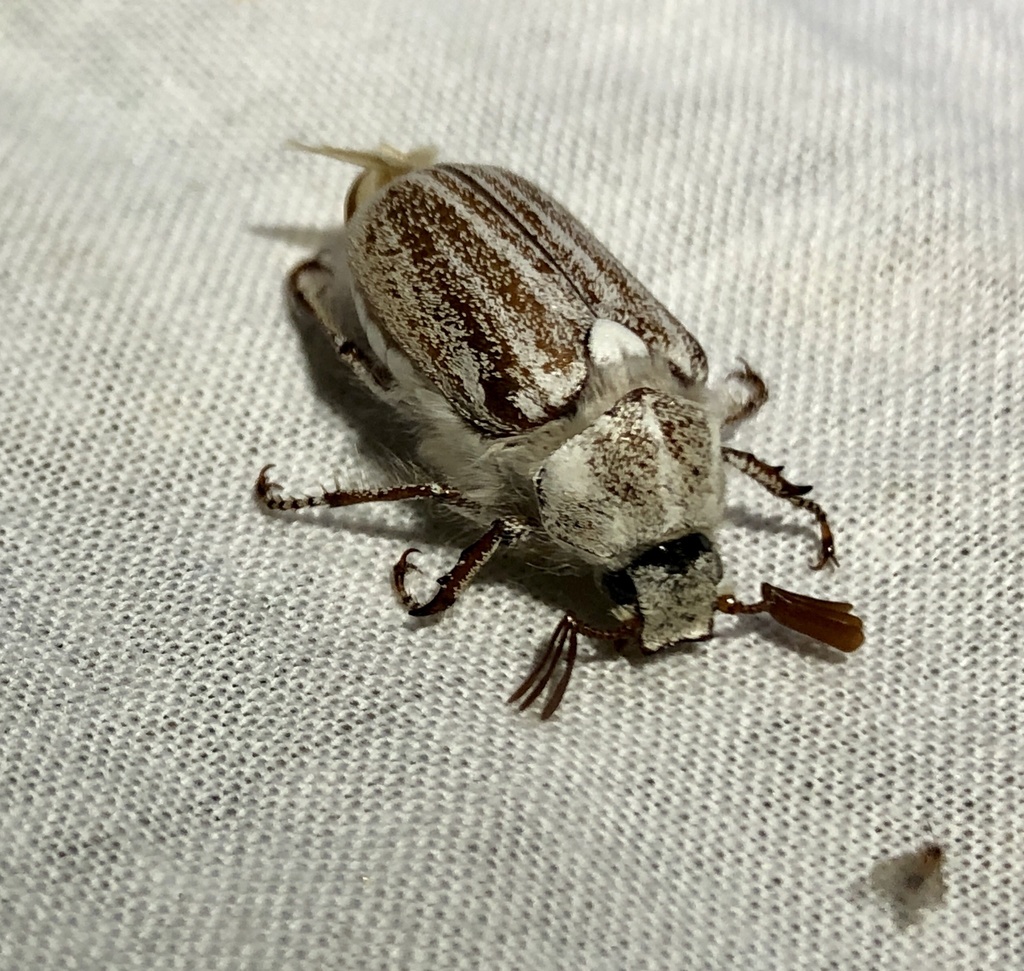
(c) nmoorhatch, some rights reserved (CC BY) · licence
Family: Scarabaeidae · Class: Insecta · Order: Coleoptera
Conservation status: Endangered · G1 S1
Dinacoma caseyi (Casey’s June beetle) is a California animal in the Scarabaeidae family.
Casey's June beetle is a small scarab beetle endemic to a highly restricted area in southern California. Adults measure approximately 8-12 millimeters in length, with females displaying a robust, oval body form and reduced wing covers that render them flightless. Males possess functional wings and are capable of flight, distinguishing them behaviorally from the ground-bound females. The species exhibits sexual dimorphism in mobility, with males observed flying in low, back-and-forth patterns or crawling along the ground in areas where females have been detected. The species has an extremely limited range, occurring only in southern portions of the City of Palm Springs, California. Distribution is primarily associated with Palm Canyon Wash and Tahquitz Creek drainages within this urban environment. This highly restricted range makes the species particularly vulnerable to localized threats and catastrophic events. Casey's June beetle inhabits sandy washes and adjacent areas within the Sonoran Desert ecosystem. The species depends on specific soil conditions that allow for the construction of underground burrows where all life stages except adult emergence occur. Adults require suitable substrate for burrowing, and the species appears closely tied to the alluvial soils found along desert wash systems. The species exhibits a brief annual emergence period, with adults appearing from underground burrows between late March and early June, reaching peak abundance during April and May. After emergence, mating occurs above ground, followed by females returning to existing burrows or excavating new ones for egg deposition. The complete life cycle from egg through larval and pupal stages occurs entirely underground, with development timing likely influenced by soil temperature and moisture conditions. Males demonstrate active mate-seeking behavior through flight and ground movement, while females remain terrestrial throughout their adult lives. Casey's June beetle was listed as federally endangered on October 24, 2011, with critical habitat designated concurrently. The species faces multiple significant threats within its restricted urban environment. Primary threats include habitat destruction and modification from residential and commercial development, soil disturbance from construction activities, and recreational impacts from off-road vehicle use. Additional threats include altered hydrology from flood control measures affecting the natural wash systems, and mortality from artificial light attraction that disrupts normal behavior patterns. The species' extremely small population size and limited range make it vulnerable to stochastic events and genetic bottlenecks. Despite conservation efforts including survey protocols established in 2016 and ongoing research into environmental influences on distribution and abundance, the species continues to face declining trends. A comprehensive study conducted from 2015-2022 examined environmental factors affecting the beetle's distribution and abundance. The U.S. Fish and Wildlife Service manages recovery efforts through the Carlsbad Fish and Wildlife Office, with continued monitoring and habitat protection as primary conservation strategies. The species' persistence depends on maintaining the integrity of remaining wash habitats and minimizing further urban encroachment within its restricted range.
Classification
Class: Insecta · Order: Coleoptera · Family: Scarabaeidae
Conservation status
Endangered · G1 S1
Frequently asked questions
How is Dinacoma caseyi classified?
Dinacoma caseyi belongs to class Insecta, order Coleoptera, family Scarabaeidae.
What family does Dinacoma caseyi belong to?
Dinacoma caseyi is in the Scarabaeidae family.
Is Dinacoma caseyi protected or of conservation concern?
Dinacoma caseyi carries the following status: Endangered · G1 S1.
What is Dinacoma caseyi?
Casey's June beetle is a small scarab beetle endemic to a highly restricted area in southern California.
Is Dinacoma caseyi found in California?
Yes. Dinacoma caseyi is recorded in California in The California Species Project's catalogue.
Related species
Other California species in the same genus, family, or bioregion.
Data from The California Species Project — 14,000+ California species with verified data from CNPS, CDFW, USFWS, and more.