Dioryctria pseudotsugella
Douglas-fir Cone Moth
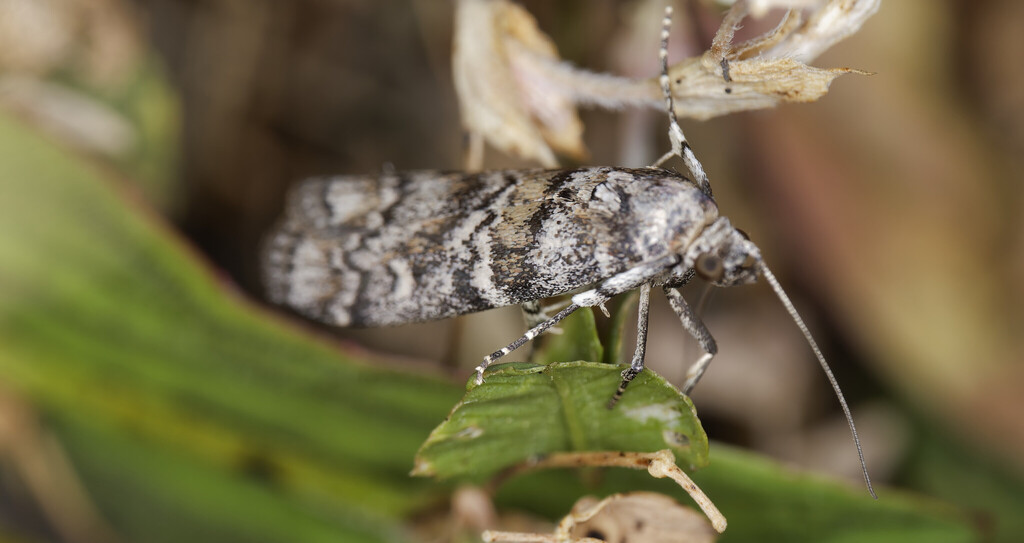
(c) Thierry Arbault, some rights reserved (CC BY) · licence
Family: Pyralidae · Class: Insecta · Order: Lepidoptera
Dioryctria pseudotsugella (Douglas-fir Cone Moth) is a California animal in the Pyralidae family.
The Douglas-fir Cone Moth (Dioryctria pseudotsugella) is a species of snout moth in the family Pyralidae. This moth was first described by Eugene G. Munroe in 1959 and belongs to a genus of coneworm moths that develop within coniferous tree structures (iNaturalist). Adults are small moths typical of the Dioryctria genus, with the characteristic elongated snout (proboscis) that gives snout moths their common name. Mature larvae reach up to 15 millimeters (0.6 inches) in length and have brown heads (Natural Resources Canada). The species exhibits the typical pyralid moth body structure with narrow forewings and broader hindwings. Dioryctria pseudotsugella has a broad western North American distribution, ranging from southern British Columbia and Alberta south through the western United States to New Mexico (iNaturalist). The species occurs throughout forested regions where its host trees are present, including mountainous areas and coniferous forest zones across this range. This species inhabits coniferous forests where Douglas-fir and related species occur. As suggested by its common name, the moth is closely associated with Douglas-fir trees, though specific host plant relationships have not been comprehensively documented in available literature. The species likely occurs across a range of elevations corresponding to the distribution of suitable host trees throughout western montane forests. The larvae of D. pseudotsugella develop as cone borers, feeding within the reproductive structures of their host trees. This feeding behavior is characteristic of many Dioryctria species, which are known as coneworms due to their larval development within cones, shoots, or bark of coniferous trees. The species is described as a "common, occasionally abundant, innocuous solitary defoliator" (Natural Resources Canada), indicating that while populations can become locally numerous, the species does not typically cause significant forest damage. Adults are attracted to artificial lights, as is typical for many nocturnal moth species. The larvae likely overwinter within host tree structures, pupating in spring before adults emerge during the flight season. Specific details regarding generation time, mating behavior, and seasonal phenology have not been well documented in available scientific literature. Dioryctria pseudotsugella does not appear on federal or state conservation lists and is considered a common forest moth throughout its range. The species' association with widespread coniferous forest habitats suggests stable populations across most of its distribution. However, like many forest-dependent insects, long-term population trends may be influenced by forest management practices, climate change effects on host tree distributions, and large-scale forest disturbances such as wildfires and insect outbreaks. Scientific documentation for this species remains limited beyond basic taxonomic and distributional information. The information presented here is based on available sources including government forest insect databases and taxonomic references. If you have additional verified information about this species' biology, distribution, or ecology, please contact us to help improve this species account.
Classification
Class: Insecta · Order: Lepidoptera · Family: Pyralidae
Frequently asked questions
How is Dioryctria pseudotsugella classified?
Dioryctria pseudotsugella belongs to class Insecta, order Lepidoptera, family Pyralidae.
What family does Dioryctria pseudotsugella belong to?
Dioryctria pseudotsugella is in the Pyralidae family.
What is Dioryctria pseudotsugella?
The Douglas-fir Cone Moth (Dioryctria pseudotsugella) is a species of snout moth in the family Pyralidae.
Is Dioryctria pseudotsugella found in California?
Yes. Dioryctria pseudotsugella is recorded in California in The California Species Project's catalogue.
Related species
Other California species in the same genus, family, or bioregion.
Data from The California Species Project — 14,000+ California species with verified data from CNPS, CDFW, USFWS, and more.