Dioryctria westerlandi
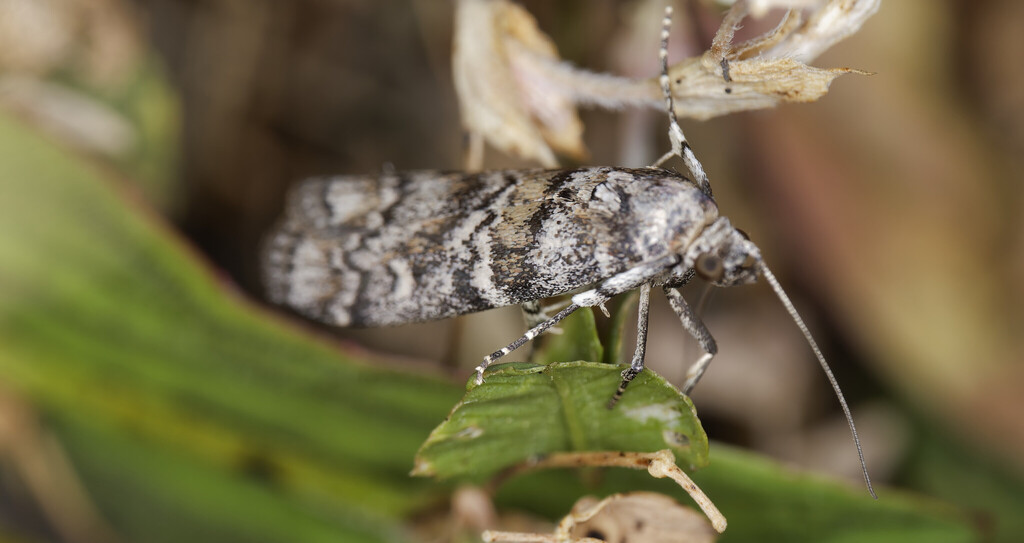
(c) Thierry Arbault, some rights reserved (CC BY) · licence
Family: Pyralidae · Class: Insecta · Order: Lepidoptera
Dioryctria westerlandi is a California animal in the Pyralidae family.
Dioryctria westerlandi is a species of snout moth in the family Pyralidae, subfamily Phycitinae. This moth was described by Julian P. Donahue and Herbert H. Neunzig in 2002 and represents a relatively recent addition to California's documented Lepidoptera fauna (Donahue & Neunzig 2002). The species belongs to a genus of moths whose larvae typically bore into conifer tissues, making them ecologically important in forest ecosystems. The forewing of D. westerlandi displays a distinctive antemedial white line that angles outward from the costal margin, serving as a key diagnostic feature for field identification (Heppner 2023). Like other Dioryctria species, adults are characterized by the elongated snout-like projection of the labial palps that gives snout moths their common name. Specific measurements and detailed coloration patterns for this species have not been extensively documented in the available literature. Dioryctria westerlandi is endemic to California, with its range potentially extending into Nevada (Wikipedia via iNaturalist). The type locality is in Placer County, California. The species occurs in the yellow pine forest plant community of montane California at elevations ranging from 1,600 to 2,286 meters (5,249 to 7,500 feet) (Donahue & Neunzig 2002). This elevational range places the species in the montane coniferous forest zone, where yellow pine (Pinus ponderosa) is a dominant tree species. The moth inhabits yellow pine forest ecosystems, which are characterized by open canopy structure and frequent natural fire regimes. These montane forests typically include ponderosa pine, Douglas fir, incense cedar, and associated understory vegetation. The specific microhabitat requirements and seasonal activity patterns of D. westerlandi have not been well documented in the scientific literature. As with other Dioryctria species, the larvae are presumed to be wood borers that feed within conifer tissues, though the specific host plants and larval ecology of D. westerlandi remain poorly studied. Adult flight periods, mating behaviors, and reproductive biology have not been detailed in available sources. The ecological role of this species within montane forest ecosystems likely involves nutrient cycling through decomposition processes associated with larval boring activities. Dioryctria westerlandi does not appear on federal or state conservation lists, and its conservation status has not been formally assessed. Given its recent description in 2002 and limited documentation, the species may be naturally rare or simply under-surveyed. The restriction to montane forest habitats at specific elevations could make populations vulnerable to climate change impacts, as warming temperatures may shift suitable habitat to higher elevations. Forest management practices and wildfire patterns in the Sierra Nevada region may also influence population dynamics, though specific threats have not been identified. Scientific documentation for this species remains limited. The information presented here is based on available taxonomic and ecological sources. If you have additional verified information about this species' biology, distribution, or ecology, please contact us to help improve this species account.
Classification
Class: Insecta · Order: Lepidoptera · Family: Pyralidae
Frequently asked questions
How is Dioryctria westerlandi classified?
Dioryctria westerlandi belongs to class Insecta, order Lepidoptera, family Pyralidae.
What family does Dioryctria westerlandi belong to?
Dioryctria westerlandi is in the Pyralidae family.
What is Dioryctria westerlandi?
Dioryctria westerlandi is a species of snout moth in the family Pyralidae, subfamily Phycitinae.
Is Dioryctria westerlandi found in California?
Yes. Dioryctria westerlandi is recorded in California in The California Species Project's catalogue.
Related species
Other California species in the same genus, family, or bioregion.
Data from The California Species Project — 14,000+ California species with verified data from CNPS, CDFW, USFWS, and more.