Diplolepis rosae
Mossy Rose Gall Wasp
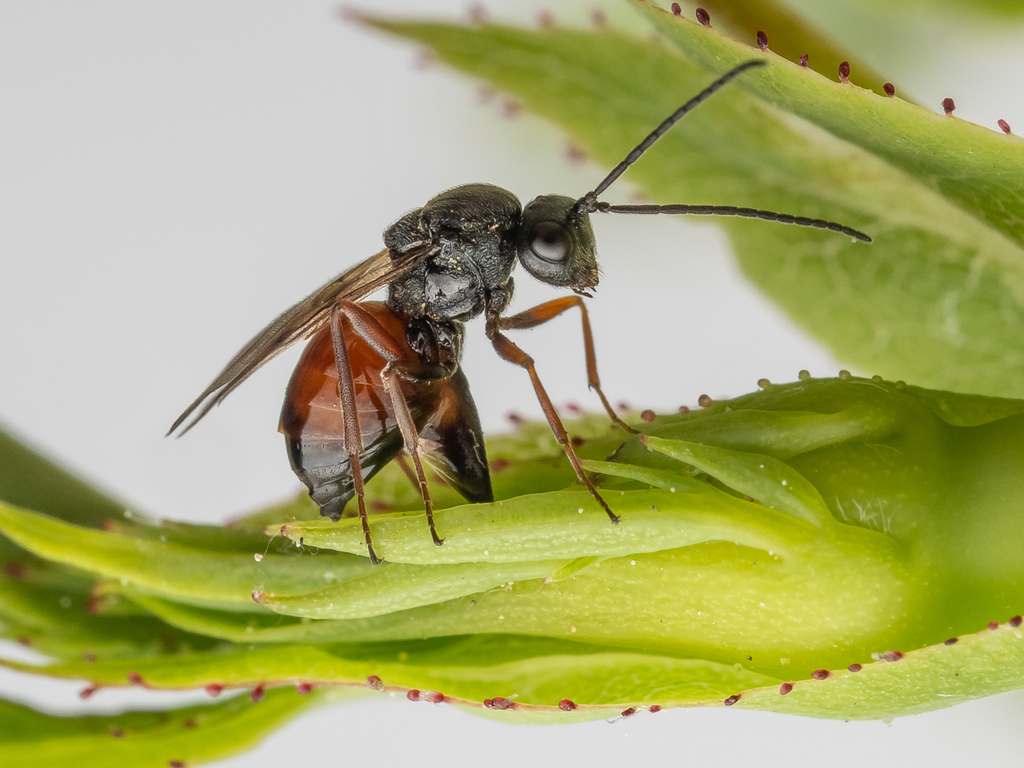
(c) Piotr Lukasik, some rights reserved (CC BY) · licence
Family: Cynipidae · Class: Insecta · Order: Hymenoptera
Diplolepis rosae (Mossy Rose Gall Wasp) is a California animal in the Cynipidae family.
The Mossy Rose Gall Wasp (Diplolepis rosae) is a small cynipid wasp native to Europe and Asia that has been introduced to North America. Adult wasps are typically 3-4 mm in length with a dark brown to black body. Females are parthenogenetic, reproducing without mating, and possess a long ovipositor for egg laying. The species is most readily identified by the distinctive galls it creates rather than by the adult wasps themselves. Diplolepis rosae has established populations across much of North America following its introduction from the Old World. The species is now found throughout the northern United States and southern Canada, with populations documented in California and other western states. Its distribution closely follows that of its primary host plants, wild roses in the genus Rosa. The species primarily inhabits areas where wild roses grow, including forest edges, riparian zones, disturbed sites, and urban landscapes. In California, it is associated with native rose species as well as naturalized European roses. The wasps are most commonly found at elevations below 2,000 meters where suitable host plants occur. They show particular preference for Rosa canina (dog rose) and Rosa arvensis (field rose), though they can utilize various Rosa species. Female wasps emerge in late spring and locate unopened rose buds, typically terminal or axillary buds, where they insert their eggs using their specialized ovipositor. The developing larvae chemically induce the formation of the characteristic mossy rose gall, also known as bedeguar gall or Robin's pincushion gall. These galls appear as large, spherical, moss-like growths covered in dense, branching filaments that can reach 5-7 cm in diameter. Each gall may contain 20-60 larval chambers. The larvae develop within the gall throughout summer and autumn, overwintering inside the structure before emerging as adults the following spring (NatureSpot). The galls provide protection from predators and environmental conditions while the larvae feed on nutritious gall tissue. As a non-native species, Diplolepis rosae is not subject to conservation protections in North America. The species appears to be well-established and expanding its range as suitable host plants are available. While the galls can affect the aesthetic appearance of roses and may impact plant vigor when numerous, the wasp is generally not considered a significant pest species. The conspicuous galls it produces have made it a subject of ecological research, particularly regarding gall formation mechanisms and host-parasite relationships. Climate change and habitat modification may influence its future distribution, as the species' range is closely tied to the availability of wild rose populations.
Classification
Class: Insecta · Order: Hymenoptera · Family: Cynipidae
Frequently asked questions
How is Diplolepis rosae classified?
Diplolepis rosae belongs to class Insecta, order Hymenoptera, family Cynipidae.
What family does Diplolepis rosae belong to?
Diplolepis rosae is in the Cynipidae family.
What is Diplolepis rosae?
The Mossy Rose Gall Wasp (Diplolepis rosae) is a small cynipid wasp native to Europe and Asia that has been introduced to North America.
Is Diplolepis rosae found in California?
Yes. Diplolepis rosae is recorded in California in The California Species Project's catalogue.
Related species
Other California species in the same genus, family, or bioregion.
Data from The California Species Project — 14,000+ California species with verified data from CNPS, CDFW, USFWS, and more.