Dipodomys agilis
Agile Kangaroo Rat
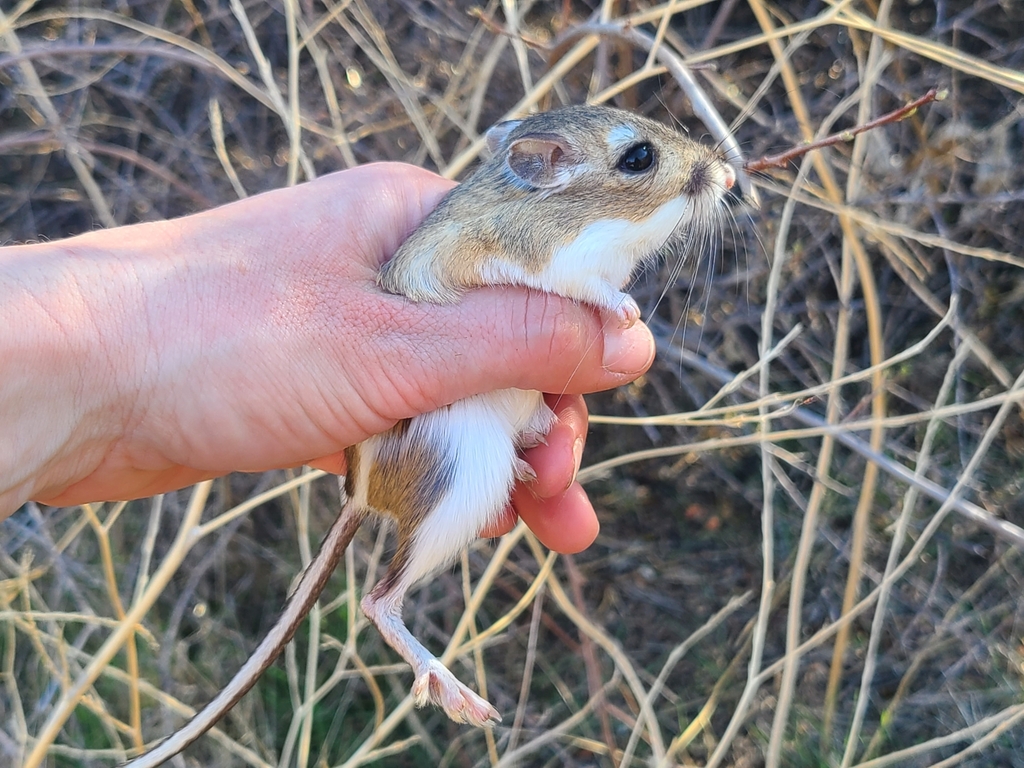
(c) Cristhian Mace, some rights reserved (CC BY) · licence
Family: Heteromyidae · Class: Mammalia · Order: Rodentia
Dipodomys agilis (Agile Kangaroo Rat) is a California animal in the Heteromyidae family.
The agile kangaroo rat (Dipodomys agilis) is a medium-sized heteromyid rodent endemic to southern California and Baja California, Mexico. Adults measure 240 to 310 mm (9.4 to 12.2 inches) in total length, with the tail comprising approximately 60% of this length. Body weight ranges from 60 to 85 grams (2.1 to 3.0 ounces). The pelage is buff to pale cinnamon above with a distinct dark dorsal stripe extending from the head to the base of the tail. The underparts are white to pale buff. The long tail is bicolored with a dark dorsal stripe and white ventral surface, terminating in a prominent white-tipped tuft. The hind feet are notably large, measuring 35 to 44 mm, and are adapted for saltatorial locomotion. Four toes are present on each hind foot, with the middle toes being longest. Historically, the agile kangaroo rat occurred throughout the coastal and inland areas of southern California from Ventura County south to San Diego County, extending into Baja California. The species currently persists in fragmented populations across this range, with documented occurrences in Ventura, Los Angeles, Orange, Riverside, and San Diego counties. Populations have been extirpated from much of the coastal plain and urbanized areas. The species inhabits chaparral, coastal sage scrub, and oak woodland communities, typically at elevations from sea level to 1,500 meters (4,921 feet). Agile kangaroo rats prefer areas with moderate to steep slopes and well-drained soils suitable for burrow construction. They are often associated with shrublands dominated by chamise, manzanita, scrub oak, and coastal sage species. Burrow systems are constructed in sandy or loamy soils and may extend 1 to 2 meters underground with multiple entrances. Agile kangaroo rats are nocturnal and solitary, emerging from burrows after sunset to forage. The diet consists primarily of small seeds from shrubs and forbs, which are collected in specialized cheek pouches and cached in underground granaries. Water requirements are met entirely through metabolic water production from seed consumption. Breeding occurs from February through May, with females producing one to two litters annually. Gestation lasts approximately 30 days, and litter size ranges from two to five young. Sexual maturity is reached at 10 to 12 weeks of age. The agile kangaroo rat is not federally listed but faces significant conservation challenges. According to NatureServe, the species is considered vulnerable to imperiled due to habitat loss and fragmentation. Primary threats include urban development, agriculture, invasive plant species, and altered fire regimes. Coastal populations have experienced the most severe declines due to development pressure. Several remaining populations occur on protected lands including Santa Monica Mountains National Recreation Area and various state parks. Conservation efforts focus on habitat restoration, invasive species control, and maintaining connectivity between fragmented populations through wildlife corridors.
Classification
Class: Mammalia · Order: Rodentia · Family: Heteromyidae
Frequently asked questions
How is Dipodomys agilis classified?
Dipodomys agilis belongs to class Mammalia, order Rodentia, family Heteromyidae.
What family does Dipodomys agilis belong to?
Dipodomys agilis is in the Heteromyidae family.
What is Dipodomys agilis?
The agile kangaroo rat (Dipodomys agilis) is a medium-sized heteromyid rodent endemic to southern California and Baja California, Mexico.
Is Dipodomys agilis found in California?
Yes. Dipodomys agilis is recorded in California in The California Species Project's catalogue.
Related species
Other California species in the same genus, family, or bioregion.
Data from The California Species Project — 14,000+ California species with verified data from CNPS, CDFW, USFWS, and more.