Dipodomys californicus eximius
Marysville California Kangaroo Rat
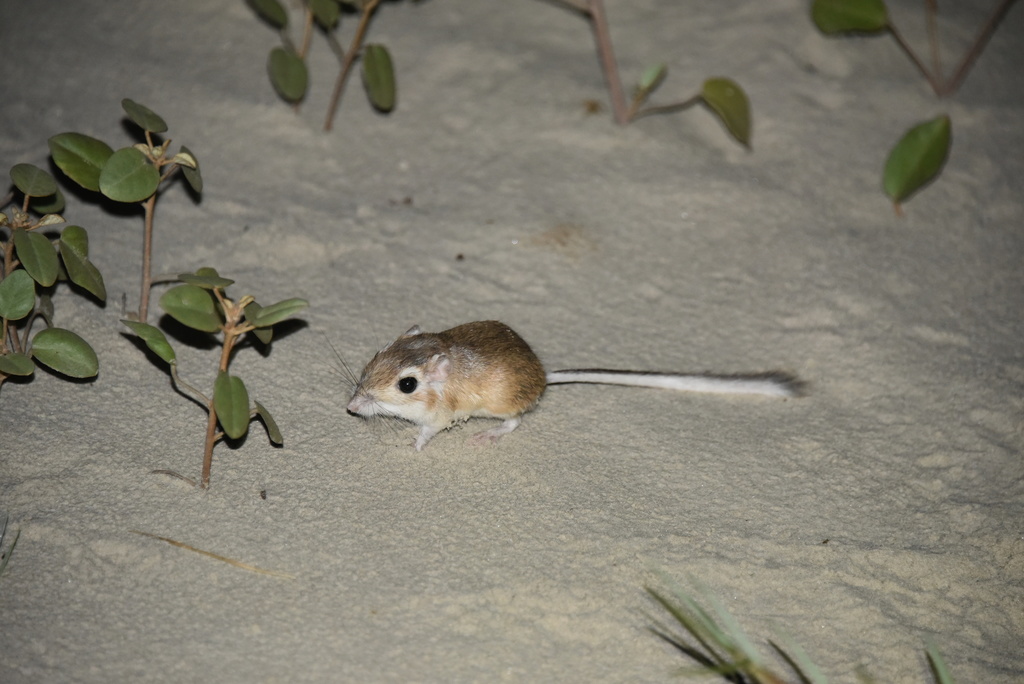
(c) Cody Stricker, some rights reserved (CC BY) · licence
Family: Heteromyidae · Class: Mammalia · Order: Rodentia
Conservation status: G4T1 S1
Dipodomys californicus eximius (Marysville California Kangaroo Rat) is a California animal in the Heteromyidae family.
The Marysville California kangaroo rat (Dipodomys californicus eximius) is a subspecies of the California kangaroo rat, characterized by the typical heteromyid body plan of enlarged hind limbs, small forelimbs, and an elongated tail with a terminal tuft. Adults measure approximately 240 to 320 mm in total length, with the tail comprising roughly 60 percent of this measurement. The pelage is buff to cinnamon-brown dorsally with white ventral surfaces, and the species exhibits the characteristic four-toed hind feet with long, densely furred soles adapted for saltatory locomotion on sandy substrates. Historically, this subspecies was endemic to a small area in the Sacramento Valley near Marysville in Yuba County, California. The range was extremely limited, occurring in grassland and oak woodland habitats at elevations below 200 meters. The subspecies was confined to areas with deep, well-drained sandy soils characteristic of ancient alluvial deposits along the Yuba and Feather rivers. The Marysville California kangaroo rat inhabited annual grasslands dominated by introduced Mediterranean grasses, with scattered valley oak (Quercus lobata) and blue oak (Quercus douglasii). The species required areas with loose, sandy soils for burrow construction, typically avoiding clay hardpan and poorly drained sites. Burrow systems served multiple functions including predator avoidance, food storage, and thermoregulation during extreme temperatures. Like other kangaroo rats, this subspecies was primarily granivorous, collecting and caching seeds from grasses and forbs in specialized cheek pouches. The diet likely included seeds from both native and introduced plant species, with foraging occurring primarily during nighttime hours to avoid predation and reduce water loss. Reproduction followed the typical heteromyid pattern, with breeding occurring from late winter through early summer. Females produced litters of two to five young after a gestation period of approximately 30 days. The Marysville California kangaroo rat carries a global rank of G4T1 and state rank of S1, indicating it is critically imperiled. The subspecies has not been observed since the early 20th century and is presumed extinct. Habitat loss due to agricultural conversion, urban development, and flood control projects eliminated virtually all suitable habitat within its limited range. The construction of levees and conversion of native grasslands to irrigated agriculture removed the deep sandy soils and native plant communities essential for the subspecies' survival. Despite intensive surveys conducted in potential habitat remnants, no populations have been documented in recent decades. The apparent extinction of the Marysville California kangaroo rat represents the loss of a unique evolutionary lineage adapted to the specific environmental conditions of the northern Sacramento Valley. This case illustrates the vulnerability of taxa with extremely restricted distributions to rapid habitat modification in California's Central Valley, where over 95 percent of native grassland habitat has been converted to other land uses.
Classification
Class: Mammalia · Order: Rodentia · Family: Heteromyidae
Conservation status
G4T1 S1
Frequently asked questions
How is Dipodomys californicus eximius classified?
Dipodomys californicus eximius belongs to class Mammalia, order Rodentia, family Heteromyidae.
What family does Dipodomys californicus eximius belong to?
Dipodomys californicus eximius is in the Heteromyidae family.
Is Dipodomys californicus eximius protected or of conservation concern?
Dipodomys californicus eximius carries the following status: G4T1 S1.
What is Dipodomys californicus eximius?
The Marysville California kangaroo rat (Dipodomys californicus eximius) is a subspecies of the California kangaroo rat, characterized by the typical heteromyid body plan of enlarged hind limbs, small forelimbs, and an elongated tail with a terminal tuft.
Is Dipodomys californicus eximius found in California?
Yes. Dipodomys californicus eximius is recorded in California in The California Species Project's catalogue.
Related species
Other California species in the same genus, family, or bioregion.
Data from The California Species Project — 14,000+ California species with verified data from CNPS, CDFW, USFWS, and more.