Dipodomys deserti
Desert Kangaroo Rat
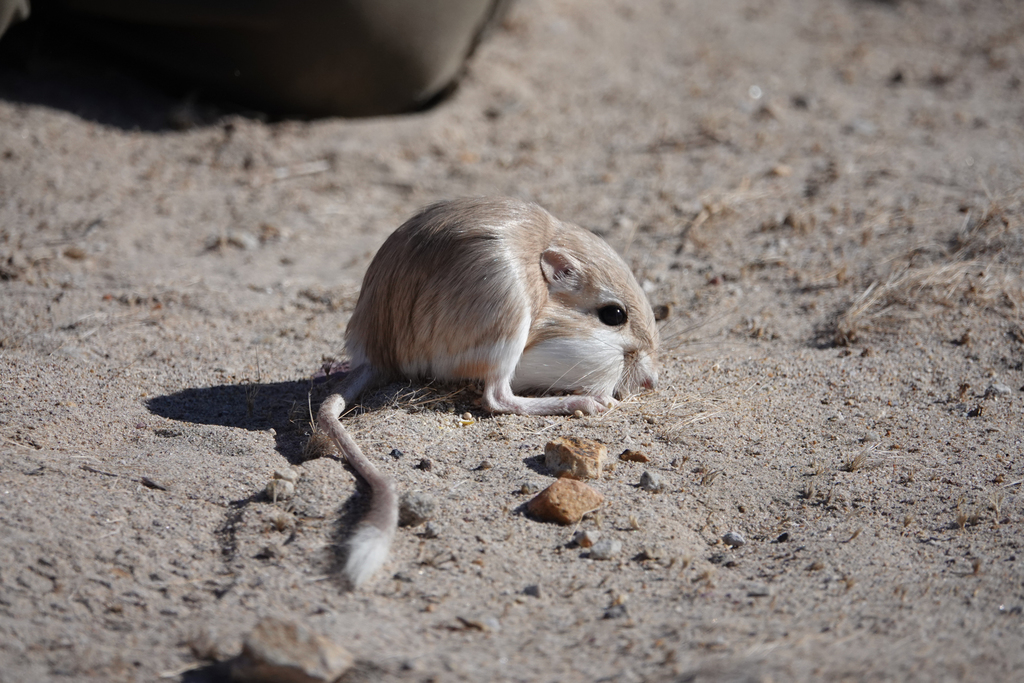
no rights reserved · CC0
Family: Heteromyidae · Class: Mammalia · Order: Rodentia
Dipodomys deserti (Desert Kangaroo Rat) is a California animal in the Heteromyidae family.
The desert kangaroo rat is a medium-sized heteromyid rodent endemic to the southwestern United States and northwestern Mexico. Adults measure 100-140 mm (3.9-5.5 inches) in head-body length, with the distinctive tail adding another 125-172 mm (4.9-6.8 inches). Total weight ranges from 70-140 grams (2.5-4.9 ounces). The species exhibits the characteristic kangaroo rat morphology with enlarged hind limbs, reduced forelimbs, and an elongated tail terminating in a dark tuft. The dorsal pelage is pale buff to sandy brown, providing camouflage against desert substrates, while the ventral surface is white. A distinctive white hip stripe extends from the flanks to the base of the tail. The large eyes and external auditory bullae reflect adaptations for nocturnal activity in open desert environments. In California, Dipodomys deserti occurs primarily in the southeastern desert regions, including the Mojave and Sonoran deserts. The species ranges through Imperial, Riverside, and San Bernardino counties, with populations documented in areas such as the Coachella Valley, Imperial Valley, and eastern Mojave Desert. The California range represents the northwestern limit of the species' distribution, which extends eastward through Arizona and southward into Baja California and Sonora, Mexico. Desert kangaroo rats inhabit low desert scrub communities, typically below 400 meters (1,312 feet) elevation. The species shows strong preference for sandy or gravelly soils that facilitate burrow construction, often in association with desert wash systems and alluvial fans. Vegetation communities include creosote bush scrub, saltbush scrub, and desert ironwood associations. Burrow systems are complex, extending 1-3 meters deep with multiple entrances and specialized chambers for food storage, nesting, and waste disposal. This species exhibits highly specialized physiological and behavioral adaptations to arid environments. Desert kangaroo rats are primarily granivorous, collecting and caching seeds from shrubs and forbs including creosote bush, bursage, and various annual plants. The species can survive without free water, deriving moisture entirely from metabolic processes and seed consumption. Individuals are strictly nocturnal and solitary, with activity patterns synchronized to avoid extreme temperatures. Breeding occurs from February through August, with females producing 1-3 litters annually. Litter size ranges from 1-5 young, with an average of 2-3 offspring per litter. Gestation lasts approximately 32 days. The desert kangaroo rat is not federally listed and maintains stable populations across most of its range as of December 2025. However, habitat loss from urban development, agriculture, and renewable energy projects poses ongoing threats, particularly in rapidly developing areas of southern California. The species' specialized habitat requirements and limited dispersal ability make populations vulnerable to fragmentation. Climate change may alter precipitation patterns and vegetation communities, potentially affecting food resources and suitable habitat availability.
Classification
Class: Mammalia · Order: Rodentia · Family: Heteromyidae
Frequently asked questions
How is Dipodomys deserti classified?
Dipodomys deserti belongs to class Mammalia, order Rodentia, family Heteromyidae.
What family does Dipodomys deserti belong to?
Dipodomys deserti is in the Heteromyidae family.
What is Dipodomys deserti?
The desert kangaroo rat is a medium-sized heteromyid rodent endemic to the southwestern United States and northwestern Mexico.
Is Dipodomys deserti found in California?
Yes. Dipodomys deserti is recorded in California in The California Species Project's catalogue.
Related species
Other California species in the same genus, family, or bioregion.
Data from The California Species Project — 14,000+ California species with verified data from CNPS, CDFW, USFWS, and more.