Dipodomys heermanni arenae
Lompoc Kangaroo Rat
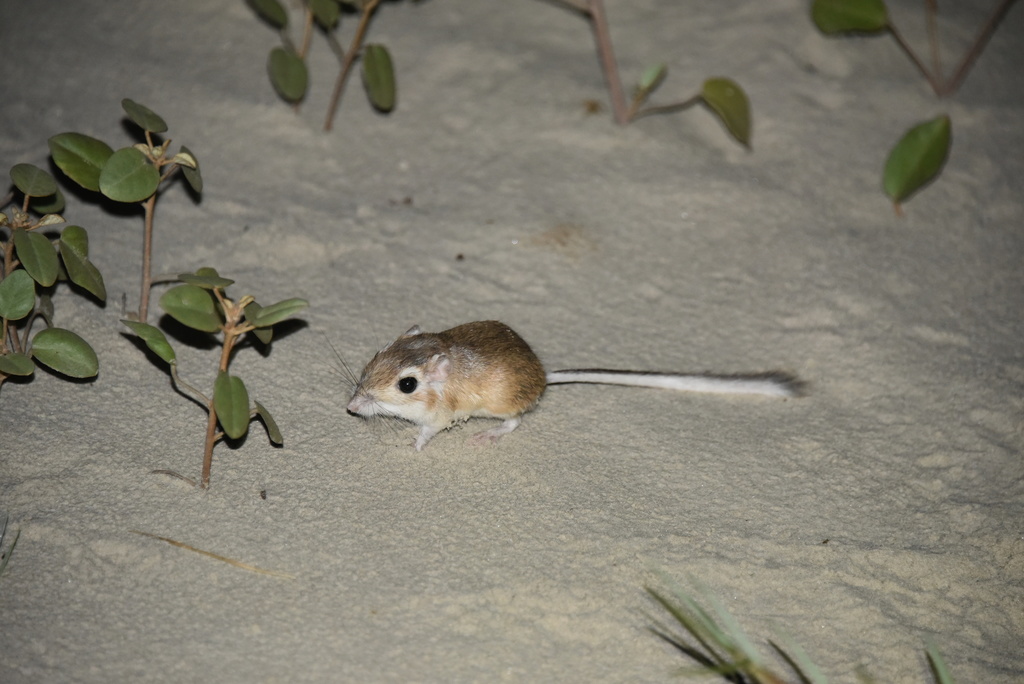
(c) Cody Stricker, some rights reserved (CC BY) · licence
Family: Heteromyidae · Class: Mammalia · Order: Rodentia
Conservation status: G4T1T2 S1S2
Dipodomys heermanni arenae (Lompoc Kangaroo Rat) is a California animal in the Heteromyidae family.
The Lompoc kangaroo rat (Dipodomys heermanni arenae) is a subspecies of Heermann's kangaroo rat endemic to the coastal sand dunes of central California. This medium-sized heteromyid rodent typically measures 220-280 mm (8.7-11 inches) in total length, with a distinctively long tail that exceeds body length and terminates in a tufted tip. The pelage is buff to pale brownish dorsally with white underparts and a distinct white lateral stripe extending from the nose to the hip. The large hind feet, measuring up to 45 mm (1.8 inches), are adapted for saltatory locomotion across loose sand substrates. Historically, the Lompoc kangaroo rat occupied coastal sand dune systems from Point Sal south to Point Conception in Santa Barbara County, California. The subspecies was closely associated with the extensive Guadalupe-Nipomo Dunes Complex, which encompasses approximately 20,000 acres of coastal dune habitat. Current populations are restricted to remnant dune areas within this historical range, with documented occurrences at the Guadalupe-Nipomo Dunes National Wildlife Refuge and adjacent protected areas. This subspecies inhabits stabilized and semi-stabilized coastal sand dunes dominated by native vegetation including beach bur (Ambrosia chamissonis), mock heather (Ericameria ericoides), and various coastal shrub species. The kangaroo rat constructs extensive burrow systems in areas with adequate sand depth and vegetation cover, typically avoiding actively shifting dunes and areas with dense shrub canopy. Elevation ranges from sea level to approximately 150 meters (500 feet) above sea level. Lompoc kangaroo rats are primarily granivorous, collecting and caching seeds from grasses, forbs, and shrubs in specialized cheek pouches. They exhibit classic heteromyid water conservation adaptations, obtaining metabolic water from seed consumption and producing highly concentrated urine. The species is nocturnal and largely solitary outside of breeding season. Reproduction occurs primarily from February through August, with females producing 1-3 litters annually of 2-5 young each. Gestation lasts approximately 30 days, and young reach sexual maturity at 2-3 months of age. The subspecies carries a Global/State rank of G4T1T2 S1S2, indicating critically imperiled status in California. Population declines result from extensive habitat loss due to urban development, agricultural conversion, recreational activities, and invasive plant species establishment within coastal dune ecosystems. European beachgrass (Ammophila arenaria) and other non-native vegetation have altered dune structure and native plant communities essential for the subspecies' survival. The Guadalupe-Nipomo Dunes National Wildlife Refuge, established in 2000, provides protected habitat and management for recovery efforts. Conservation actions include invasive species control, native vegetation restoration, and habitat connectivity enhancement. Current population estimates and detailed distribution data remain limited, highlighting the need for comprehensive surveys and long-term monitoring to assess subspecies status and inform management decisions.
Classification
Class: Mammalia · Order: Rodentia · Family: Heteromyidae
Conservation status
G4T1T2 S1S2
Frequently asked questions
How is Dipodomys heermanni arenae classified?
Dipodomys heermanni arenae belongs to class Mammalia, order Rodentia, family Heteromyidae.
What family does Dipodomys heermanni arenae belong to?
Dipodomys heermanni arenae is in the Heteromyidae family.
Is Dipodomys heermanni arenae protected or of conservation concern?
Dipodomys heermanni arenae carries the following status: G4T1T2 S1S2.
What is Dipodomys heermanni arenae?
The Lompoc kangaroo rat (Dipodomys heermanni arenae) is a subspecies of Heermann's kangaroo rat endemic to the coastal sand dunes of central California.
Is Dipodomys heermanni arenae found in California?
Yes. Dipodomys heermanni arenae is recorded in California in The California Species Project's catalogue.
Related species
Other California species in the same genus, family, or bioregion.
Data from The California Species Project — 14,000+ California species with verified data from CNPS, CDFW, USFWS, and more.