Dipodomys heermanni dixoni
Merced Kangaroo Rat
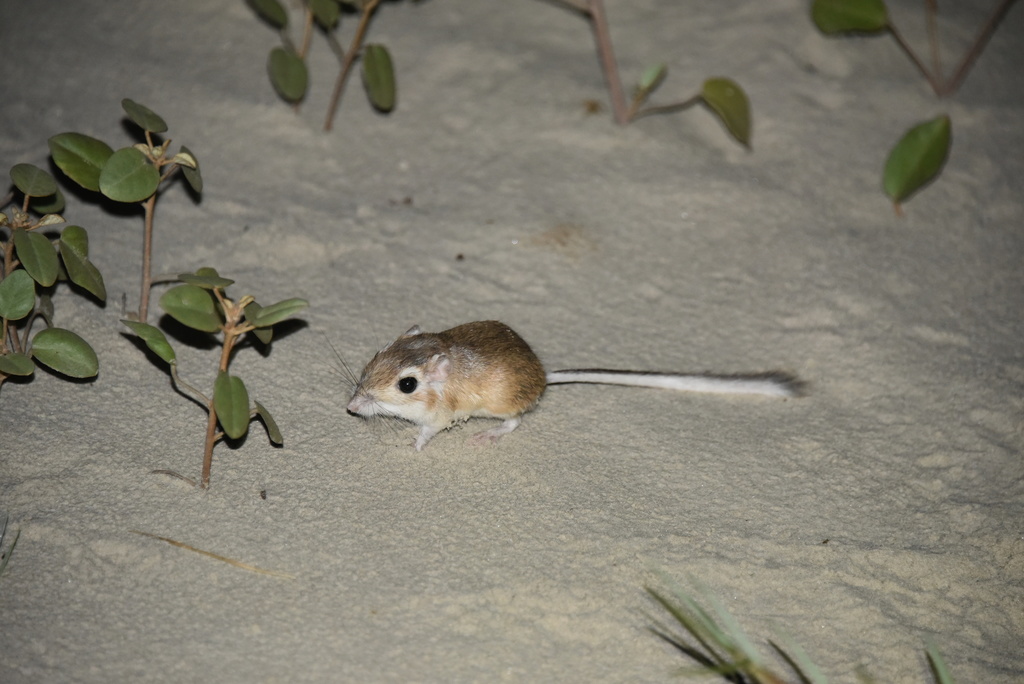
(c) Cody Stricker, some rights reserved (CC BY) · licence
Family: Heteromyidae · Class: Mammalia · Order: Rodentia
Conservation status: G4T2 S2
Dipodomys heermanni dixoni (Merced Kangaroo Rat) is a California animal in the Heteromyidae family.
The Merced kangaroo rat is a subspecies of Heermann's kangaroo rat endemic to California's Central Valley. This medium-sized rodent measures approximately 240-280 mm (9.4-11.0 inches) in total length, with the distinctive long tail accounting for roughly 60% of total body length. The species exhibits the characteristic kangaroo rat morphology with enlarged hind limbs adapted for bipedal locomotion, large eyes, and oversized external ear pinnae. The pelage is typically buff to sandy brown dorsally with white ventral surfaces and a distinct white hip stripe. Historically, the Merced kangaroo rat occurred throughout the grasslands of the central San Joaquin Valley, primarily in Merced County and adjacent areas of Stanislaus and San Joaquin counties. The subspecies' range has contracted significantly from its historical distribution, with current populations fragmented into small, isolated colonies. The species is closely associated with the San Luis National Wildlife Refuge Complex and surrounding grassland areas, which represent some of the largest remaining blocks of suitable habitat in the region. The Merced kangaroo rat inhabits annual grassland and alkali meadow communities on level to gently rolling terrain. These areas are characterized by sparse to moderate vegetation cover, allowing for the construction of extensive burrow systems in friable soils. The species typically occurs at elevations below 300 meters (980 feet) and shows a preference for areas with scattered shrubs and forbs interspersed within the grassland matrix. Soil type appears to be an important habitat factor, with the subspecies favoring sandy or sandy-loam substrates that facilitate burrow excavation. As a primarily granivorous species, the Merced kangaroo rat feeds on seeds from annual grasses and forbs, with diet varying seasonally based on seed availability. The species exhibits typical kangaroo rat behavioral adaptations including bipedal locomotion for predator avoidance and highly efficient kidney function that allows survival without drinking free water. Individuals are strictly nocturnal and solitary except during breeding season. Reproduction typically occurs from February through May, with females producing one to two litters annually containing two to five young per litter. The species constructs complex burrow systems with multiple entrances, storage chambers, and nesting areas. The Merced kangaroo rat is designated as G4T2 S2, indicating it is globally secure as a species but imperiled as a subspecies both globally and within California. While not federally listed, the subspecies faces significant conservation challenges from habitat loss and fragmentation due to agricultural conversion, urban development, and altered hydrology in the Central Valley. The remaining population is estimated to be extremely small and continues to decline. Primary threats include continued habitat conversion, invasive plant species that alter grassland structure, and potential impacts from climate change. Conservation efforts focus on habitat protection and management within the San Luis National Wildlife Refuge Complex and coordination with private landowners to maintain suitable grassland conditions.
Classification
Class: Mammalia · Order: Rodentia · Family: Heteromyidae
Conservation status
G4T2 S2
Frequently asked questions
How is Dipodomys heermanni dixoni classified?
Dipodomys heermanni dixoni belongs to class Mammalia, order Rodentia, family Heteromyidae.
What family does Dipodomys heermanni dixoni belong to?
Dipodomys heermanni dixoni is in the Heteromyidae family.
Is Dipodomys heermanni dixoni protected or of conservation concern?
Dipodomys heermanni dixoni carries the following status: G4T2 S2.
What is Dipodomys heermanni dixoni?
The Merced kangaroo rat is a subspecies of Heermann's kangaroo rat endemic to California's Central Valley.
Is Dipodomys heermanni dixoni found in California?
Yes. Dipodomys heermanni dixoni is recorded in California in The California Species Project's catalogue.
Related species
Other California species in the same genus, family, or bioregion.
Data from The California Species Project — 14,000+ California species with verified data from CNPS, CDFW, USFWS, and more.