Dipodomys heermanni goldmani
Salinas Kangaroo Rat
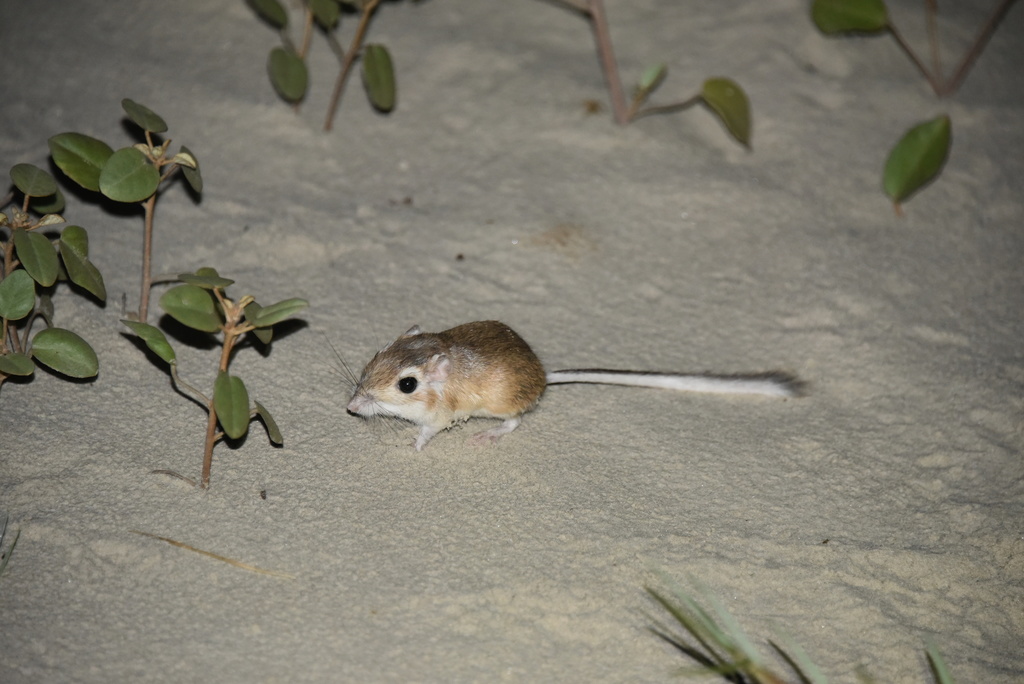
(c) Cody Stricker, some rights reserved (CC BY) · licence
Family: Heteromyidae · Class: Mammalia · Order: Rodentia
Conservation status: G4T2T3 S2S3
Dipodomys heermanni goldmani (Salinas Kangaroo Rat) is a California animal in the Heteromyidae family.
The Salinas kangaroo rat (Dipodomys heermanni goldmani) is a subspecies of Heermann's kangaroo rat endemic to central California's coastal regions. This medium-sized heteromyid rodent typically measures 240-310 mm in total length, with the distinctive long tail accounting for approximately 60% of total body length. The pelage is pale buff to grayish-brown dorsally with white underparts, and the tail displays the characteristic dark dorsal and ventral stripes with white lateral bands and a prominent white tuft at the tip. Large hind feet and relatively small forelimbs reflect adaptations for bipedal locomotion and seed gathering. Historically, the Salinas kangaroo rat occurred throughout the Salinas Valley and adjacent coastal areas of Monterey and San Benito counties. Current distribution is severely fragmented, with populations restricted to isolated patches of suitable habitat. The subspecies has been extirpated from much of its former range due to agricultural conversion and urban development. Remaining populations are concentrated in scattered locations within the Salinas Valley, with some occurrences documented in the Panoche Valley region of San Benito County. The species inhabits annual grasslands, oak savannas, and scrubland communities, typically on sandy or gravelly soils that facilitate burrow construction. Preferred elevations range from sea level to approximately 1,000 feet. Habitat requirements include areas with sufficient shrub cover for protection and open spaces for foraging. The subspecies shows particular association with native perennial grasslands and oak woodland edges, though it can persist in some modified agricultural landscapes with appropriate vegetation structure. Salinas kangaroo rats are primarily granivorous, collecting and caching seeds from grasses, forbs, and shrubs. Foraging occurs nocturnally, with individuals creating extensive burrow systems that include multiple entrances, food storage chambers, and nesting areas. Breeding typically occurs from February through May, coinciding with peak seed availability. Females produce one to two litters annually, with litter sizes averaging two to four young. The species exhibits territorial behavior, with individuals defending core areas around their burrow systems. The Salinas kangaroo rat carries a global rank of G4T2T3 and state rank of S2S3, indicating moderate concern for the subspecies' conservation status (CDFW 2024). While not federally listed, the subspecies faces significant threats from habitat loss and fragmentation. Primary conservation challenges include conversion of native grasslands to intensive agriculture, urban development, and invasion by non-native plant species that alter habitat structure. Remaining populations are small and isolated, making them vulnerable to local extinctions from stochastic events. Climate change may exacerbate these threats by altering precipitation patterns and native plant communities. Conservation efforts focus on habitat protection and restoration within the subspecies' remaining range, though comprehensive population monitoring and management strategies are needed to ensure long-term viability.
Classification
Class: Mammalia · Order: Rodentia · Family: Heteromyidae
Conservation status
G4T2T3 S2S3
Frequently asked questions
How is Dipodomys heermanni goldmani classified?
Dipodomys heermanni goldmani belongs to class Mammalia, order Rodentia, family Heteromyidae.
What family does Dipodomys heermanni goldmani belong to?
Dipodomys heermanni goldmani is in the Heteromyidae family.
Is Dipodomys heermanni goldmani protected or of conservation concern?
Dipodomys heermanni goldmani carries the following status: G4T2T3 S2S3.
What is Dipodomys heermanni goldmani?
The Salinas kangaroo rat (Dipodomys heermanni goldmani) is a subspecies of Heermann's kangaroo rat endemic to central California's coastal regions.
Is Dipodomys heermanni goldmani found in California?
Yes. Dipodomys heermanni goldmani is recorded in California in The California Species Project's catalogue.
Related species
Other California species in the same genus, family, or bioregion.
Data from The California Species Project — 14,000+ California species with verified data from CNPS, CDFW, USFWS, and more.