Dipodomys heermanni heermanni
Heermann's Kangaroo Rat
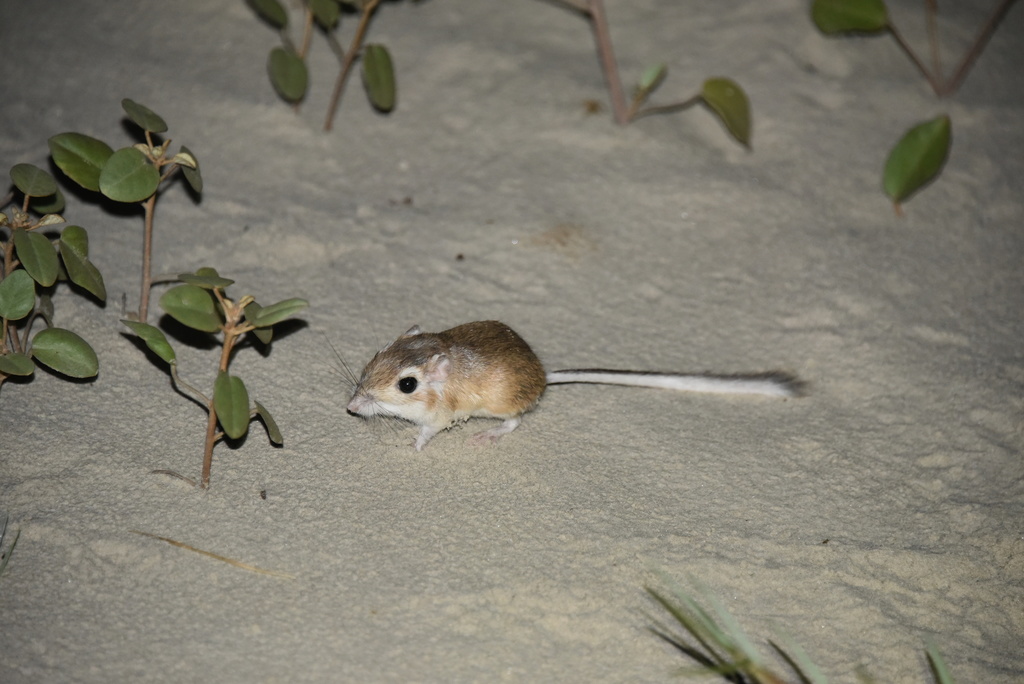
(c) Cody Stricker, some rights reserved (CC BY) · licence
Family: Heteromyidae · Class: Mammalia · Order: Rodentia
Conservation status: G4T2 S2
Dipodomys heermanni heermanni (Heermann's Kangaroo Rat) is a California animal in the Heteromyidae family.
Heermann's kangaroo rat (Dipodomys heermanni heermanni) is a medium-sized heteromyid rodent endemic to California's Central Valley and surrounding foothills. Adults measure approximately 240-300 mm (9.4-11.8 inches) in total length, with the tail accounting for roughly 60% of total body length. The species exhibits the characteristic kangaroo rat morphology with enlarged hind limbs adapted for saltatorial locomotion, a long tufted tail for balance, and large eyes suited for nocturnal activity. The pelage is typically buff to grayish-brown dorsally with white ventral surfaces and distinctive white hip stripes. Historically, Heermann's kangaroo rat occupied much of California's Central Valley from Redding south to the Tehachapi Mountains, extending into the Coast Ranges and Sierra Nevada foothills. The nominate subspecies D. h. heermanni has experienced substantial range contraction due to agricultural conversion and urban development. Current populations are fragmented and primarily restricted to remaining natural habitat patches in the San Joaquin Valley and adjacent foothill regions. The species has been extirpated from much of its former range in the Sacramento Valley and northern Central Valley. This subspecies inhabits annual grasslands, oak woodlands, and chaparral communities, typically on well-drained soils with sparse to moderate shrub cover. Preferred habitat includes areas with 10-60% shrub cover and native forb and grass species. The species constructs elaborate burrow systems in friable soils, with multiple entrances and chambers for food storage and nesting. Burrows may extend 1-2 meters underground and serve as protection from predators and temperature extremes. Heermann's kangaroo rat is primarily granivorous, feeding on seeds of native plants including Erodium, Plantago, and various grass species. The species exhibits water-independent physiology, obtaining metabolic water from seed consumption and possessing highly efficient kidneys. Breeding occurs from February through May, with females producing 1-3 litters annually. Litter size ranges from 1-5 young, with an average of 2-3 offspring. The species is strictly nocturnal and exhibits solitary behavior except during breeding season. The nominate subspecies is currently ranked G4T2 S2, indicating it is imperiled in California with 6-20 occurrences or few remaining individuals. While not federally listed, unlike the endangered Morro Bay kangaroo rat subspecies (D. h. morroensis), Heermann's kangaroo rat faces significant conservation challenges. Primary threats include habitat loss from agricultural conversion, urban development, and invasive plant species that alter seed resources. Habitat fragmentation has isolated remaining populations, potentially leading to reduced genetic diversity and local extinctions. The species has declined in area of occupancy throughout much of its range due to these anthropogenic factors. Conservation efforts focus on habitat protection, restoration of native plant communities, and maintenance of connectivity between remaining population centers. Given the continued pressure from development in California's Central Valley, the long-term persistence of this subspecies requires coordinated conservation planning and habitat management.
Classification
Class: Mammalia · Order: Rodentia · Family: Heteromyidae
Conservation status
G4T2 S2
Frequently asked questions
How is Dipodomys heermanni heermanni classified?
Dipodomys heermanni heermanni belongs to class Mammalia, order Rodentia, family Heteromyidae.
What family does Dipodomys heermanni heermanni belong to?
Dipodomys heermanni heermanni is in the Heteromyidae family.
Is Dipodomys heermanni heermanni protected or of conservation concern?
Dipodomys heermanni heermanni carries the following status: G4T2 S2.
What is Dipodomys heermanni heermanni?
Heermann's kangaroo rat (Dipodomys heermanni heermanni) is a medium-sized heteromyid rodent endemic to California's Central Valley and surrounding foothills.
Is Dipodomys heermanni heermanni found in California?
Yes. Dipodomys heermanni heermanni is recorded in California in The California Species Project's catalogue.
Related species
Other California species in the same genus, family, or bioregion.
Data from The California Species Project — 14,000+ California species with verified data from CNPS, CDFW, USFWS, and more.