Dipodomys heermanni morroensis
Morro Bay kangaroo rat
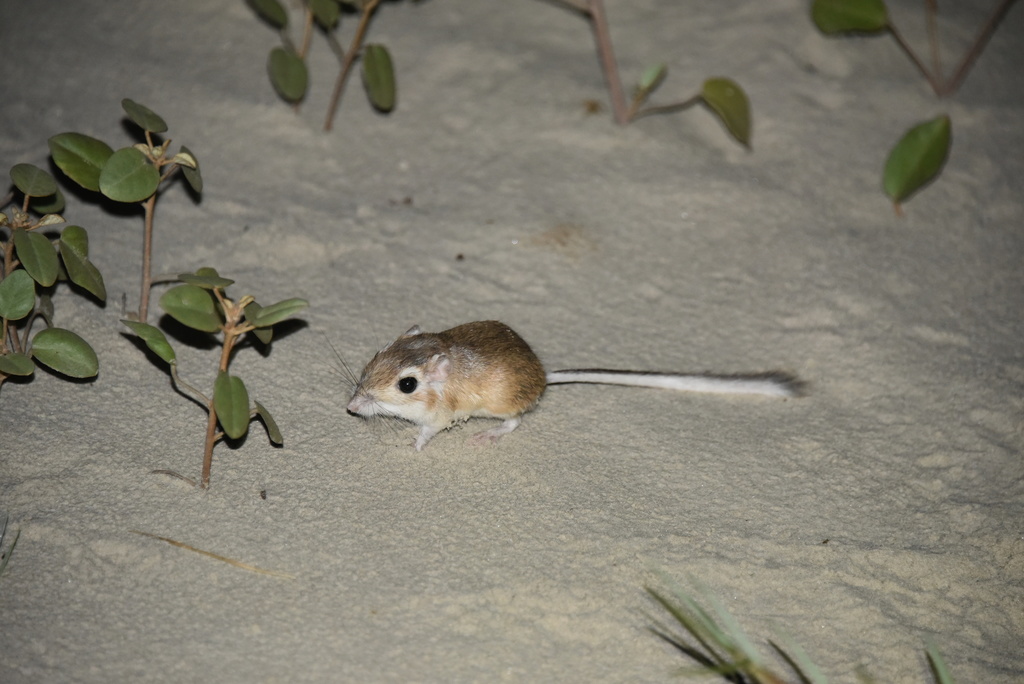
(c) Cody Stricker, some rights reserved (CC BY) · licence
Family: Heteromyidae · Class: Mammalia · Order: Rodentia
Conservation status: SE · Endangered · G4TH SH
Dipodomys heermanni morroensis (Morro Bay kangaroo rat) is a California animal in the Heteromyidae family.
The Morro Bay kangaroo rat is a small rodent subspecies endemic to the Los Osos area of western San Luis Obispo County in coastal central California. As a member of the Heermann's kangaroo rat complex, this subspecies exhibits the typical kangaroo rat morphology with elongated hind legs adapted for saltatorial locomotion, a long tufted tail for balance, and large eyes suited for nocturnal activity. Adults measure approximately 240-280 mm (9.4-11.0 inches) in total length, with the tail comprising roughly 60% of total body length. The dorsal pelage is typically buff to brownish-gray, while the ventral surface is white to pale gray. Historically, the Morro Bay kangaroo rat occupied coastal scrub and chaparral habitats in the Los Osos area, including maritime chaparral, coastal sage scrub, and oak woodland communities. The subspecies was restricted to a small geographic range encompassing approximately 2,590 hectares (6,400 acres) in the Morro Bay area. Critical habitat designated by the U.S. Fish and Wildlife Service covers 675.4 acres in San Luis Obispo County (USFWS 1977). The species preferred areas with sandy soils that facilitated burrow construction and supported the shrub communities that provided food resources. Morro Bay kangaroo rats constructed elaborate burrow systems in sandy substrates, serving as shelter from predators and temperature extremes. Like other kangaroo rats, this subspecies was primarily granivorous, feeding on seeds from shrubs and forbs characteristic of coastal scrub communities. The species exhibited typical kangaroo rat behavioral adaptations, including bipedal locomotion, seed caching behavior, and the ability to obtain metabolic water from dry seeds without drinking free water. Breeding likely occurred from late winter through early summer, with females producing one to three litters annually. The Morro Bay kangaroo rat was listed as federally endangered on October 13, 1970, making it one of the earliest species protected under federal endangered species legislation. The subspecies is also listed as endangered by the California Department of Fish and Wildlife and designated as Fully Protected. Despite extensive survey efforts covering most of the known historical range, no Morro Bay kangaroo rats have been captured or observed in the wild since the 1980s (USFWS 2000). The U.S. Fish and Wildlife Service completed a 5-year review in 2000, recommending the subspecies be reclassified as extinct, though formal delisting has not occurred as of December 2025. Primary threats that led to the subspecies' apparent extinction included habitat loss and fragmentation from urban development, agricultural conversion, and recreational activities in the Los Osos area. The small population size and restricted range made the subspecies particularly vulnerable to stochastic events and habitat degradation. Current conservation efforts focus on habitat protection and restoration in the Los Osos area, maintaining hope for potential rediscovery while protecting remaining coastal scrub communities that could support reintroduction efforts should populations be located.
Classification
Class: Mammalia · Order: Rodentia · Family: Heteromyidae
Conservation status
SE · Endangered · G4TH SH
Frequently asked questions
How is Dipodomys heermanni morroensis classified?
Dipodomys heermanni morroensis belongs to class Mammalia, order Rodentia, family Heteromyidae.
What family does Dipodomys heermanni morroensis belong to?
Dipodomys heermanni morroensis is in the Heteromyidae family.
Is Dipodomys heermanni morroensis protected or of conservation concern?
Dipodomys heermanni morroensis carries the following status: SE · Endangered · G4TH SH.
What is Dipodomys heermanni morroensis?
The Morro Bay kangaroo rat is a small rodent subspecies endemic to the Los Osos area of western San Luis Obispo County in coastal central California.
Is Dipodomys heermanni morroensis found in California?
Yes. Dipodomys heermanni morroensis is recorded in California in The California Species Project's catalogue.
Related species
Other California species in the same genus, family, or bioregion.
Data from The California Species Project — 14,000+ California species with verified data from CNPS, CDFW, USFWS, and more.