Dipodomys ingens
Giant kangaroo rat
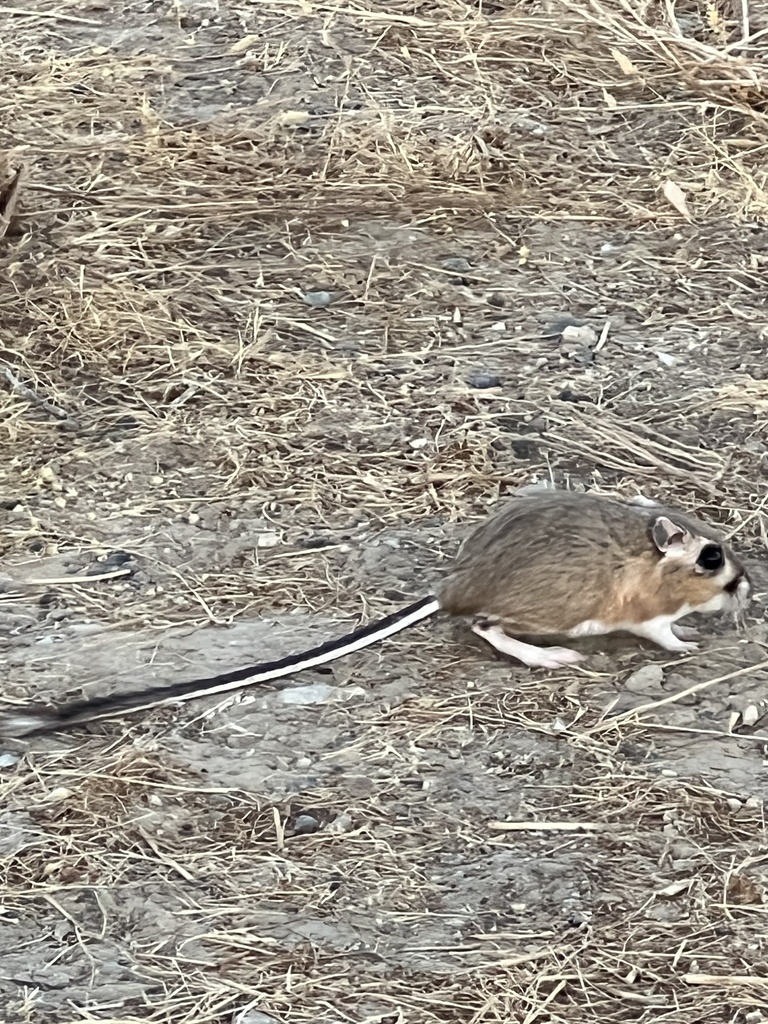
(c) Ryan Donnelly, some rights reserved (CC BY) · licence
Family: Heteromyidae · Class: Mammalia · Order: Rodentia
Conservation status: SE · Endangered · G1G2 S2
Dipodomys ingens (Giant kangaroo rat) is a California animal in the Heteromyidae family.
The giant kangaroo rat is the largest member of the kangaroo rat family, measuring 305 to 355 mm (12 to 14 inches) in total length with a weight of 120 to 180 grams (4.2 to 6.3 ounces). The species exhibits the characteristic kangaroo rat body plan with oversized hind legs, small forelimbs, and a long tail that exceeds body length. The tail terminates in a prominent tuft of dark hairs bordered by white. The dorsal pelage is pale buff to grayish-brown, while the ventral surface is white. Large, dark eyes and external cheek pouches used for seed transport distinguish this nocturnal rodent. The skull is notably robust compared to other kangaroo rats, with enlarged auditory bullae adapted for enhanced hearing. Historically, giant kangaroo rats occupied approximately 1.5 million acres across the western San Joaquin Valley from Merced County south to Kern County. The species' range extended from the valley floor to elevations of approximately 800 meters (2,600 feet) on surrounding foothills. Current distribution is severely fragmented, with populations restricted to less than 2 percent of the original range. The largest remaining populations occur in western Fresno County, eastern San Luis Obispo County, and parts of Kern County. Small, isolated populations persist in Merced and Kings counties. Giant kangaroo rats inhabit grasslands and scrublands characterized by gentle topography and fine-textured, friable soils suitable for burrow excavation. The species shows strong preference for areas with 10 to 40 percent shrub cover, particularly saltbush scrub and grasslands with scattered shrubs. Suitable habitat typically occurs on alluvial fans and valley floors with sandy loam or clay loam soils. The species avoids areas with dense vegetation, steep slopes, or hardpan soils that impede burrow construction. This species is primarily granivorous, with seeds of forbs and small shrubs comprising the majority of the diet. During spring months, green vegetation may supplement seed consumption. Giant kangaroo rats are central-place foragers, collecting seeds in specialized cheek pouches and transporting them to underground caches within their burrow systems. Breeding occurs from January through May, with peak activity in February and March. Females produce one to three litters annually, with litter sizes ranging from one to seven young. The species constructs elaborate burrow systems with multiple entrances, storage chambers, and nesting areas extending 1 to 2 meters below ground. The U.S. Fish and Wildlife Service listed the giant kangaroo rat as endangered in 1987 due to extensive habitat loss from agricultural conversion, urban development, and oil extraction. According to recent surveys, fewer than 10,000 individuals remain across all populations. Primary threats include continued habitat fragmentation, drought effects on food availability, livestock grazing, and invasive plant species that alter habitat structure. Recovery efforts focus on habitat restoration, land acquisition, and population monitoring through the Giant Kangaroo Rat Recovery Plan implemented by federal and state agencies.
Classification
Class: Mammalia · Order: Rodentia · Family: Heteromyidae
Conservation status
SE · Endangered · G1G2 S2
Frequently asked questions
How is Dipodomys ingens classified?
Dipodomys ingens belongs to class Mammalia, order Rodentia, family Heteromyidae.
What family does Dipodomys ingens belong to?
Dipodomys ingens is in the Heteromyidae family.
Is Dipodomys ingens protected or of conservation concern?
Dipodomys ingens carries the following status: SE · Endangered · G1G2 S2.
What is Dipodomys ingens?
The giant kangaroo rat is the largest member of the kangaroo rat family, measuring 305 to 355 mm (12 to 14 inches) in total length with a weight of 120 to 180 grams (4.2 to 6.3 ounces).
Is Dipodomys ingens found in California?
Yes. Dipodomys ingens is recorded in California in The California Species Project's catalogue.
Related species
Other California species in the same genus, family, or bioregion.
Data from The California Species Project — 14,000+ California species with verified data from CNPS, CDFW, USFWS, and more.