Dipodomys merriami
Merriam's Kangaroo Rat
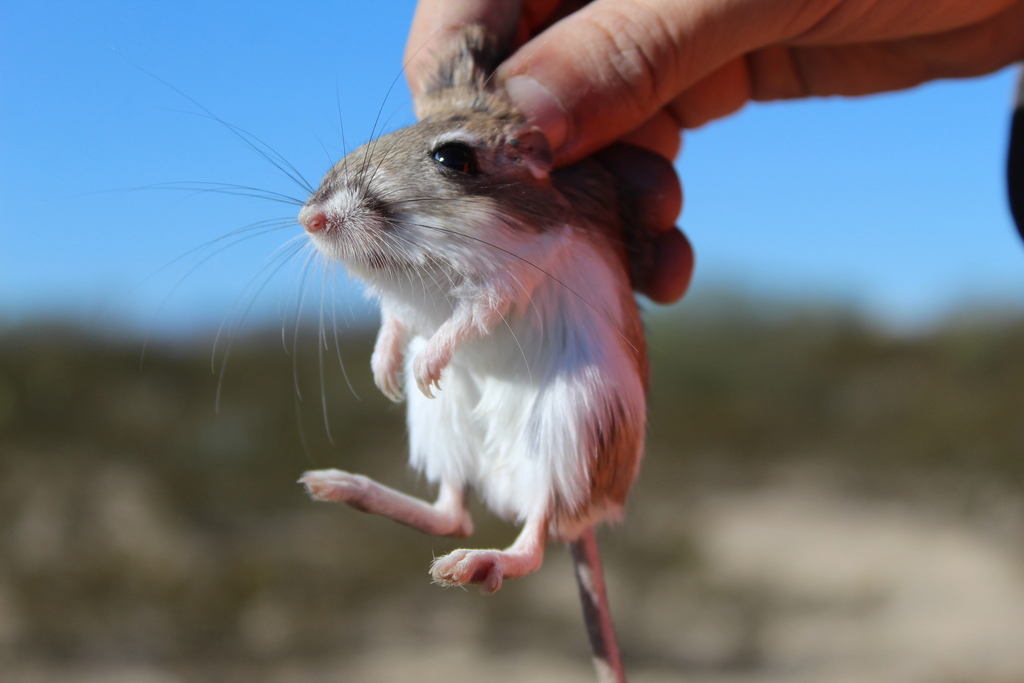
no rights reserved · CC0
Family: Heteromyidae · Class: Mammalia · Order: Rodentia
Dipodomys merriami (Merriam's Kangaroo Rat) is a California animal in the Heteromyidae family.
Merriam's kangaroo rat is a small desert rodent characterized by its distinctive saltatorial locomotion and specialized adaptations to arid environments. Adults measure 90 to 110 mm (3.5 to 4.3 inches) in head-body length with a tail length of 120 to 155 mm (4.7 to 6.1 inches), nearly 1.5 times the body length. The species weighs between 35 to 50 grams (1.2 to 1.8 ounces). The dorsal pelage is pale yellowish-buff to sandy brown, providing excellent camouflage against desert substrates, while the ventral surface is white. The tail is distinctly bicolored with a dark dorsal stripe and white lateral stripes, terminating in a prominent tuft. The hind feet are elongated and possess four toes with hairy soles that facilitate movement across loose sand. Merriam's kangaroo rat occurs across the southwestern United States and northwestern Mexico. In California, the species is distributed throughout the Mojave and Sonoran deserts, extending from Inyo County in the north to Imperial County in the south. The range includes the eastern slopes of the Sierra Nevada, the Owens Valley, Death Valley, and desert regions of Riverside, San Bernardino, Los Angeles, Kern, and Tulare counties. Populations also occur in suitable habitat throughout the Colorado Desert. This species inhabits open desert scrublands, creosote bush flats, and sandy washes at elevations ranging from below sea level in Death Valley to approximately 1,220 meters (4,000 feet). Preferred habitat consists of sandy or gravelly soils with sparse vegetation dominated by creosote bush, burrobush, desert broom, and various cacti. Merriam's kangaroo rat constructs complex burrow systems in areas with firm soil suitable for excavation, often near the base of shrubs or on slight slopes that provide drainage. Merriam's kangaroo rat is strictly nocturnal and solitary outside of breeding periods. The species exhibits highly efficient water conservation adaptations, obtaining metabolic water from dry seeds and producing highly concentrated urine. Diet consists primarily of small seeds from desert shrubs and forbs, including creosote bush, mesquite, and various grasses. Seeds are collected in specialized cheek pouches and cached in underground granaries within the burrow system. Breeding occurs from February through September, with peak activity during spring months. Females produce one to three litters annually, each containing two to five young after a gestation period of approximately 30 days. Young reach sexual maturity at 60 to 65 days of age. Merriam's kangaroo rat is not federally listed and maintains stable populations throughout most of its range as of December 2025. The species demonstrates considerable adaptability to desert conditions and shows resilience to moderate habitat disturbance. However, localized populations face pressure from urban development, agriculture, off-road vehicle activity, and renewable energy projects in desert regions. Climate change may alter precipitation patterns and vegetation communities within the species' range, potentially affecting seed availability and habitat suitability in some areas.
Classification
Class: Mammalia · Order: Rodentia · Family: Heteromyidae
Frequently asked questions
How is Dipodomys merriami classified?
Dipodomys merriami belongs to class Mammalia, order Rodentia, family Heteromyidae.
What family does Dipodomys merriami belong to?
Dipodomys merriami is in the Heteromyidae family.
What is Dipodomys merriami?
Merriam's kangaroo rat is a small desert rodent characterized by its distinctive saltatorial locomotion and specialized adaptations to arid environments.
Is Dipodomys merriami found in California?
Yes. Dipodomys merriami is recorded in California in The California Species Project's catalogue.
Related species
Other California species in the same genus, family, or bioregion.
Data from The California Species Project — 14,000+ California species with verified data from CNPS, CDFW, USFWS, and more.