Dipodomys merriami collinus
Earthquake Merriam's Kangaroo Rat
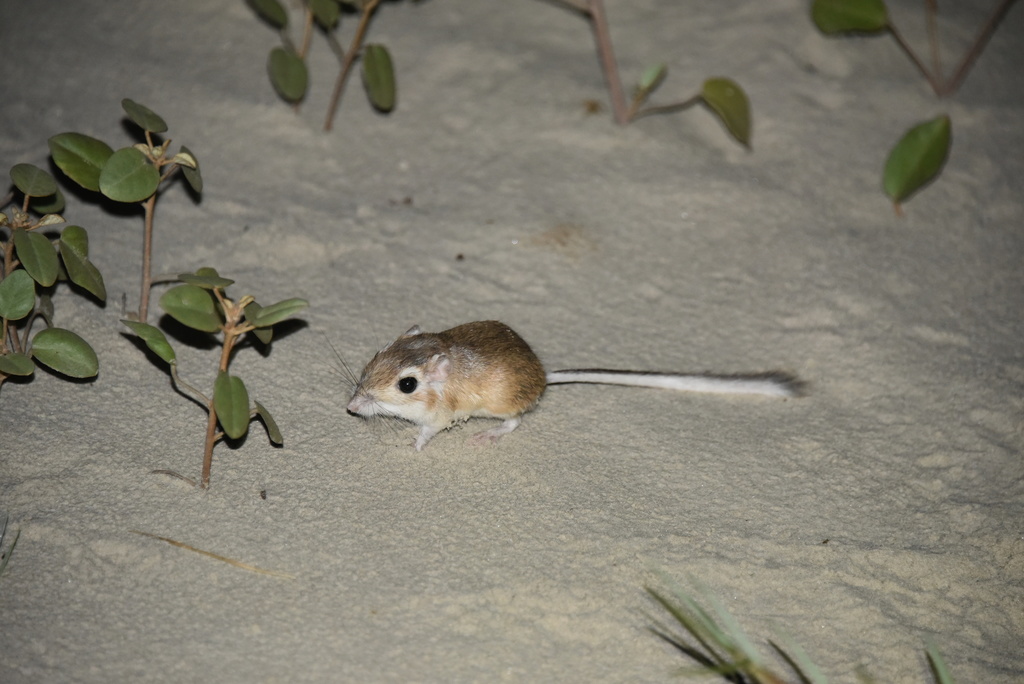
(c) Cody Stricker, some rights reserved (CC BY) · licence
Family: Heteromyidae · Class: Mammalia · Order: Rodentia
Conservation status: G5T2? S2
Dipodomys merriami collinus (Earthquake Merriam's Kangaroo Rat) is a California animal in the Heteromyidae family.
The Earthquake Merriam's kangaroo rat is a small rodent subspecies endemic to California, representing one of several geographically distinct populations of Merriam's kangaroo rat (Dipodomys merriami). Like other kangaroo rats, this subspecies exhibits the characteristic bipedal locomotion, enlarged hind limbs, and long tail that distinguish members of the family Heteromyidae. Adults typically measure 100-110 mm in head-body length, with tails extending 130-170 mm, and weigh between 35-50 grams. The pelage is pale sandy or buffy above with white underparts, providing camouflage against desert soils. The species possesses enlarged auditory bullae and sensitive hearing adaptations for detecting predators in open habitats. The Earthquake Merriam's kangaroo rat occurs exclusively in California, with its range centered in Riverside County and adjacent areas of southern California. This subspecies occupies a relatively restricted geographic area compared to the broader distribution of Dipodomys merriami across the southwestern United States and northwestern Mexico. The subspecies name "collinus" reflects its association with hilly terrain within its limited range. This kangaroo rat inhabits arid and semi-arid environments characterized by sparse vegetation and well-drained soils suitable for burrow construction. Preferred habitats include desert scrubland, chaparral edges, and areas with scattered shrubs that provide cover and foraging opportunities. The species constructs elaborate burrow systems in sandy or gravelly soils, with multiple entrances and specialized chambers for food storage, nesting, and refuge from predators and extreme temperatures. Elevational preferences and specific microhabitat requirements within its range have not been extensively documented. Earthquake Merriam's kangaroo rats are primarily granivorous, feeding on seeds of desert shrubs, forbs, and grasses. Their highly efficient kidneys allow them to obtain water metabolically from their diet, rarely requiring free water. The species exhibits nocturnal activity patterns, foraging under cover of darkness to avoid predators and extreme daytime temperatures. Breeding typically occurs from late winter through early summer, with females producing 2-3 litters annually. Litter sizes range from 1-4 young, with a gestation period of approximately 30 days. Young remain in natal burrows for several weeks before dispersing. The subspecies is currently designated as a Species of Concern by the U.S. Fish and Wildlife Service, indicating potential conservation needs but lacking formal protection under the Endangered Species Act. The global rank of G5T2? reflects the overall stability of the species Dipodomys merriami while acknowledging the uncertain status and limited population size of this particular subspecies. Primary threats likely include habitat loss and fragmentation from urban development, agriculture, and infrastructure projects within its restricted southern California range. Climate change may pose additional challenges through altered precipitation patterns and increased fire frequency. The subspecies is covered under the Western Riverside Multi-Species Habitat Conservation Plan, which provides some conservation protection through habitat preservation and management guidelines. Population trends and specific conservation measures for this subspecies remain poorly documented, highlighting the need for additional research and monitoring efforts.
Classification
Class: Mammalia · Order: Rodentia · Family: Heteromyidae
Conservation status
G5T2? S2
Frequently asked questions
How is Dipodomys merriami collinus classified?
Dipodomys merriami collinus belongs to class Mammalia, order Rodentia, family Heteromyidae.
What family does Dipodomys merriami collinus belong to?
Dipodomys merriami collinus is in the Heteromyidae family.
Is Dipodomys merriami collinus protected or of conservation concern?
Dipodomys merriami collinus carries the following status: G5T2? S2.
What is Dipodomys merriami collinus?
The Earthquake Merriam's kangaroo rat is a small rodent subspecies endemic to California, representing one of several geographically distinct populations of Merriam's kangaroo rat (Dipodomys merriami).
Is Dipodomys merriami collinus found in California?
Yes. Dipodomys merriami collinus is recorded in California in The California Species Project's catalogue.
Related species
Other California species in the same genus, family, or bioregion.
Data from The California Species Project — 14,000+ California species with verified data from CNPS, CDFW, USFWS, and more.