Dipodomys merriami parvus
San Bernardino kangaroo rat
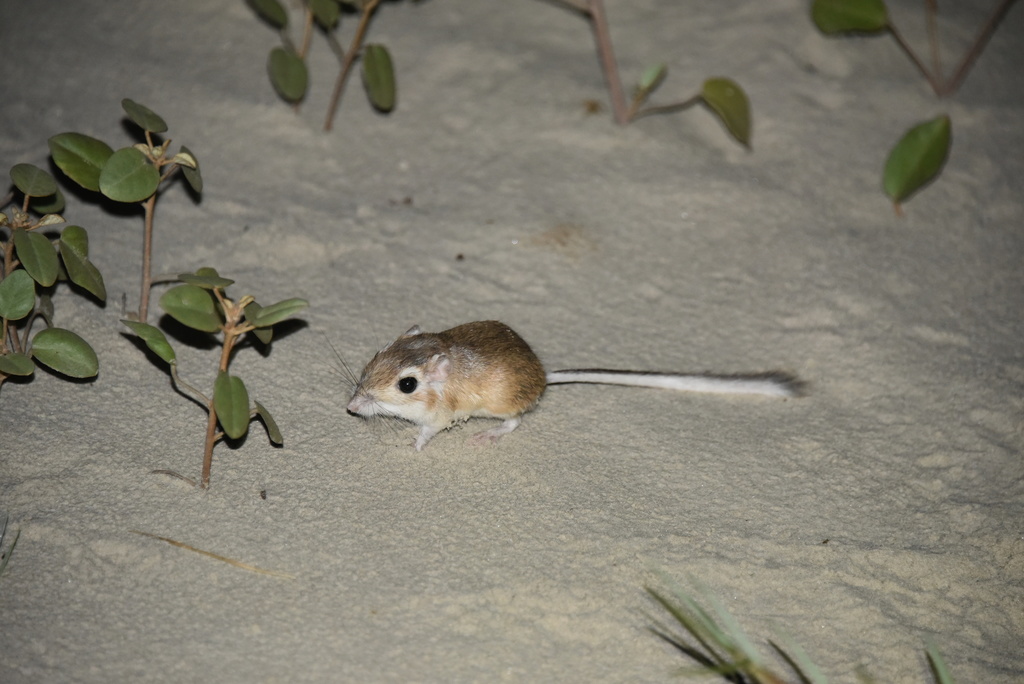
(c) Cody Stricker, some rights reserved (CC BY) · licence
Family: Heteromyidae · Class: Mammalia · Order: Rodentia
Conservation status: SE · Endangered · G5T1 S1
Dipodomys merriami parvus (San Bernardino kangaroo rat) is a California animal in the Heteromyidae family.
The San Bernardino kangaroo rat is a subspecies of Merriam's kangaroo rat, characterized as a large-headed rodent with enlarged hind feet adapted for saltatory locomotion and a long tail. This heteromyid rodent is one of 19 recognized subspecies of Dipodomys merriami, distinguished by its specialized morphology for desert living and seed collection (USFWS 2009). Historically, the San Bernardino kangaroo rat was distributed from the San Bernardino Valley in San Bernardino County to the Menifee Valley in Riverside County, California. Current populations are restricted to three disjunct areas in San Bernardino and Riverside counties, representing the largest remaining patches of suitable habitat. These areas include the historical floodplain along the upper Santa Ana River wash, Lytle and Cajon washes, and the San Jacinto River corridor (USFWS 2025). The species inhabits scattered, isolated patches of alluvial sage-scrub habitat, typically occurring in areas with sandy or gravelly soils that facilitate burrow construction. San Bernardino kangaroo rats reside in complex burrow systems that provide protection from predators and temperature extremes. The burrows serve multiple functions including nesting sites, food storage areas, and refugia during adverse conditions (USFWS 2009). Reproductive activities peak during June and July, though the San Bernardino kangaroo rat maintains a prolonged breeding season. Pregnant or lactating females have been captured between January and November, while males in reproductive condition have been documented between January and August. Females are capable of producing multiple litters per year, with litter sizes averaging between two and three young. Like other kangaroo rat species, populations typically exhibit significant annual fluctuations in response to environmental conditions (USFWS 2009). The San Bernardino kangaroo rat was federally listed as endangered on September 24, 1998, primarily due to habitat loss associated with agricultural, urban, and industrial development, combined with small population size. Critical habitat was designated on October 17, 2008, encompassing essential areas for the species' survival and recovery. Ongoing threats include habitat loss, fragmentation, and degradation, along with alterations of natural hydrological processes that affect the alluvial habitats upon which the species depends. Climate change poses additional challenges by potentially altering precipitation patterns and temperature regimes that influence habitat suitability and food resource availability. The species' conservation status remains precarious due to its limited distribution and continued pressure from development activities within its remaining range.
Classification
Class: Mammalia · Order: Rodentia · Family: Heteromyidae
Conservation status
SE · Endangered · G5T1 S1
Frequently asked questions
How is Dipodomys merriami parvus classified?
Dipodomys merriami parvus belongs to class Mammalia, order Rodentia, family Heteromyidae.
What family does Dipodomys merriami parvus belong to?
Dipodomys merriami parvus is in the Heteromyidae family.
Is Dipodomys merriami parvus protected or of conservation concern?
Dipodomys merriami parvus carries the following status: SE · Endangered · G5T1 S1.
What is Dipodomys merriami parvus?
The San Bernardino kangaroo rat is a subspecies of Merriam's kangaroo rat, characterized as a large-headed rodent with enlarged hind feet adapted for saltatory locomotion and a long tail.
Is Dipodomys merriami parvus found in California?
Yes. Dipodomys merriami parvus is recorded in California in The California Species Project's catalogue.
Related species
Other California species in the same genus, family, or bioregion.
Data from The California Species Project — 14,000+ California species with verified data from CNPS, CDFW, USFWS, and more.