Dipodomys microps
Chisel-toothed Kangaroo Rat
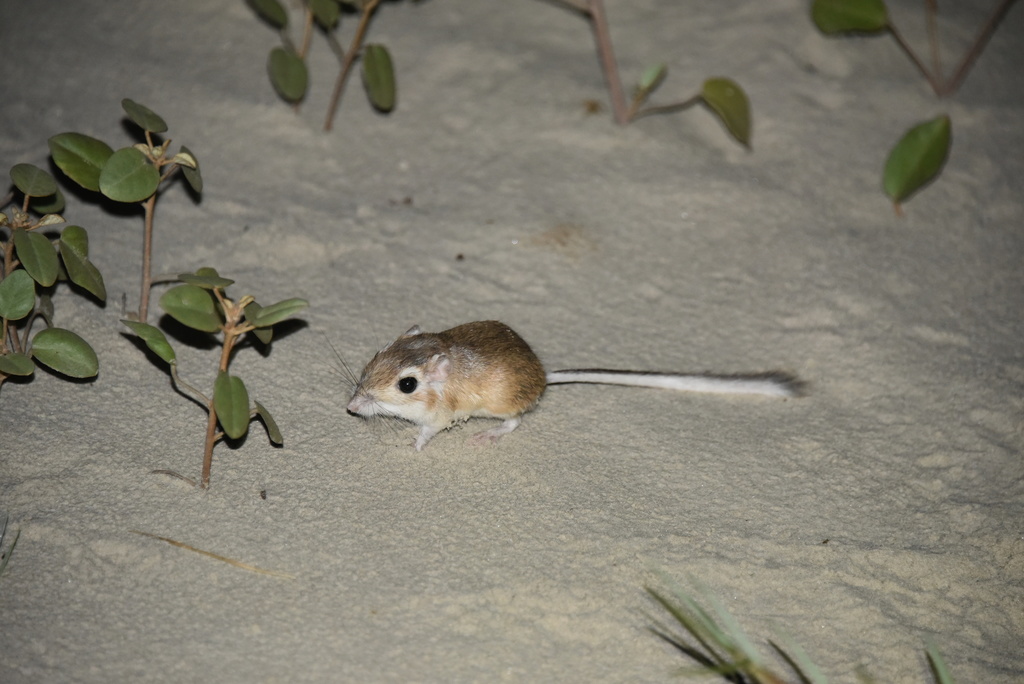
(c) Cody Stricker, some rights reserved (CC BY) · licence
Family: Heteromyidae · Class: Mammalia · Order: Rodentia
Dipodomys microps (Chisel-toothed Kangaroo Rat) is a California animal in the Heteromyidae family.
The chisel-toothed kangaroo rat is a medium-sized heteromyid rodent distinguished by its specialized dental adaptation for processing saltbush vegetation. Adults measure 240 to 290 mm (9.4 to 11.4 inches) in total length, with the tail accounting for approximately 60% of this measurement. Body weight ranges from 60 to 85 grams (2.1 to 3.0 ounces). The species exhibits typical kangaroo rat morphology with enlarged hind limbs, a long tufted tail, and large dark eyes adapted for nocturnal activity. The dorsal pelage is pale buffy-brown to grayish-brown, while the ventral surface is white. The distinguishing feature is the modified lower incisors that are flattened and chisel-shaped, an adaptation for scraping salt-laden leaves of saltbush plants. Historically, the chisel-toothed kangaroo rat occurred throughout the Great Basin region of western North America. In California, populations are restricted to the eastern Sierra Nevada and portions of the Mojave Desert, primarily in Mono and Inyo counties. The species' range extends into Nevada, Utah, and small portions of Oregon and Idaho. Current California populations are considered disjunct from the main Great Basin distribution and represent the southwestern extent of the species' range. The species inhabits arid shrubland communities dominated by four-wing saltbush (Atriplex canescens) and shadscale (Atriplex confertifolia) at elevations ranging from 1,200 to 2,100 meters (3,900 to 6,900 feet). Preferred habitat includes sandy or gravelly soils with sparse to moderate shrub cover. The species constructs elaborate burrow systems with multiple entrances, food caches, and nesting chambers. These burrows are typically located beneath or adjacent to shrubs and may extend 1 to 2 meters underground. Chisel-toothed kangaroo rats are highly specialized feeders, with their diet consisting almost exclusively of leaves from saltbush species. The chisel-shaped incisors allow them to scrape the green chlorophyll-rich tissue from leaves while avoiding the salt-concentrated epidermis. This unique feeding strategy enables the species to exploit a food source largely unavailable to other rodents. Breeding occurs from late winter through early summer, with females producing one to two litters annually. Litter size ranges from two to five young, with an average of three. The species exhibits solitary behavior except during mating, with individuals maintaining exclusive territories around their burrow systems. The chisel-toothed kangaroo rat is not currently listed under federal or California endangered species legislation, though populations have experienced local declines due to habitat conversion and fragmentation. Primary threats include urbanization, agricultural conversion, grazing pressure that alters shrub communities, and climate change impacts on precipitation patterns. The specialized habitat requirements and narrow dietary niche make populations particularly vulnerable to ecosystem changes. Conservation efforts focus on habitat protection and monitoring of population trends, particularly in California where the species occurs at the periphery of its range.
Classification
Class: Mammalia · Order: Rodentia · Family: Heteromyidae
Frequently asked questions
How is Dipodomys microps classified?
Dipodomys microps belongs to class Mammalia, order Rodentia, family Heteromyidae.
What family does Dipodomys microps belong to?
Dipodomys microps is in the Heteromyidae family.
What is Dipodomys microps?
The chisel-toothed kangaroo rat is a medium-sized heteromyid rodent distinguished by its specialized dental adaptation for processing saltbush vegetation.
Is Dipodomys microps found in California?
Yes. Dipodomys microps is recorded in California in The California Species Project's catalogue.
Related species
Other California species in the same genus, family, or bioregion.
Data from The California Species Project — 14,000+ California species with verified data from CNPS, CDFW, USFWS, and more.