Dipodomys nitratoides brevinasus
Short-nosed Kangaroo Rat
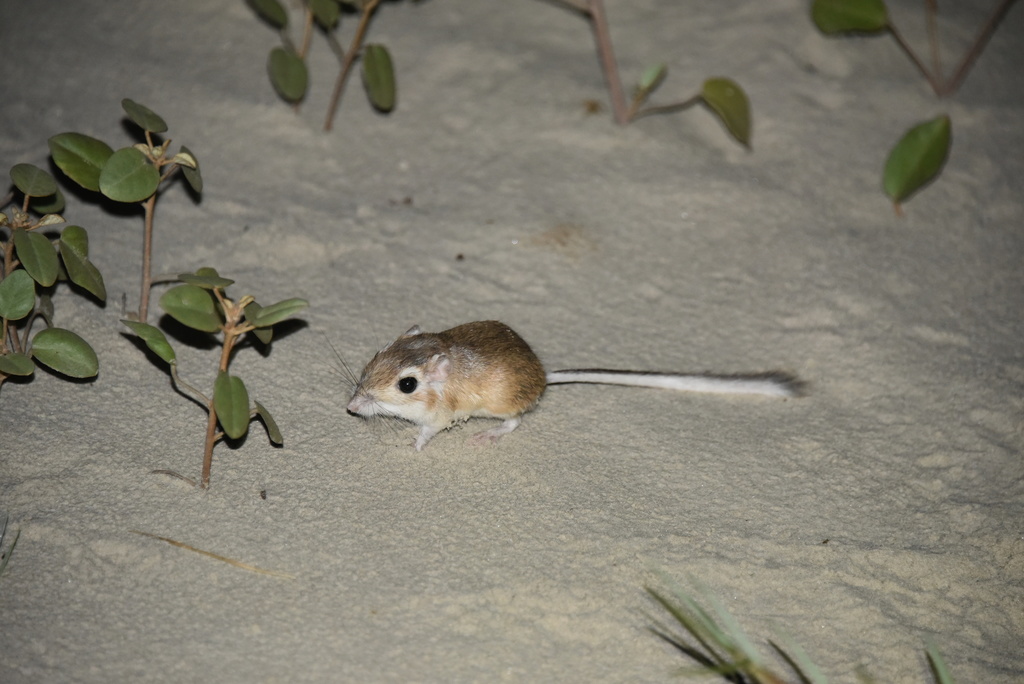
(c) Cody Stricker, some rights reserved (CC BY) · licence
Family: Heteromyidae · Class: Mammalia · Order: Rodentia
Conservation status: G2T1T2 S1S2
Dipodomys nitratoides brevinasus (Short-nosed Kangaroo Rat) is a California animal in the Heteromyidae family.
The Short-nosed kangaroo rat (Dipodomys nitratoides brevinasus) is one of three subspecies of San Joaquin kangaroo rats, distinguished by its small size and relatively shortened rostrum compared to the Tipton kangaroo rat subspecies. Adults measure approximately 23 centimeters (9 inches) in total length, with proportionally large hind limbs adapted for saltatorial locomotion across sandy substrates. The pelage is buff-colored dorsally with white underparts, and the species possesses the characteristic large eyes and elongated tail with terminal tuft typical of kangaroo rats. This subspecies has an extremely restricted range within California's San Joaquin Valley. The Short-nosed kangaroo rat historically occurred on sandy soils in the western and southwestern portions of the San Joaquin Valley, with documented populations in Fresno and Kings counties. Current distribution is highly fragmented, representing only a small fraction of the subspecies' historical range due to extensive agricultural conversion and urban development throughout the valley floor. Short-nosed kangaroo rats inhabit areas with sandy, well-drained soils that support sparse vegetation typical of San Joaquin Valley alkali sink scrub and valley saltbush scrub communities. The species shows strong substrate preferences for fine-textured, sandy soils that allow for efficient burrow construction (Williams et al. 1993). Elevation ranges are generally low, confined to the valley floor typically below 150 meters (500 feet). The subspecies requires areas with scattered shrub cover but avoids densely vegetated habitats that impede movement and predator detection. Like other kangaroo rats, this subspecies is primarily granivorous, feeding on small seeds collected during nocturnal foraging excursions. The species possesses specialized cheek pouches for seed transport and demonstrates efficient water conservation mechanisms, obtaining metabolic water from seed consumption without requiring free water sources (Kenagy 1973). Breeding occurs primarily during winter and spring months, with females producing litters of two to five young after a gestation period of approximately 30 days (Williams & Kilburn 1991). Home ranges are typically small, with individuals maintaining territories of 0.1 to 0.3 hectares and showing limited dispersal beyond a few hundred meters (NatureServe Explorer). The Short-nosed kangaroo rat faces severe conservation challenges, reflected in its global rank of G2T1T2, indicating it is imperiled to critically imperiled throughout its range. The California state rank of S1S2 similarly designates the subspecies as critically imperiled to imperiled within the state. Primary threats include habitat loss and fragmentation from agricultural conversion, urban development, and infrastructure projects. Remaining populations are highly isolated, making them vulnerable to local extirpations from stochastic events. The species lacks federal protection under the Endangered Species Act, though it is considered a species of conservation concern by the California Department of Fish and Wildlife. Recovery efforts focus on habitat protection and restoration within the subspecies' remaining range, though the extent of habitat conversion presents ongoing challenges for long-term population viability.
Classification
Class: Mammalia · Order: Rodentia · Family: Heteromyidae
Conservation status
G2T1T2 S1S2
Frequently asked questions
How is Dipodomys nitratoides brevinasus classified?
Dipodomys nitratoides brevinasus belongs to class Mammalia, order Rodentia, family Heteromyidae.
What family does Dipodomys nitratoides brevinasus belong to?
Dipodomys nitratoides brevinasus is in the Heteromyidae family.
Is Dipodomys nitratoides brevinasus protected or of conservation concern?
Dipodomys nitratoides brevinasus carries the following status: G2T1T2 S1S2.
What is Dipodomys nitratoides brevinasus?
The Short-nosed kangaroo rat (Dipodomys nitratoides brevinasus) is one of three subspecies of San Joaquin kangaroo rats, distinguished by its small size and relatively shortened rostrum compared to the Tipton kangaroo rat subspecies.
Is Dipodomys nitratoides brevinasus found in California?
Yes. Dipodomys nitratoides brevinasus is recorded in California in The California Species Project's catalogue.
Related species
Other California species in the same genus, family, or bioregion.
Data from The California Species Project — 14,000+ California species with verified data from CNPS, CDFW, USFWS, and more.