Dipodomys nitratoides exilis
Fresno kangaroo rat
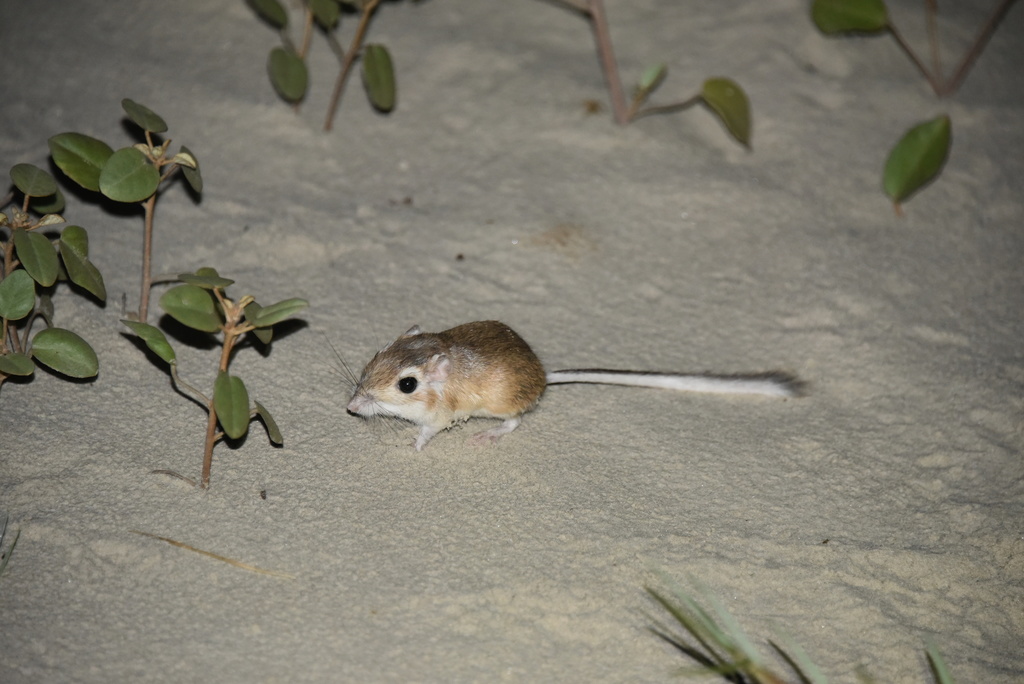
(c) Cody Stricker, some rights reserved (CC BY) · licence
Family: Heteromyidae · Class: Mammalia · Order: Rodentia
Conservation status: SE ST · Endangered · G2TH SH
Dipodomys nitratoides exilis (Fresno kangaroo rat) is a California animal in the Heteromyidae family.
The Fresno kangaroo rat (Dipodomys nitratoides exilis) is one of three subspecies of San Joaquin kangaroo rats and the smallest member of this group. Adults average approximately 9 inches (23 cm) in total length, making them noticeably smaller than the related Tipton kangaroo rat (Dipodomys nitratoides nitratoides) and short-nosed kangaroo rat (Dipodomys nitratoides brevinasus). Like other kangaroo rats, this subspecies exhibits the characteristic large hind legs adapted for bipedal hopping locomotion, oversized hind feet, and a long tail with a tuft at the tip. The pelage is typically pale sandy brown dorsally with white underparts, providing camouflage in their arid grassland habitat. The Fresno kangaroo rat has the most restricted range of any kangaroo rat species in North America, occurring only in the central portion of California's San Joaquin Valley. According to the U.S. Fish and Wildlife Service, the subspecies is limited to the flat valley floor from Merced County in the north to portions of Fresno and Kings counties in the south (USFWS 2025). This represents a dramatic reduction from their historical range, where they were once abundant across the valley floor. This subspecies inhabits arid grassland areas characterized by sparse vegetation and well-drained sandy soils. They prefer open areas with scattered shrubs and annual grasses, avoiding densely vegetated sites. The flat topography of the San Joaquin Valley floor provides optimal habitat conditions, with gentle slopes and minimal elevation variation. Critical habitat was designated for this species on January 30, 1985, though much of the original habitat has been converted to agricultural and urban uses. Fresno kangaroo rats are primarily granivorous, feeding mainly on seeds with occasional supplements of green vegetation and insects when available. They exhibit typical kangaroo rat foraging behavior, using their specialized hind feet to dig through the upper layers of sand and soil to locate fallen seeds. These nocturnal animals maintain large home ranges and forage extensively throughout their territory. Like other kangaroo rats, they are highly water-efficient, obtaining most of their moisture from their seed diet and producing concentrated urine to conserve water in their arid environment. The Fresno kangaroo rat was listed as federally endangered in 1985 due to severe habitat loss and population decline. The primary threat continues to be habitat conversion, with agricultural development and urbanization eliminating much of the original grassland habitat throughout the San Joaquin Valley. According to USFWS expenditure reports, the species received $122,300 in recovery funding in 1998 and $172,080 in 1999, indicating ongoing conservation efforts. Additional threats include habitat fragmentation, which isolates remaining populations and reduces genetic diversity, and competition from introduced species. The extremely limited range makes this subspecies particularly vulnerable to local extinctions, and coordinated habitat protection and restoration efforts are essential for long-term survival.
Classification
Class: Mammalia · Order: Rodentia · Family: Heteromyidae
Conservation status
SE ST · Endangered · G2TH SH
Frequently asked questions
How is Dipodomys nitratoides exilis classified?
Dipodomys nitratoides exilis belongs to class Mammalia, order Rodentia, family Heteromyidae.
What family does Dipodomys nitratoides exilis belong to?
Dipodomys nitratoides exilis is in the Heteromyidae family.
Is Dipodomys nitratoides exilis protected or of conservation concern?
Dipodomys nitratoides exilis carries the following status: SE ST · Endangered · G2TH SH.
What is Dipodomys nitratoides exilis?
The Fresno kangaroo rat (Dipodomys nitratoides exilis) is one of three subspecies of San Joaquin kangaroo rats and the smallest member of this group.
Is Dipodomys nitratoides exilis found in California?
Yes. Dipodomys nitratoides exilis is recorded in California in The California Species Project's catalogue.
Related species
Other California species in the same genus, family, or bioregion.
Data from The California Species Project — 14,000+ California species with verified data from CNPS, CDFW, USFWS, and more.