Dipodomys nitratoides nitratoides
Tipton kangaroo rat
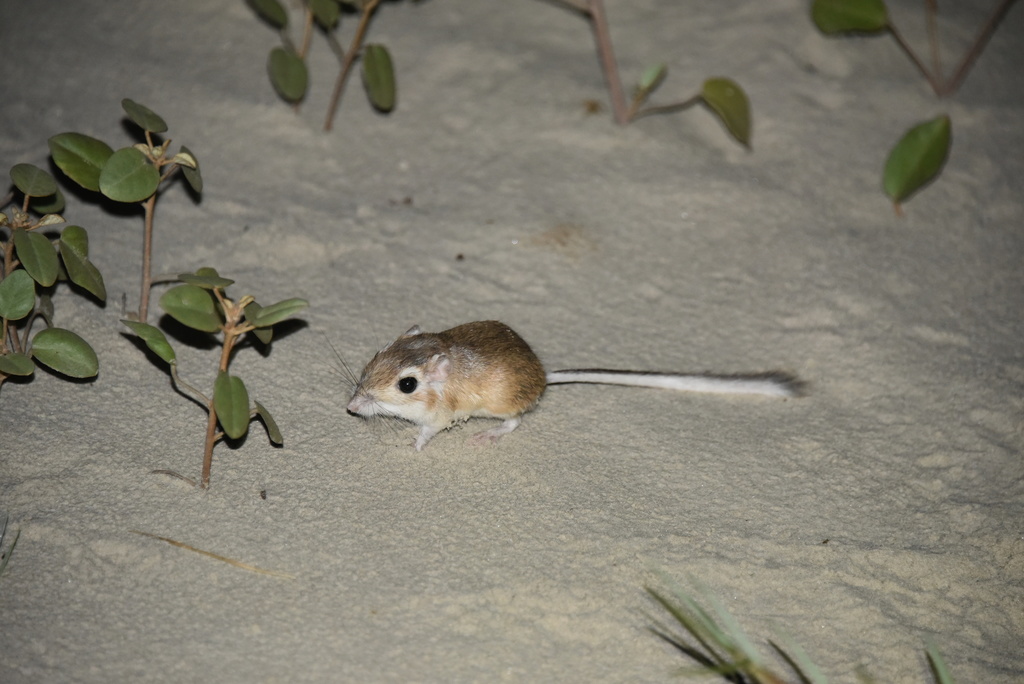
(c) Cody Stricker, some rights reserved (CC BY) · licence
Family: Heteromyidae · Class: Mammalia · Order: Rodentia
Conservation status: SE · Endangered · G2T1T2 S2
Dipodomys nitratoides nitratoides (Tipton kangaroo rat) is a California animal in the Heteromyidae family.
The Tipton kangaroo rat is one of three subspecies of the San Joaquin kangaroo rat, distinguished by its small size and specialized adaptations for arid environments. Adults measure 100 to 110 mm (3.9 to 4.3 inches) in head and body length, with a tail length of 125 to 130 mm (4.8 to 5.1 inches) and weighing 35 to 38 grams (1.2 to 1.3 ounces) (USFWS). The species exhibits characteristic kangaroo rat morphology with a shortened neck, large flattened head, dark whisker patches, and small rounded ears. The long, tufted tail provides balance during bipedal hopping locomotion, while strong claws on the front feet facilitate digging burrows. Historically, Tipton kangaroo rats occupied valley floor habitats throughout portions of the San Joaquin Valley in California. The subspecies is morphologically distinguished from the other San Joaquin kangaroo rat subspecies, being larger than the Fresno kangaroo rat but smaller than other related forms. Current distribution is severely restricted compared to historical range, with approximately 75 occurrences reported to the California Natural Diversity Database as of 2009 (CDFW 2009). Populations now exist only on small, fragmented habitat patches scattered across the former range. Tipton kangaroo rats inhabit arid grassland and shrubland communities on valley floors and gentle slopes. The species requires loose, sandy soils suitable for burrow construction and areas with scattered shrubs and forbs that provide food resources. Like other kangaroo rats, they construct elaborate burrow systems with multiple entrances, storage chambers, and nesting areas. These burrows provide protection from predators and temperature extremes while serving as food storage sites. As granivores, Tipton kangaroo rats feed primarily on small seeds from grasses, forbs, and shrubs, which they collect and cache in their burrows. The species exhibits specialized physiological adaptations to arid environments, obtaining metabolic water from seed consumption and producing highly concentrated urine to minimize water loss. Breeding typically occurs from late winter through early summer, with females producing litters of two to five young after a gestation period of approximately 30 days. The species is primarily nocturnal, emerging from burrows after sunset to forage and engage in social behaviors. The Tipton kangaroo rat has been federally listed as endangered and is classified as endangered by California. The primary threat to the subspecies is habitat loss due to conversion of native grasslands to agricultural and urban uses throughout the San Joaquin Valley. Habitat fragmentation has isolated remaining populations, reducing genetic diversity and increasing vulnerability to local extinctions. Additional threats include grazing pressure, invasive plant species, and altered fire regimes that degrade habitat quality. The U.S. Fish and Wildlife Service conducts regular status reviews and has developed survey protocols requiring live-trapping for reliable species identification, as visual identification in the field is unreliable (USFWS). Conservation efforts focus on habitat protection, restoration of native grassland communities, and population monitoring to prevent further declines of this critically imperiled subspecies.
Classification
Class: Mammalia · Order: Rodentia · Family: Heteromyidae
Conservation status
SE · Endangered · G2T1T2 S2
Frequently asked questions
How is Dipodomys nitratoides nitratoides classified?
Dipodomys nitratoides nitratoides belongs to class Mammalia, order Rodentia, family Heteromyidae.
What family does Dipodomys nitratoides nitratoides belong to?
Dipodomys nitratoides nitratoides is in the Heteromyidae family.
Is Dipodomys nitratoides nitratoides protected or of conservation concern?
Dipodomys nitratoides nitratoides carries the following status: SE · Endangered · G2T1T2 S2.
What is Dipodomys nitratoides nitratoides?
The Tipton kangaroo rat is one of three subspecies of the San Joaquin kangaroo rat, distinguished by its small size and specialized adaptations for arid environments.
Is Dipodomys nitratoides nitratoides found in California?
Yes. Dipodomys nitratoides nitratoides is recorded in California in The California Species Project's catalogue.
Related species
Other California species in the same genus, family, or bioregion.
Data from The California Species Project — 14,000+ California species with verified data from CNPS, CDFW, USFWS, and more.