Dipodomys panamintinus argusensis
Argus Mountains Kangaroo Rat
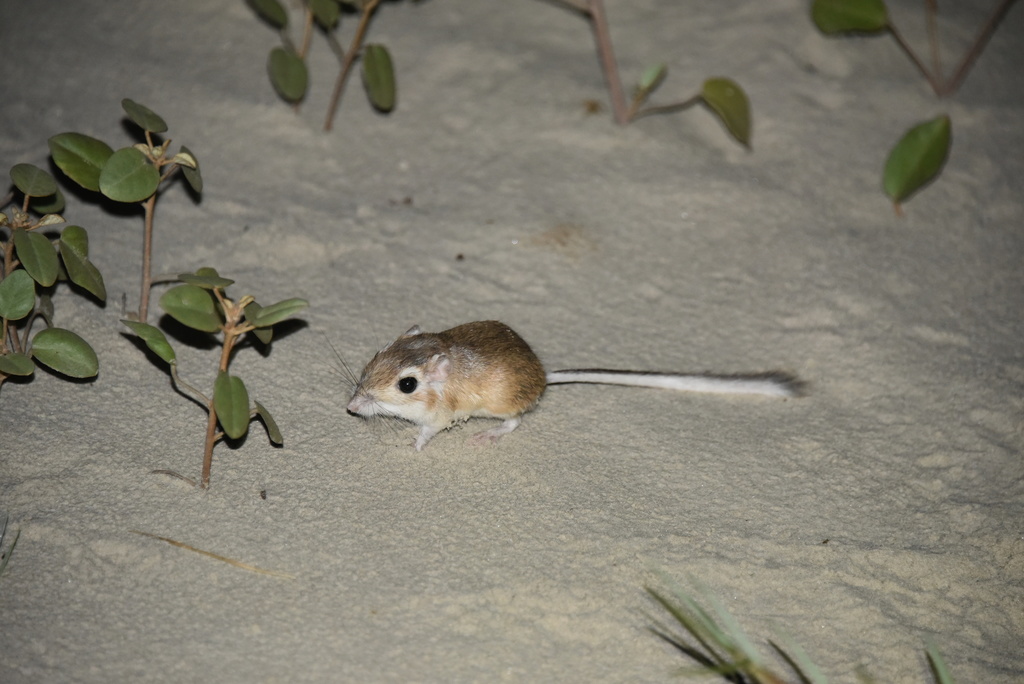
(c) Cody Stricker, some rights reserved (CC BY) · licence
Family: Heteromyidae · Class: Mammalia · Order: Rodentia
Conservation status: G5T1T3 S1S3
Dipodomys panamintinus argusensis (Argus Mountains Kangaroo Rat) is a California animal in the Heteromyidae family.
The Argus Mountains kangaroo rat is a subspecies of the Panamint kangaroo rat (Dipodomys panamintinus) endemic to a small area in southeastern California. This medium-sized heteromyid rodent exhibits the characteristic kangaroo rat morphology, with enlarged hind limbs adapted for bipedal locomotion, a long tufted tail that exceeds body length, and large eyes suited for nocturnal activity. Adults typically measure 230 to 290 mm (9.1 to 11.4 inches) in total length, with the tail comprising approximately 60% of total body length. The pelage is pale sandy-brown dorsally with white underparts, providing effective camouflage in desert environments. This subspecies is known from an extremely limited range on the western slopes of the Argus Mountains in Inyo County, California (NatureServe 2025). The entire known distribution falls within the China Lake Naval Air Weapons Station, representing one of the most geographically restricted mammalian taxa in California. Historical surveys have documented the subspecies from elevations between 1,200 and 1,800 meters (3,937 to 5,906 feet) in this mountainous desert region. The Argus Mountains kangaroo rat inhabits desert scrub communities dominated by blackbrush (Coleogyne ramosissima), Joshua tree (Yucca brevifolia), and scattered cacti. The substrate consists primarily of rocky slopes with scattered boulders and granitic outcrops that provide refuge sites and foraging areas. Unlike kangaroo rats of sandy habitats, this subspecies appears adapted to rockier terrain with well-developed boulder fields and erosional channels. Like other kangaroo rats, this subspecies is nocturnal and primarily granivorous, collecting and caching seeds from shrubs and forbs in underground burrows. The species likely exhibits water independence, obtaining metabolic water from seed consumption and kidney adaptations that minimize water loss. Breeding probably occurs from late winter through early summer, with females producing one to two litters annually of two to four young each. Individuals construct complex burrow systems with multiple entrances among rock crevices and beneath shrubs. The Argus Mountains kangaroo rat receives no federal protection but carries a state conservation rank of S1S3, indicating it is critically imperiled to vulnerable in California. The Global/State Rank of G5T1T3 reflects that while the species D. panamintinus is secure overall, this particular subspecies faces significant conservation concerns due to its extremely limited range. Primary threats include habitat modification from military activities, potential impacts from renewable energy development, and the subspecies' vulnerability to local extinction due to its restricted distribution. The location within a military installation provides some protection from civilian development but may present other management challenges. Given the small population size and limited habitat availability, this subspecies represents one of California's most range-restricted mammals and warrants continued monitoring and habitat protection efforts.
Classification
Class: Mammalia · Order: Rodentia · Family: Heteromyidae
Conservation status
G5T1T3 S1S3
Frequently asked questions
How is Dipodomys panamintinus argusensis classified?
Dipodomys panamintinus argusensis belongs to class Mammalia, order Rodentia, family Heteromyidae.
What family does Dipodomys panamintinus argusensis belong to?
Dipodomys panamintinus argusensis is in the Heteromyidae family.
Is Dipodomys panamintinus argusensis protected or of conservation concern?
Dipodomys panamintinus argusensis carries the following status: G5T1T3 S1S3.
What is Dipodomys panamintinus argusensis?
The Argus Mountains kangaroo rat is a subspecies of the Panamint kangaroo rat (Dipodomys panamintinus) endemic to a small area in southeastern California.
Is Dipodomys panamintinus argusensis found in California?
Yes. Dipodomys panamintinus argusensis is recorded in California in The California Species Project's catalogue.
Related species
Other California species in the same genus, family, or bioregion.
Data from The California Species Project — 14,000+ California species with verified data from CNPS, CDFW, USFWS, and more.