Dipodomys panamintinus panamintinus
Panamint Kangaroo Rat
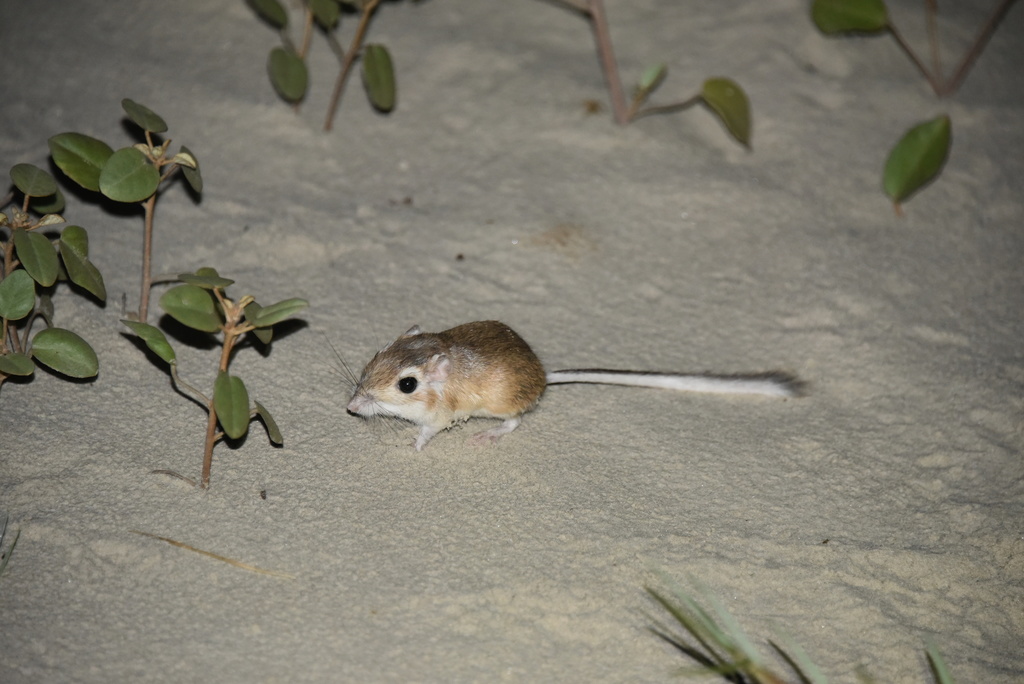
(c) Cody Stricker, some rights reserved (CC BY) · licence
Family: Heteromyidae · Class: Mammalia · Order: Rodentia
Conservation status: G5T3 S3
Dipodomys panamintinus panamintinus (Panamint Kangaroo Rat) is a California animal in the Heteromyidae family.
The Panamint kangaroo rat (Dipodomys panamintinus panamintinus) is a medium-sized heteromyid rodent adapted for life in arid environments. Adults typically measure 240-300 mm (9.4-11.8 inches) in total length, with the distinctive long tail comprising roughly 60% of total body length. The tail features a prominent tuft of long hairs at the tip and distinctive white lateral stripes. The dorsal pelage ranges from pale buff to ochraceous brown, while the ventral surface is white. The species possesses enlarged hind limbs adapted for saltatorial locomotion, large eyes for nocturnal vision, and specialized kidneys that concentrate urine to conserve water. This subspecies is endemic to the southwestern United States, occurring in east-central California, west-central Nevada, and southern Nevada. The range extends from the Panamint Mountains eastward through the Amargosa Desert and Death Valley region. In California, populations are documented in the Panamint, Argus, Coso, and White Mountains, with elevational ranges typically between 1,200-2,100 meters (3,900-6,900 feet). The species exhibits a fragmented distribution pattern across desert mountain ranges and intervening valleys. Panamint kangaroo rats inhabit pinyon-juniper woodland and Great Basin scrub communities. According to NatureServe, the species is characteristic of both Great Basin pinyon-juniper woodland and Madrean pinyon-juniper woodland ecosystems. Preferred microhabitats include areas with scattered shrubs, rocky outcrops, and well-drained sandy or gravelly soils that facilitate burrow construction. The species occurs primarily on bajadas, alluvial fans, and gentle mountain slopes with sparse to moderate vegetation cover. These nocturnal rodents are primarily granivorous, feeding on seeds of shrubs, forbs, and grasses. They cache seeds in specialized cheek pouches and transport them to underground storage chambers within their burrow systems. Burrows typically feature multiple entrances and extensive tunnel networks extending 1-2 meters below ground. Breeding occurs from February through May, with females producing 2-5 young per litter after a gestation period of approximately 30 days. The species exhibits behavioral adaptations for water conservation, including concentrated urine production and minimal water loss through respiration. The Panamint kangaroo rat subspecies currently holds a global rank of G5T3 (globally secure species, but subspecies vulnerable) and a state rank of S3 (vulnerable) in California. While the species as a whole (Dipodomys panamintinus) is ranked G4 by NatureServe, indicating apparent security, the nominate subspecies faces more significant conservation concerns due to its restricted range and habitat fragmentation. Primary threats include habitat degradation from off-road vehicle use, mining activities, and urban development in desert valleys. Climate change poses additional challenges through altered precipitation patterns and increased temperatures that may affect food plant productivity and water availability. The subspecies is not currently federally listed but warrants monitoring due to its limited distribution and specialized habitat requirements.
Classification
Class: Mammalia · Order: Rodentia · Family: Heteromyidae
Conservation status
G5T3 S3
Frequently asked questions
How is Dipodomys panamintinus panamintinus classified?
Dipodomys panamintinus panamintinus belongs to class Mammalia, order Rodentia, family Heteromyidae.
What family does Dipodomys panamintinus panamintinus belong to?
Dipodomys panamintinus panamintinus is in the Heteromyidae family.
Is Dipodomys panamintinus panamintinus protected or of conservation concern?
Dipodomys panamintinus panamintinus carries the following status: G5T3 S3.
What is Dipodomys panamintinus panamintinus?
The Panamint kangaroo rat (Dipodomys panamintinus panamintinus) is a medium-sized heteromyid rodent adapted for life in arid environments.
Is Dipodomys panamintinus panamintinus found in California?
Yes. Dipodomys panamintinus panamintinus is recorded in California in The California Species Project's catalogue.
Related species
Other California species in the same genus, family, or bioregion.
Data from The California Species Project — 14,000+ California species with verified data from CNPS, CDFW, USFWS, and more.