Dipodomys stephensi
Stephens’ kangaroo rat
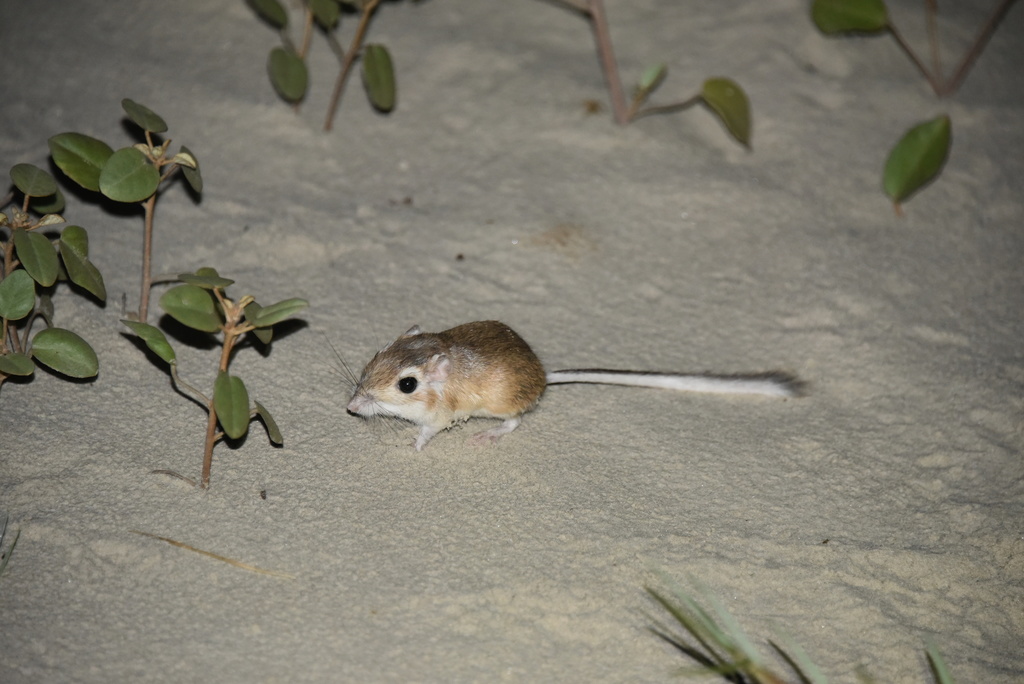
(c) Cody Stricker, some rights reserved (CC BY) · licence
Family: Heteromyidae · Class: Mammalia · Order: Rodentia
Conservation status: ST · Threatened · G2 S3
Dipodomys stephensi (Stephens’ kangaroo rat) is a California animal in the Heteromyidae family.
Stephens' kangaroo rat (Dipodomys stephensi) is a medium-sized heteromyid rodent endemic to southern California. Adults measure 250 to 300 mm (9.8 to 11.8 inches) in total length, with the tail comprising approximately 60% of total body length. Body weight ranges from 60 to 90 grams (2.1 to 3.2 ounces). The species exhibits the characteristic kangaroo rat body plan with enlarged hind limbs, small forelimbs, and a long, tufted tail. The dorsal pelage is pale cinnamon to buff-colored with darker guard hairs, while the ventral surface is white. A distinctive white lateral stripe extends from the nose to the base of the tail, bordered above and below by darker fur. The large, dark eyes and small, rounded ears reflect its nocturnal lifestyle. Historically, Stephens' kangaroo rat occupied shrubland and grassland habitats across southwestern Riverside County and northwestern San Diego County. The species' range has contracted dramatically from its original extent of approximately 2,330 square kilometers to fewer than 890 square kilometers of remaining habitat. Current populations persist in fragmented areas near Hemet, Winchester, Temecula, and Fallbrook, with the largest remaining populations in the San Jacinto Valley and areas around Lake Skinner. The species inhabits open shrubland communities dominated by chamise, California sagebrush, and bitterbrush, typically at elevations between 120 and 750 meters (390 to 2,460 feet). Stephens' kangaroo rat requires areas with sparse to moderate shrub cover and annual grassland openings, avoiding dense chaparral. Soils are typically well-drained sandy or gravelly substrates that facilitate burrow construction. Individual home ranges average 0.5 to 2.0 hectares, with males maintaining larger territories than females. Stephens' kangaroo rat is primarily granivorous, feeding on seeds of shrubs and herbaceous plants including chamise, filaree, plantain, and various grass species. The species exhibits typical heteromyid adaptations for arid environments, including specialized kidneys that minimize water loss and cheek pouches for seed transport and storage. Breeding occurs primarily from February through May, with females producing one to two litters per year. Litter size ranges from one to four young, with an average of 2.5 offspring per litter. The species constructs elaborate burrow systems with multiple entrances, storage chambers, and nesting areas. The U.S. Fish and Wildlife Service listed Stephens' kangaroo rat as endangered in 1988, later reclassifying it as threatened in 2002 following habitat conservation efforts. California listed the species as threatened in 1971. According to USFWS population estimates, fewer than 3,000 to 4,000 individuals remain across approximately 20 fragmented populations. Primary threats include habitat loss and fragmentation from urban development, agricultural conversion, and infrastructure projects. Additional threats include invasive plant species that alter habitat structure, increased fire frequency, vehicle strikes, and predation by domestic cats. The Western Riverside County Multiple Species Habitat Conservation Plan has established preserve areas totaling over 600 hectares specifically for Stephens' kangaroo rat conservation.
Classification
Class: Mammalia · Order: Rodentia · Family: Heteromyidae
Conservation status
ST · Threatened · G2 S3
Frequently asked questions
How is Dipodomys stephensi classified?
Dipodomys stephensi belongs to class Mammalia, order Rodentia, family Heteromyidae.
What family does Dipodomys stephensi belong to?
Dipodomys stephensi is in the Heteromyidae family.
Is Dipodomys stephensi protected or of conservation concern?
Dipodomys stephensi carries the following status: ST · Threatened · G2 S3.
What is Dipodomys stephensi?
Stephens' kangaroo rat (Dipodomys stephensi) is a medium-sized heteromyid rodent endemic to southern California.
Is Dipodomys stephensi found in California?
Yes. Dipodomys stephensi is recorded in California in The California Species Project's catalogue.
Related species
Other California species in the same genus, family, or bioregion.
Data from The California Species Project — 14,000+ California species with verified data from CNPS, CDFW, USFWS, and more.