Dipodomys venustus
Narrow-faced Kangaroo Rat
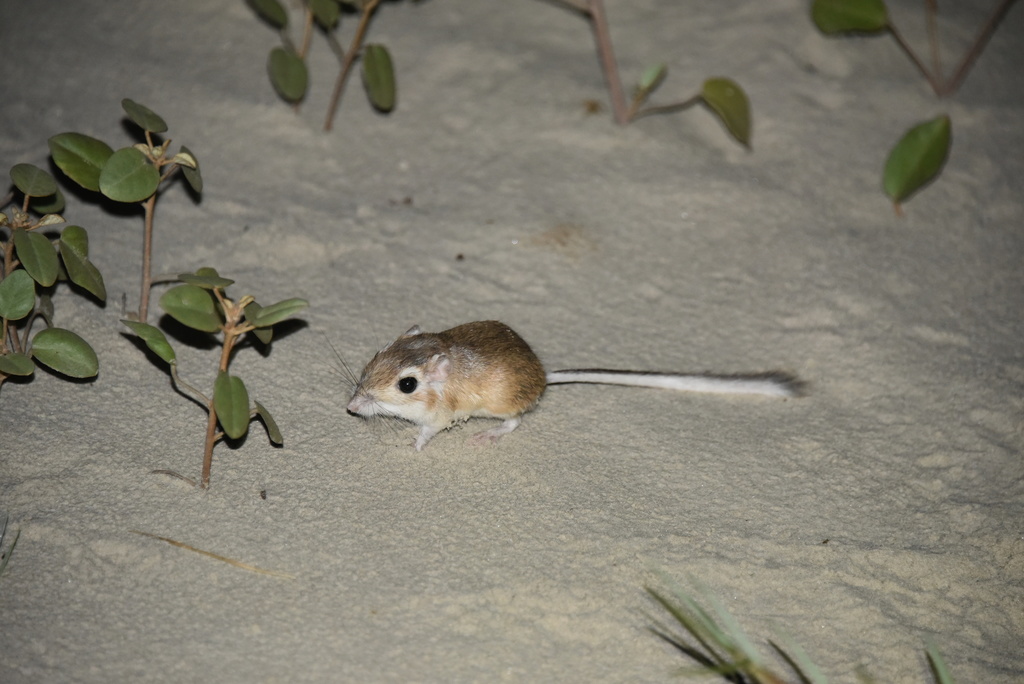
(c) Cody Stricker, some rights reserved (CC BY) · licence
Family: Heteromyidae · Class: Mammalia · Order: Rodentia
Dipodomys venustus (Narrow-faced Kangaroo Rat) is a California animal in the Heteromyidae family.
The narrow-faced kangaroo rat (Dipodomys venustus), also known as the Santa Cruz kangaroo rat, is a medium-sized heteromyid rodent endemic to central coastal California. Adults measure 240 to 305 mm (9.4 to 12.0 inches) in total length, with the tail accounting for approximately 60% of this measurement. Body weight ranges from 35 to 65 grams (1.2 to 2.3 ounces). The species exhibits the characteristic kangaroo rat morphology with enlarged hind limbs, small forelimbs, and a long, tufted tail used for balance during bipedal locomotion. The dorsal pelage is pale brownish-gray to buff-colored, while the ventral surface is white. A distinct white hip stripe extends along each side, and the facial pattern includes white markings above and below the eye, giving the species its narrow-faced appearance. Historically, the narrow-faced kangaroo rat occurred throughout the coastal scrub and chaparral habitats of the central California coast, from San Francisco Bay south to northern San Luis Obispo County. The current range is severely fragmented, with populations restricted to scattered locations in San Francisco, San Mateo, Santa Cruz, and Monterey counties. Major population centers include areas around Año Nuevo State Park, the Santa Cruz Sandhills, and portions of the Monterey Peninsula. Many historical localities have been extirpated due to habitat conversion. The species inhabits coastal scrub, maritime chaparral, and oak woodland communities, typically on sandy or gravelly soils that facilitate burrow construction. Elevation ranges from sea level to approximately 600 meters (1,970 feet). Preferred vegetation includes chamise, manzanita, coyote brush, and California sagebrush. The species requires areas with sufficient shrub cover for protection from predators and open patches for foraging. Burrow systems are complex, extending 0.5 to 2.0 meters below ground with multiple entrances and cache chambers. Narrow-faced kangaroo rats are primarily granivorous, feeding on seeds of shrubs, forbs, and grasses. They exhibit specialized adaptations for seed harvesting and storage, including cheek pouches for transport and hoarding behavior in underground caches. The species is nocturnal and largely solitary outside the breeding season. Breeding occurs from February through July, with females producing one to three litters annually. Litter size ranges from two to five young, with an average of three. Gestation lasts approximately 30 days, and young reach sexual maturity at 60 to 75 days of age. The narrow-faced kangaroo rat is not federally listed but faces significant conservation challenges due to extensive habitat loss and fragmentation. According to NatureServe, the species is considered vulnerable (G3) globally and imperiled (S2) in California as of December 2025. Primary threats include urban and suburban development, agricultural conversion, recreational activities, and invasive plant species that alter habitat structure. Fire suppression has led to vegetation changes that may negatively impact suitable habitat. Several populations persist on protected lands, including state parks and university reserves, but long-term viability requires habitat connectivity and management of surrounding landscapes.
Classification
Class: Mammalia · Order: Rodentia · Family: Heteromyidae
Frequently asked questions
How is Dipodomys venustus classified?
Dipodomys venustus belongs to class Mammalia, order Rodentia, family Heteromyidae.
What family does Dipodomys venustus belong to?
Dipodomys venustus is in the Heteromyidae family.
What is Dipodomys venustus?
The narrow-faced kangaroo rat (Dipodomys venustus), also known as the Santa Cruz kangaroo rat, is a medium-sized heteromyid rodent endemic to central coastal California.
Is Dipodomys venustus found in California?
Yes. Dipodomys venustus is recorded in California in The California Species Project's catalogue.
Related species
Other California species in the same genus, family, or bioregion.
Data from The California Species Project — 14,000+ California species with verified data from CNPS, CDFW, USFWS, and more.