Dipodomys venustus sanctiluciae
Santa Lucia Mountain Kangaroo Rat
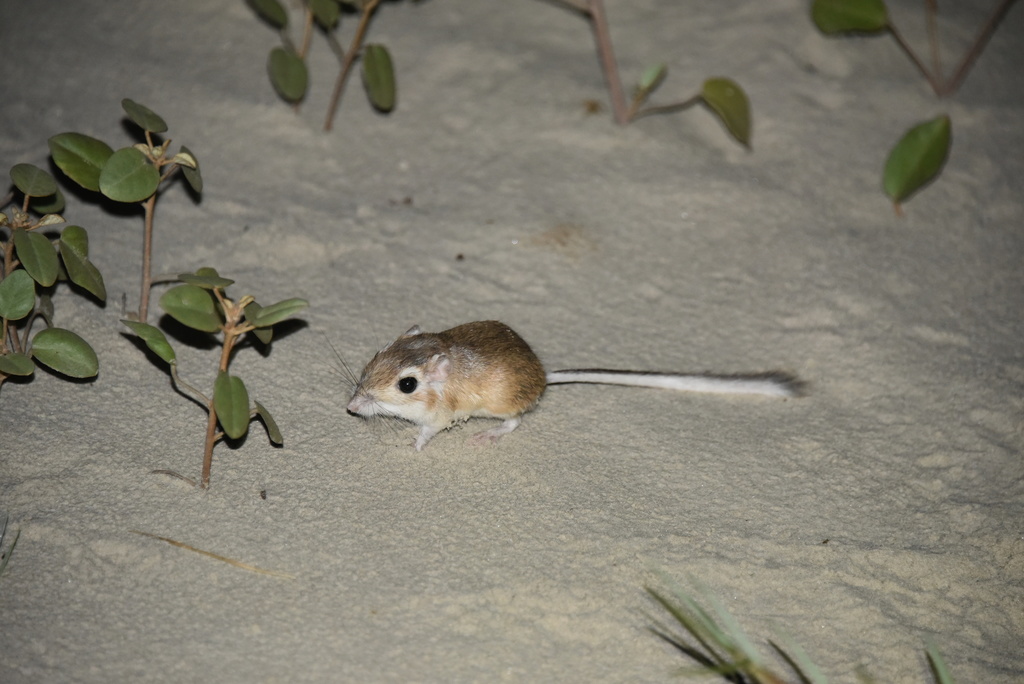
(c) Cody Stricker, some rights reserved (CC BY) · licence
Family: Heteromyidae · Class: Mammalia · Order: Rodentia
Conservation status: G4T3 S3
Dipodomys venustus sanctiluciae (Santa Lucia Mountain Kangaroo Rat) is a California animal in the Heteromyidae family.
The Santa Lucia Mountain kangaroo rat (Dipodomys venustus sanctiluciae) is a subspecies of the narrow-faced kangaroo rat, distinguished by its slender build and relatively small size compared to other kangaroo rats. Adults typically measure 240-290 mm (9.4-11.4 inches) in total length, with the tail comprising approximately 60% of the total body length. The pelage is grayish-brown dorsally with white underparts, and the characteristic long hind legs and large eyes are adaptations for nocturnal saltatory locomotion. This subspecies is endemic to the Santa Lucia Mountains of west-central California, representing the southern portion of the narrow-faced kangaroo rat's range. According to NatureServe, the historical range of D. venustus extends from San Mateo County southward to San Luis Obispo County, with D. v. sanctiluciae occupying the southern coastal mountains. The subspecies occurs primarily in Monterey and San Luis Obispo counties within the coastal mountain ranges. Santa Lucia Mountain kangaroo rats inhabit chaparral and oak woodland communities, typically on slopes with well-drained soils. They show preference for areas with scattered shrub cover and open patches that facilitate their hopping locomotion. Unlike most kangaroo rat species, D. venustus is water-dependent and requires access to free water sources (Animal Diversity Web). These animals become emaciated and will die without water access, making them particularly vulnerable to drought conditions. The species is primarily granivorous, feeding on seeds of shrubs and forbs, though they may supplement their diet with green vegetation when available. They are nocturnal and highly fossorial, constructing elaborate burrow systems with multiple entrances and specialized chambers for food storage and nesting. Breeding typically occurs from February through June, with females producing 2-4 young per litter. The species exhibits strong site fidelity, with individuals often occupying the same territory for extended periods. The Santa Lucia Mountain kangaroo rat has a NatureServe conservation rank of G4T3 S3, indicating it is apparently secure globally but vulnerable both as a subspecies and within California. Primary threats include habitat loss and fragmentation due to residential development, agricultural conversion, and infrastructure projects in coastal California. Fire suppression has altered natural fire regimes, leading to increased shrub density that may reduce suitable habitat. Climate change poses additional concerns through increased drought frequency and intensity, particularly problematic given the subspecies' water dependence. Urban expansion in the Monterey Bay region continues to fragment remaining habitat patches. Conservation efforts focus on habitat protection through land acquisition and management agreements with private landowners. The subspecies benefits from protection within some public lands, though much of its range occurs on private property. Continued monitoring of population trends and habitat quality is essential for long-term conservation, particularly as coastal California faces increasing development pressure and climate-related environmental changes.
Classification
Class: Mammalia · Order: Rodentia · Family: Heteromyidae
Conservation status
G4T3 S3
Frequently asked questions
How is Dipodomys venustus sanctiluciae classified?
Dipodomys venustus sanctiluciae belongs to class Mammalia, order Rodentia, family Heteromyidae.
What family does Dipodomys venustus sanctiluciae belong to?
Dipodomys venustus sanctiluciae is in the Heteromyidae family.
Is Dipodomys venustus sanctiluciae protected or of conservation concern?
Dipodomys venustus sanctiluciae carries the following status: G4T3 S3.
What is Dipodomys venustus sanctiluciae?
The Santa Lucia Mountain kangaroo rat (Dipodomys venustus sanctiluciae) is a subspecies of the narrow-faced kangaroo rat, distinguished by its slender build and relatively small size compared to other kangaroo rats.
Is Dipodomys venustus sanctiluciae found in California?
Yes. Dipodomys venustus sanctiluciae is recorded in California in The California Species Project's catalogue.
Related species
Other California species in the same genus, family, or bioregion.
Data from The California Species Project — 14,000+ California species with verified data from CNPS, CDFW, USFWS, and more.